Big Bad Wolf IV – Who Killed Mohogany Davis?

Mahogany DavisWho would still be alive today if the right men had been arrested and convicted for the killing of John Hartman?

Often discussed in the realm of the innocence movement are the consequences of wrongful conviction on those who are wrongfully convicted. The pain and suffering, the damage to the justice system, the social ramifications for a false sense of justice, the difficulty of rebuilding a life after years of imprisonment – these are topics that the innocence movement gives great consideration. Less discussed is the effect it has to leave the guilty on the streets. As this case has progressed we have become more and more aware of that impact, and as the Fairbanks Four approach a trial date we want to recount as many of the damages as we can. The Fairbanks Four have lost pieces of their lives, years. But they have not lost all. Some have.

Three of the five suspects now believed to have killed John Hartman are currently serving long sentences for other murders. The other two have long criminal records for drugs and violence but remain on the streets. John Hartman was the first person they killed, but within five years the body count of their known victims had risen to five. Five murders which could not have happened if these men were arrested and convicted on the timeline that the Fairbanks Four were instead arrested and convicted of the crime. Teaka Bacote, Hakeem Bryant, Christopher Martin, Victor Torres, and Julie Ann Wilde would be alive today if the right people were arrested in October of 1997.

In addition to the known victims, there is the concerning list of the missing which surround these perpetrators. One crime to which they had distressing and memorable proximity is the killing of Mahogany Davis.

Mogohany Davis was a 21-year old mother of three, including a three-week old, when she ran bleeding and barely dressed into the parking lot of the Little Dipper apartments. She collapsed onto the pavement and a neighbor called 911. The call came in at 4:13am on May 11, 2002. Mahogany lived nearly two hours past the 911 call, and Fairbanks Police officer Jim Geier, who was instrumental in the Fairbanks Four arrest and convictions, was able to speak to Mahogany before she passed. An excerpt from a May 13, 2002 Juneau Empire article confirms that Mahogany did speak.

Sgt. Jim Geier said officers were able to talk to Davis before she died at Fairbanks Memorial Hospital about 90 minutes later.

“We did have the opportunity to obtain information from the victim,” Geier said. “We also obtained some information from witnesses and are pursuing leads.”

If Mahogany, barely clinging to life, was able to speak, what did she say? What would you say? Those unknown words have long unsettled her family, who believe she would have used her last moments on this earth to reveal the identity and motivation of her killer in an effort to protect her children as a final act. They are haunted by a troubling and lingering question – if one of the lead detectives on the Hartman crime heard deathbed revelations that named alternative suspects in the Hartman killing, would that story have died with Mahogany? If there were reputations at stake, would this young mother’s case be allowed to fall cold? It is a weighty accusation, and one that cannot truly be known. But what she said and why it did not lead to her homicide being solved weighs heavily on her surviving family. It is only know that she spoke, but because her murder investigation remains open, the contents of the file are confidential, and her family knows little more today than they did in the days after her death.

According to Davis’ mother, Rhonda Davis, the crime scene was horrific. The apartment opened to a short hallways that was splattered and smeared with blood.

Jason Wallace, 2004

Jason Wallace, 2004

The family believes Mahogany Davis was killed by someone she knew since there was no sign of forced entry. Mahogany was attacked in front of her three sons, aged 4 years, 20 months, and 3 weeks at the time of her murder. Mahogany’s youngest son was fathered by William Z. Holmes and she was a close associate of Jason Wallace. According to Mahogany’s mother, the oldest of the children described the assailant as a yellow-skinned black man. They also said her wounds were stabs, but did not appear to be from a knife. Wallace was arrested later in 2002 for attacking and killing a woman in her home with a hammer, and attacking and stabbing another man in his home with a screwdriver. They see parallels between these non-knife stabbing murders and the death of Mahogany. Rhonda Davis points out that Jason Wallace, longtime Holmes associate and convicted killer, has a “yellow complexion.”

Mahogany had a long relationship with William Holmes, was his ex girlfriend, and mother to his son. Her family believes Mahogany was killed by William Holmes or his associate Jason Wallace because she had information about them – either about upcoming large drug deals or their involvement with John Hartman’s murder, or any other incriminating information.

Today, Mahogany’s case is cold. No suspects were ever arrested, and if William Holmes or Jason Wallace were ever investigated, the Davis family was never informed. Local station KTVF 11 reporter Stephanie Woodard ran series on the Mahogany Davis killing called “A Look Into the Cold Case Murder of Mahogany Davis,” which we have linked to below.

Mahogany’s family yearns for justice and as much closure as that can bring. Please hold them and the families of other victims in prayer, because the wrongfully convicted may come home someday, but the victims of the wrongfully free will never return. They have paid a terrible price at the hands of wrongful conviction. In this regard the Fairbanks Four and their families are blessed, although their suffering has been significant and long, they woke up today with their lives, and although family may have to visit them through windows and in chains, they are still with us.

If any reader has tips about the murder of Mahogany Davis please do call Crime Stoppers at 907-450-6500.

Big Bad Wolf III – The Police Killing of Henry Kettendorf

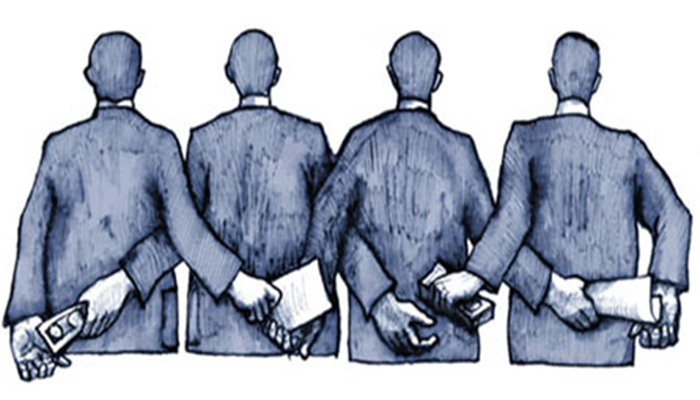
badcop In 1994 the words “viral post” would have meant nothing. There was no status update, no like or share buttons, and to the common Interior resident, no internet. It was in this era that the Golden Heart City saw the height of city and police corruption and lived with violence against Native people by the police force as a social norm.

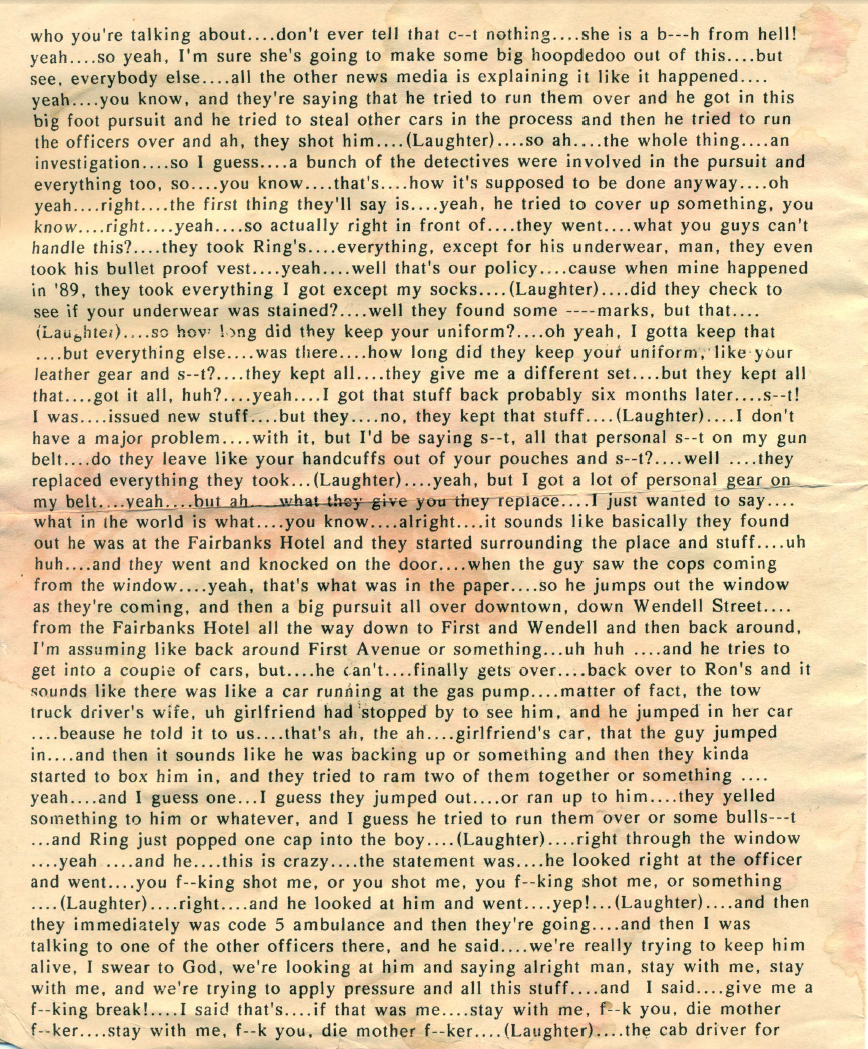
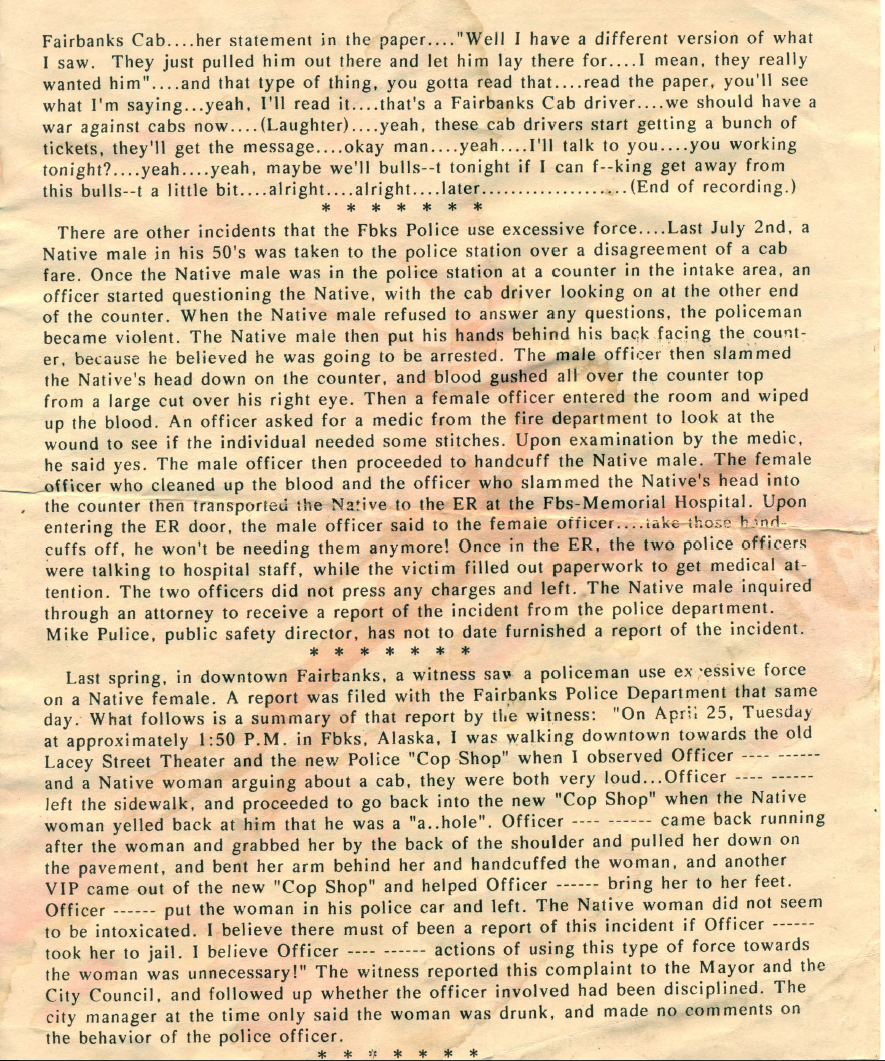
Activism and advocacy journalism in this time was not for the faint of heart. Gene George, then a resident of North Pole, Alaska, ran a small publication Athabascan Reports. He was known for reporting on controversial topics. Today we are posting Volume 5, Issue #1 of Athabascan Report titled “Fairbanks Cops Out of Control.” This issue contains a transcript of a conversation between two city police officers following the killing of Henry Kettendorf.

Kettendorf, a 32 year old Native male, was wanted on burglary charges out of Anchorage. He was unarmed and killed by a single shot through his heart fired by Officer Aaron Ring. Civilian witness accounts differed from the police report. Troopers investigated the shooting and concluded it was justified, although they also “declined to release their findings” according to a February 13, 1995 article in the Sitka Sentenial.

A coroner’s inquest was eventually held, and Officer Aaron Ring was represented by none other than former Fairbanks District Attorney Bill Murphy, who went on to represent Eugene Vent through a trial which ended in his wrongful conviction. If this constitutes a conflict of interest it was never disclosed. The death of Henry Kettendorf all but disappeared into obscurity after the coroner’s inquest found in favor of Officer Aaron Ring and FPD and has remained a topic of conversation largely through the efforts of a determined and controversial local activist.

Athabascan Reports published articles on this Kettendorf killing, but none were so controversial as the report below. In this issue, Gene George published the full transcript of a conversation between two FPD officers in which they berate the female reporter from the Daily Newsminer for publishing an unflattering article, calling her a cunt and bitch among other gender-specific slurs. They go on to make light of the shooting of Kettendorf, joking that they would not have tried to save him, but said “die, motherfucker” to him as he bled out. The two officers also discuss retaliation on the witness.

By this account, the last sight Henry Kettendorf saw while he was alive was Aaron Ring’s face, after Kettendorf cried out, “you shot me!” Officer Ring apparently answered, “Yep.” The men in the transcript think this is hilarious.

It is not fair nor logical for us to weigh in on whether the shooting of Kettendorf was justified. It appears that it was not – he was an unarmed man in a well-lit parking lot. But without complete information, which has proved difficult to find, we will withhold a conclusion. But the death of Henry Kettendorf certainly took place inside an unacceptable police culture. The fact that officers would speak about a person this way, talk of retaliation through inappropriate use of police power against witnesses, and that the climate in general was so destructive dispatchers felt the need to secretly record and expose officers, and that when they did, the tapes provided to the City Council and Mayor simply went missing, exposes a lot about the power structure in Fairbanks in the 1990’s. The events which led to the wrongful conviction of the Fairbanks Four took place on this same stage with all the same players. Rumor has it that shortly after this leak the dispatchers were fired and replace by the wives of Aaron Ring and Jim Geier.

Inside this climate people like Gene George reported these events when that was so much harder than it is today. We owe a debt to people like him.

Below, his work speaks for itself.

Athabascanreport1

Athabascanreport2

athabascanreport3

athabascanreport4

Big Bad Wolf II – Drug, Sex, Money, Guns, and a “Set Up” – Fairbanks Police Chief “Mafia” Mike Pulice

elephantsfight

There is a popular Swahili proverb “Wapiganapo tembo nyasi huumia.” 

Translated, it means, “When Elephants fight, it is the grass which suffers.”

It is a poignant reference to the structure of most societies. When kings fight, soldiers die. When the rich argue, the poor starve. Nearly all specific injustices take place inside a larger universal injustice. Every family who said heart-wrenching goodbyes today on the frontlines of wars did so inside the larger injustice of genocide, inside the even larger universal injustice of religious discrimination and hate as rhetoric for political gain. Which is to say, nothing happens in a vacuum, a specific injustice is always a symptom of a universal one, and this case is no different. Through discussion about the players and circumstances in the Fairbanks Four case we hope to shed some light on the bigger injustices.

By October of 1997 the Fairbanks Police Department Chief and his right-hand men were struggling to maintain control under the weight of a series of scandals that had rocked public faith in the system and had severe financial consequences. John Hartman’s murder was arguably the most notorious crimes ever committed in Fairbanks, and the public demand for swift justice was overwhelming. The men in power in the “golden heart city” simply could not afford another scandal.  It was in this climate that four young men were accused, arrested, and convicted of the murder of John Hartman.

All four men have maintained though nearly eighteen years of incarceration that they are innocent, and evidence mounts indicating that they are indeed innocent. The investigation and trials which led to their convictions are haunted by accusations of corruption and conspiracy, and as evidence exonerating the men continues to accumulate, so do accusations that their convictions are more than an unfortunate mistake. When considering the possibility of deliberate or negligent wrongful conviction, most citizens ponder motivation. It seems offensive to the concept of justice and even against personal interests of the players to wrongfully arrest or convict someone. But the state of the city of Fairbanks circa 1997 reveals a climate ripe for such a turn of events.

A critical and almost never mentioned player in the Fairbanks Four case is Mike Pulice. Pulice served as both the Fairbanks City manager and Police Chief for a number of years. Tracking down the exact positions and duties held by Pulice in October 1997 have proved difficult, but it appears he was still on payroll and may have been on leave. It is unlikely that he played an active role in the investigation, but he was highly involved in creating the climate in which it happened. If the series of events which took place following the Hartman murder were a play, Pulice would be the set designer. It was his stage on which these events played out.

The Pulice scandal is almost a parody of itself in its extravagant inclusion of the most cliché scandal elements – allegations involving sex, drugs, public corruption, money, conspiracy, and organized crime.

Mike Pulice – colloquially referred to as “Mafia Mike” by critics – was the man at the center of a controversy centered on money, drugs, and weapons that went missing from the Fairbanks Police evidence locker during his tenure.

CorruptionAccording to court records, two firefighters employed under Pulice, Jimmy Rice and Lee DeSpain, came forward as whistleblowers in the evidence locker thefts and pointed fingers at Mike Pulice. They believed that Mr. Pulice was engaged in an extramarital affair with his employee, that he was running a criminal enterprise openly and preventing information leaks by threatening those in the know, and that he was responsible for the thefts. Mr. Pulice responded to this turn of events by threatening to have the men “set up” if they proceeded with their complaints. One such conversation occurred when Pulice called an attorney for one of the men. The two firefighters resigned from their positions, citing “intolerable” working conditions and fear of retaliation. A police officer who had spent some twenty years with Fairbanks Police testified that he cautioned the men to take the threats by Pulice seriously. What ensued was a long and drawn out litigation which the city ultimately lost, and an investigation into the corruption that went nowhere.

An AP article in the December 5, 1996 Sitka Sentinel made mention of the events and a dollar figure – “With the disappearance of $510,000 from a police evidence locker still a mystery; the Fairbanks City Council has agreed to conduct its own probe into the matter.”

Over half a million dollars in cash was missing, along with an untold amount of cocaine and guns. Hearsay accusations of a local gun dealer pulling up to the old “Main School” building, where evidence was housed, and departing with weapons abounded. In an executive session meeting of the city council, transcribed and published HERE, the city’s approach was clear – the sitting Mayor Jim Hayes (himself later arrested and imprisoned for fraud after stealing money from his own church) and other local leaders pontificated about how, despite not having read the 45-page investigation into the thefts, they felt certain that Mr. Pulice wouldn’t steal money. Mayor Hayes suggested Mr. Pulice step down from Chief of Police into a higher paid position as a high ranking officer, but Mr. Pulice declined, expressing that he was willing to take a “harsh” letter of remand and two weeks off.


By 1997, Rice and DeSpain had already filed a lawsuit and as the case progressed through the system it revealed more and more disturbing details about the inner-workings of the FPD and City of Fairbanks at the time. The accusations of financial mismanagement and corruption at both the FPD and City shook public faith tremendously, and also took a lite out of their respective budgets. When John Hartman was murdered, the community demanded swift justice, and demanded it inside a climate where distrust and anger toward the local powers were at an incredible high. The bottom line is that this was NOT a typical crime in a typical climate. This was a horrific crime at a time that the citizens of Fairbanks were already outraged. Careers and more were at stake, and decisions about what came next were made by people under the employ and influence of a man who is on record using wrongful conviction as a threat against a colleague. One can only imagine how little the lives of strangers, let alone children of a lower class, would have meant in this high stakes game.

We do not know if Pulice had any direct involvement in the Fairbanks Four case, and in fact there is no indication he did. However, the officers who ran the investigation were the same men that worked closely with Pulice for many years. Some were trained and promoted by him into the positions they held. They came up in a professional climate where the kind of behavior revealed in the DeSpain and Rice suit was normative, This case came into the scene of a terribly corrupt and messy police department right at the moment they most needed a victory. And it was, indeed, applauded as an incredible victory. Within a handful of months the Hartman case was cited directly when the FPD requested more funding.

Rice and DeSpain went on to be awarded $1.6 million in 2000 by the Alaska Supreme Court in their suit against the city and Mike Pulice, although both men allege that the damage to their lives was irreparable. Neither are employed as firefighters. Pulice slipped quietly into retirement, and no one was ever held accountable for the evidence locker thefts.

In 1997 the city of Fairbanks was being run by a man who ultimately served significant prison time for corruption and fraud, a police chief who cost the city 1.6 million after openly threatening whistleblowers who accused him of activities that if true and pursued criminally would spell out many felonies and a long prison sentence. The FPD was being lead by a man who threatened wrongful conviction as retaliation for exposing him. There should be no debate as to whether there existed sufficient motivation and moral capability to wrongfully convict the Fairbanks Four for the murder of John Hartman, it is clear that there was both.

When elephants fight, it is the grass that suffers. Yet, the grass remains.

Introducing The Big Bad Wolf I – Officer Clifford “Aaron” Ring

justicequoteThe decision to fight for the Fairbanks Four has not come without hardship. Many of us who chose to take a stand have, and will continue to, come under attack. One of the hardest things to do is speak out against people who we know are powerful, at least in the worldly sense. However, it is also one of the most important things we have done and will do. This is one of those difficult posts.

We are not fighting against an accident. We are not rallying against an injustice of coincidence. The Fairbanks Four were not the unfortunate four harmed by chance. They were the victims of deliberate actions taken by human beings. We do not believe that means they were forsaken by their maker or tossed aside. Instead, they came under the hardship they were born to bear, and we were given the responsibility of freeing them and exposing the anatomy of injustice in our hometown so that a greater good could come of it.

We have discussed some of the noteworthy corruption in a previous post HERE  and we do not plan to stop talking about corruption in this case until it is fully revealed, until those who committed the crime of deliberate injustice are exposed, and until amends are made to all who were hurt.

We will never be able to make a completely comprehensive post about the players in this case whose mistakes or deliberate actions led to this injustice. It is not possible to know the heart and mind, and therefore the intentions, of another human being. But we can tell you what we know and what we have been told about the men and women whose actions and choices paved the road to this injustice. It is not our wish to enact revenge on them. It is only our wish that the whole truth be known someday so that there may come a time when there is indeed justice for all.

We will post a series of pieces on individuals who played a critical role in the arrest, investigation, wrongful conviction, and illegal incarceration of the Fairbanks Four.

Clifford “Aaron” Ring

aaron ringIt seems fitting to make Aaron Ring first in the “Big Bad Wolf” recounting of the key players in the wrongful conviction of the Fairbanks Four. If this was a movie, he would be the bad guy. He was extremely active in the case, from the initial arrests to the court trials, and touched almost every aspect of the case.

George Frese, Marvin Roberts, Eugene Vent, and Kevin Pease have spent most of the last 18 years in 5X8 concrete prison cells, often for 23 of 24 hours in a day. For the duration of their time in prison, and indeed since their arrests, all four have procalimed their innocence in a case that has long been one of the most contested and controversial in Alaska’s history.

AaronRingsHouseBy contrast, Aaron Ring lives here. The only thing these accommodations have in common is, of course, that both are funded by the State of Alaska. The retired FPD officer lives in Florida now on a comfortable pension where apparently he can wake up every morning, put his shoes on one at a time, eat breakfast, and apparently go about life with no outward betrayal of regret, if it is there at all.

The goal of this case-specific wrongful conviction blog has been to tell a wrongful conviction story in great detail to create a broader awareness of the issue at large and this case. We have long implored the public to come forward with any information related to this case and enter a public dialogue. What we receive in response to that request perhaps more often than anything else is information on or complaints about Officer Aaron Ring. We have had multiple source accusations of race-based hate crimes by Aaron Ring as a juvenile and young adult at Lathrop High School, two accusations of sexual assault on an underage victim, one while a uniformed officer and one not. We have had many unsolicited reports by people who had contact with officer Aaron Ring as juveniles that they consider abusive. These range from actual assaults (being thrown on the ground, hit, tripped, knocked off a bicycle, slammed on a car door, etc.) to pseudo-assaults (being cuffed in the back of a police car while the breaks are repeatedly slammed), to psychologically abusive contact. Keep in mind, these accusers all have one thing in common –  they were CHILDREN when these events occurred.

This is not the first time that dozens upon dozens of alleged adult victims of child abuse have come forward to finger an individual who held a trusted position in the community. The Catholic Church had a whole scandal. Teachers, boy scout troop leaders, favorite coaches, priests, pastors…….this is recognizable territory. A scandal tends to deepen as more and more alleged victims surface with their claims. In general, mounting accusations are often perceived as confirmation that there is after all “something to it.” We have all seen that before, and on our side of the internet we are seeing it again here.

We are neither qualified nor prepared to evaluate or determine the veracity of these statements. But we want to acknowledge that they have been made.

What we can document and verify is the conduct and speech on record by Officer Aaron Ring as he investigated the Fairbanks Four case, and we have. These pages ultimately together just tell a story, and Aaron Ring is a character that appears over and over. Here are some of the more stand-out moments of his conduct.

  • Aaron Ring lied to the people being interviewed and threatened them. He made up evidence, told people that their friends or families had placed them there or told the officers they were lying, threatened people with jail or other harm if they failed to agree.
  • Aaron Ring, according to multiple witnesses, turned the tape recorders off and on during police interviews. Ring used the times the recorder was off, according to these witnesses, to threaten them more directly, provide more extreme false information, or reassure them that if they just said what he wanted them to say it would not be a big deal. Alaska law requires interrogations be taped in their entirety.
  • When George Frese said, “I want to go home,” Aaron Ring claimed he had said it alone in an empty room. Ring would have been obligated to stop the interrogation if George (which he indeed did) asked to go home.
  • When Eugene Vent, drunk and only seventeen, said “I want my mama,” Ring downplayed the statement and continued with the interview.
  • Played the major part in some of the most harrowing interviews in the case, including Shara David, Edgar Henry, Antonio Sisto, Eugene Vent, George Frese, Kevin Pease, Marvin Roberts, and conducted the first interview with Chris Stone, which is “missing,” and with EJ Stephens, likewise “missing.”
  • Aaron Ring made a damning and misleading exhibit with the help of prosecutor Jeff O’Bryant. This exhibit was called “totally unscientific” by the only expert who saw it in trial, but he was not called to testify. The exhibit was not to scale, and consisted of an overlay of George Frese’s boot print overtop of a photo of the victim. The size had been adjusted to create an appearance of a match. The lab logo was left on the boot print, creating the misleading impression that the exhibit had been created by scientists.

We must preface the following with a statement that we have no comment as to the veracity of the accusations made below. We have no idea if the accusations below are valid, but can only report that the following accusations have been made against Aaron Ring in statements to us by others.

  • A woman contacted us to tell us that she had known Aaron Ring as a young man, from adolescence to his late teens. She was substantially younger than him and claims he sexually assaulted her on multiple occasions.
  • Several individuals claiming to have known Ring in high school have contacted us to claim that Ring was widely known as a racist, and was extremely and overtly racist against Native students.
  • A woman contacted us to tell us her now-deceased daughter claimed to have been sexually assaulted by Aaron Ring as a teenager and while Aaron Ring was on duty as a police officer. According to this woman, Ring made contact with her teen daughter and picked her up for underage consumption of alcohol, but agreed to let her go in exchange for sex acts, and threatened her with severe legal consequences if she did not comply. Her story was apparently taken and preserved by a local journalist.
  • A man contacted us to tell us that as a young person he was arrested by Aaron Ring and was physically assaulted during the arrest. The man claims that while he was in the back of the squad car Mr. Ring repeatedly and deliberately slammed on the breaks to cause injury to the him.
  • More than a dozen individuals have contacted us to report that Aaron Ring used unnecessary force.
  • A Fairbanks resident alerted us to the existence of the Henry Kettendorf case – a young man named Henry Kettendorf was shot and killed by Aaron Ring in downtown Fairbanks. The case created some controversy at the time. An eyewitness to the shooting described it very differently than the officers at the scene. A transcript was later published by reporter Gene George of “The Athabascan Report,” in which officers can be heard mocking Kettendorf, his death, and threatening to conspire against the witness to the shooting. After years of searching for this particular edition of the publication and finding it was removed from nearly every library in the state, we finally procured a copy.

There was a time when we believed, or at least wanted to, that this was all one big mistake. But the more information that surfaces about the case, the more it seems that the wrongful conviction of the Fairbanks Four was not a mistake so much as an event on a timeline of terrible deeds committed against the young and vulnerable of Alaska for minimal personal gain. We can choose to believe, and for now we will, that the actions that harmed so many were not so much intentional as they were the byproduct of a kind of thinking so ingrained that it produced great harm. If someone as a young person believes an entire race to be animalistic or below them it is not hard to imagine that deep seeded thought growing into a tree of injustice as the person’s schemas hardened and their power grew. Whether a source is corrupted or bad is impossible to say, but there is wisdom in the verse that says “Ye shall know them by their fruit.”

To change the landscape of our community or country as it relates to biased thinking inside the justice system it is not enough to attack the tree or judge the fruits, we have to ensure that the seeds of racism and bias are not sown into the minds of the next generation and find a way to articulate their visibility in our current social structures. There comes a point where an individuals intentions in a series of actions do not matter nearly as much as the fact that they were capable. In other words –  maybe didn’t know better. And if that is the case perhaps the people most responsible for the damage he did are those who surrounded him, knew better, and stayed silent.

Many children were harmed in the making of this wrongful conviction. The players in this game who moved them like pawns failed to calculate the outcome now at hand – they didn’t crush ALL of those children. Some persevered. Some found self-worth against the odds. Some of those kids didn’t fall into addiction,early graves, fold into the small town inside a small town and disappear into the familiar. Some did not bow down under shame. Some of them grew up. And they remembered.

As for Aaron Ring, accountability is not ours to assign. As is often the case, there is probably not as much peace inside the beautiful Florida home as there appears to be from outside. All we can do is wish him well, hope that if he indeed struggles with the demon of pride or racism or rage that he wrestles it and prevails, and that if he is guilty of any actions that were illegal that the justice system may find him and treat him fairly. After all, our wish is the same for him as it is for you, or for the Fairbanks Four. Justice for all.

Race in the Case – The Hartman Murder was a Hate Crime

bookertwashingtonJohn Hartman was killed in the commission of a premeditated racial hate crime.

 “A hate crime is a traditional offense like murder, arson, or vandalism with an added element of bias. For the purposes of collecting statistics, Congress has defined a hate crime as a ‘criminal offense against a person or property motivated in whole or in part by an offender’s bias against a race, religion, disability, ethnic origin or sexual orientation.’” – F.B.I.

According to William Holmes who confessed in detail to his role in killing John Hartman, he and four friends went out onto the streets of Fairbanks the night they attacked Hartman to physically assault Native Alaskans.

Holmes and his fellow conspirators “decided to go downtown and have some fun.” Their idea of “fun”?

Harassing “drunk natives by throwing eggs at them, or 2 or 3 guys from the car would jump out with the driver still in the running car and punch them. We’d laugh at them falling or a cigarette flying from their mouth upon impact. The thrill came from running away, speeding off and messing with these drunks barely able to walk.”

holmesletterOn the night that they killed John Hartman, Holmes describes patrolling downtown looking for Native victims. The group found at least one victim, but their attack was thwarted when others appeared on the scene. When they were unable to find the victim they were looking for – a vulnerable Native person walking alone – they decided to end their “fun.” Sadly, as they were driving out of the downtown area they spotted “a white boy” walking alone and decided he would have to do. The group fell on the young boy with no warning, knocked him to the ground, and kicked him into a coma that would prove fatal.

John Hartman was kicked and stomped to death with violence so callous it defies explanation. He was killed because five young men carried with them a racial hate so strong and dehumanizing that group beatings of vulnerable Natives was a form of recreation. John Hartman was killed by hate directed toward a race of people he did not belong to in life. But in death, he joined a long list of the persecuted. He is not the first boy to die at the hands of race-based violence, but he may be the only white child to die in the cross-hairs of racism against Alaska’s first people.

In the days after Hartman was killed, when his face and the faces of the young men wrongfully accused of his murder appeared on the front page of the local newspaper, someone bought that paper and brought it back to Midtown Apartments, where a group of people acquainted with the four accused gathered around to read in disbelief. An elderly woman looking over our shoulders said, “I bet they were looking for a Native boy, I wish they had found one.”

For the majority of Fairbanks residents the idea that a young person could be attacked at random and assaulted simply for walking alone was unfathomable. Yet, for another sector of the community, it was routine. The other side of the story in a community where violent beatings are a form of recreation, and a person’s ethnicity is what makes them a target, and in turn makes them invisible to the rest of the community, was that there was a legion of kids who were familiar with the attacks. Scores of boys who were on guard, who slipped into the bushes when a car approached, who ran like hell when they heard the sound of tires slowing down behind them because those kids knew it was the cops or the people who jumped Natives, and that both were dangerous. Kids who curled into a ball and protected their heads if they didn’t run fast enough. If they had found the victim they meant to find, maybe no one would have died.

Eugene. Eugene was walking alone that night. They wanted Eugene, but the timing was off.

George. George walked downtown the very same evening, and George was exactly who they were looking for.

Pick a name off the witness list. Pull a name from the wedding guest book. Nearly every person whose life would intersect with the wrongful arrest, trials, conviction, and decades long fight to overturn it was guilty of the crime of being Native that night, and it was hate directed at them that motivated the men who killed John Hartman. It was that same hate, woven into the fabric of the community and its institutions, which allowed for the immediate arrest and wrongful conviction of people who were guilty of nothing besides being Native.

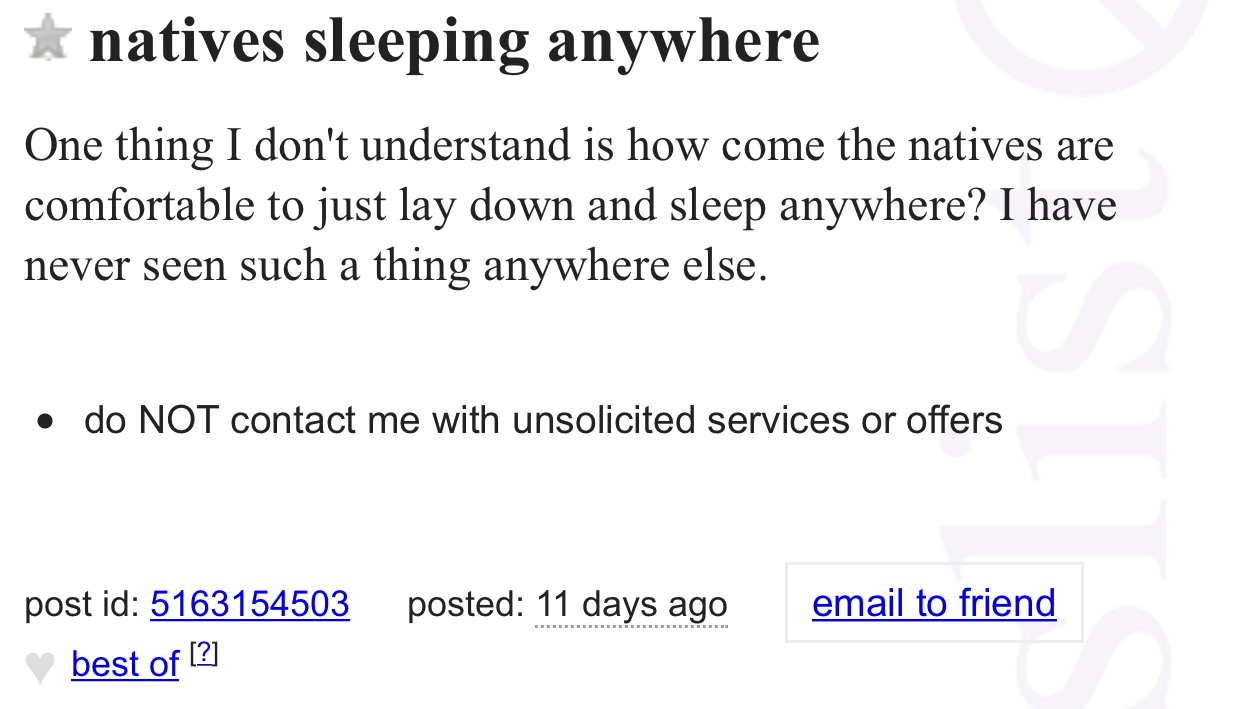
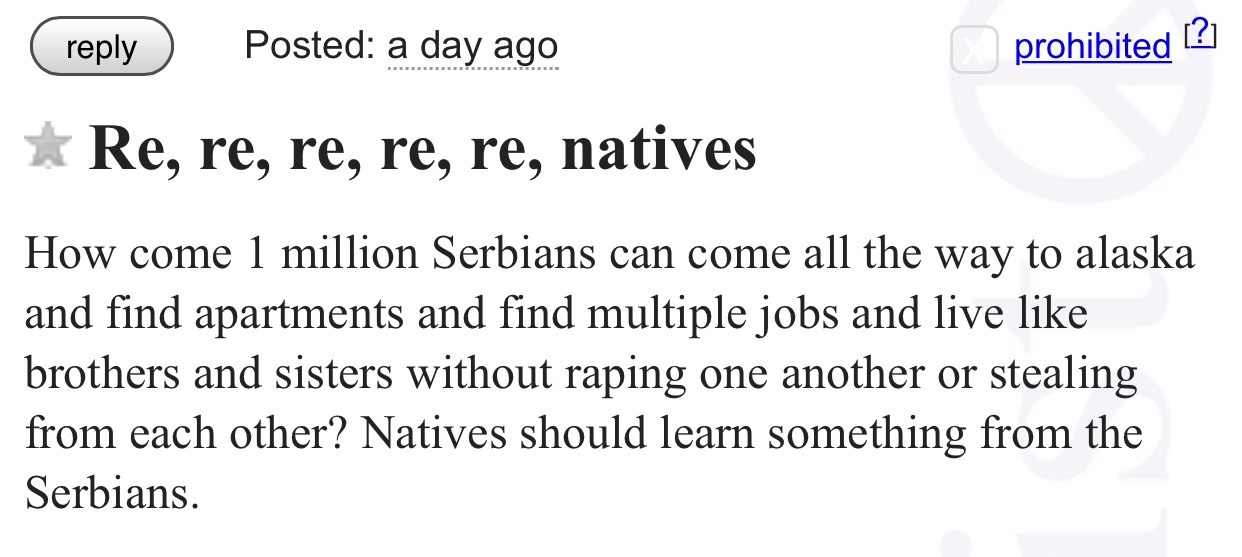
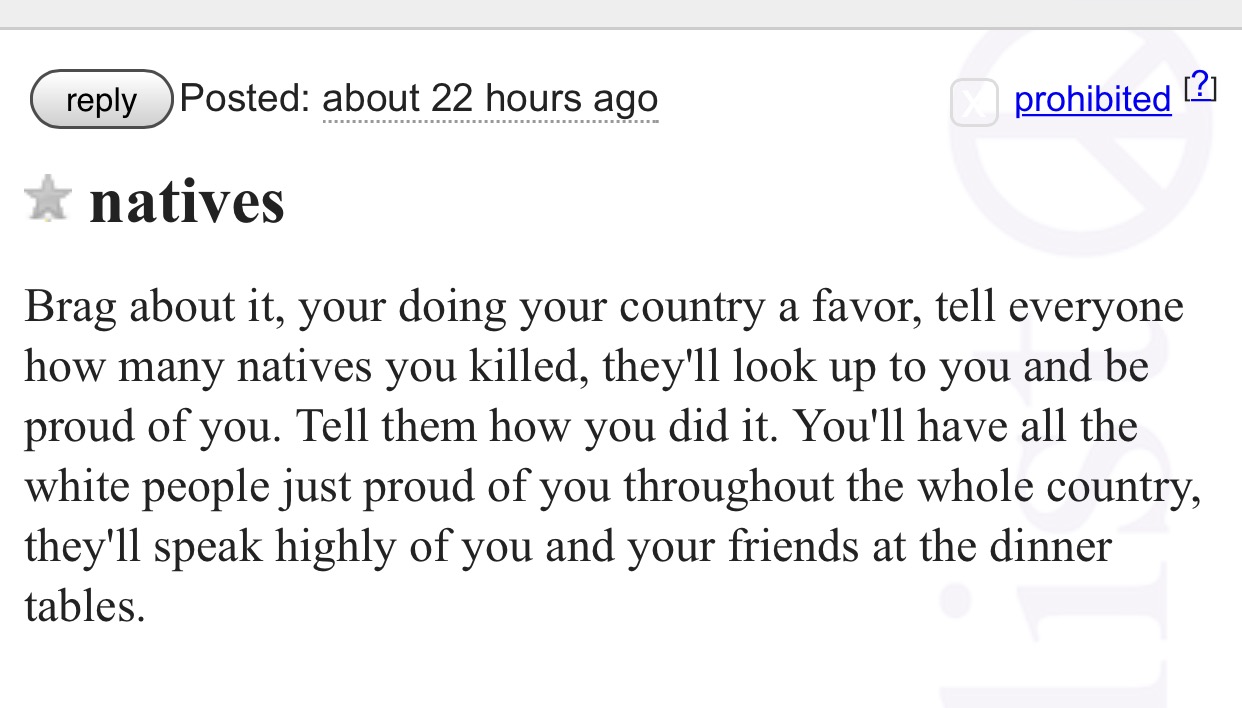
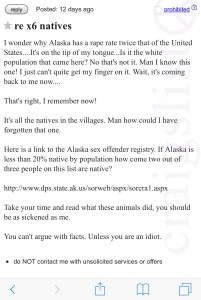
This hate is alive and well, virtually unchanged since 1997. Ask any Native man if they have been physically attacked in the streets of Fairbanks at random, and you will hear the stories. Read the crime statistics, sexual assault statistics, human rights reports. Read. Open your eyes, look. Open any Alaskan Craigslist and word search the term “Natives,” and you will read the thoughts of the community members who carry this hate. The posts below are chosen at random, and simply some of the most recent posts on the topic in the local Craigslist. We include them simply as a reminder that this hate remains, and offer it as “proof” of racism to those readers who believe that racism does not exist, or that conversations about race undermine the credibility of our cause. We are not playing the race card. We are playing the had we were dealt.

CL1

CL2

CL3

CL7

The newspapers continue to describe the assault as random, when in reality the assault that killed John Hartman was premeditated, and the motivation was racial hate. The fact that he was walking at that moment, at that intersection, that the men responsible had not been able to find their ideal victim, that the assault proved fatal – perhaps all of that can be considered the product of coincidence. But his murder was not random violence – it was very specific and intentional violence.

The two most common pieces of advice we receive in writing this blog are to avoid writing about race or John Hartman, because it makes people uncomfortable. But we are not here to make anyone comfortable, we are here to tell the truth. And the truth is, race was a huge factor in this case.CL6

Racial hate motivated the crime, it motivated the wrongful arrest and conviction of innocent young men, and it was the overtly stated factor used to dismiss the testimony of many witnesses.

John Hartman deserves justice. He was killed in hate and denied justice in hate, and that is not an acceptable legacy for a loved and innocent child. Nearly every person who speaks of this young man in life emphasizes his kindness and open-mindedness. He deserves better than this. His family deserves the truth. The community that rallied around his memory and his family to demand justice deserve the truth.

The answer to hate is not silence. The answer to hate is not fear. The answer to hate is not regret, grief, shame, and it certainly is not hate. The only counter to hate is love. So with love, we think it is time to start an honest conversation about race in this case, race in our community, and what we can do to change the future for the better.

Readers, we want to hear what you have to say. Leave a comment, tell your story, share your thoughts.

We heard the advice loud and clear to stay away from the topic of race so that people feel comfortable, and it reminded us how very important it is to make people uncomfortable. This post will mark the first in a series about race in this case, because if we can’t even say the words, we will never be able to change the story. We welcome contributors.

Jason Wallace Confession Leaked by Jason Wallace’s Attorney

Do Not EnterThe Fairbanks Daily Newsminer briefly published an article on August 20, 2015 which revealed the detailed statements of Jason Wallace regarding his participation in the murder of John Hartman. The revelation was significant in the case because the statements have remained under a seemingly impenetrable court seal since they were first referenced in a September 2013 filing by the Alaska Innocence Project for post-conviction relief base on actual innocence.. All that was previously known about the Wallace confession was that his statements corroborated those of William Holmes.

The article revealed that the local newspaper had come into possession of the documents when they were inadvertently sent to a reporter by someone who lawfully possessed them.

The article remained online for only a few hours before it disappeared. A court hearing held August 21 provided significant insight into the series of events that lead to the document leak and its temporary removal from the Newsminer website.

Judge Paul Lyle, the presiding judge over the Fairbanks Four case, called an emergency hearing to discuss the leak of the confidential documents. In that hearing, it was revealed that the documents were leaked by Jason Gazewood’s firm. Gazewood is Jason Wallace’s attorney, who recently took his request to keep the statements of his client confidential to the Alaska Supreme Court. Mr. Gazewood has been tasked with helping Wallace to prevent his statements about the Hartman murder from every becoming public. Ironically, or perhaps karmically, it was Gazewood’s office who inadvertently emailed the sealed document to reporter Sam Friedman.

At the hearing, Gazewood sought a gag order from Judge Lyle, hoping to stall or prevent the newspaper’s republication of the story. The Newsminer, represented by Anchorage attorney John McKay, emphasized their respect for the court but argued that any order blocking their right to publish would be unconstitutional. The Newsminer further expressed that they possessed the information for an entire week before making the decision to publish, and described the process of deciding whether to proceed as “soul searching.” The Newsminer ultimately decided to publish the article on August 20th, then took it down a few hours later in response to communications from Jason Gazewood. Attorneys for the newspaper noted that although the Newsminer had only had the article online for a few hours, it had since been republished on at least one blog and had been read there more than 18,000 times.

Indeed, the article attracted rapid attention, as did its removal from the Newsminer’s website. We republished the article here, and PDF and photographic versions of the text dominated local social media feeds. This case has a long and troubled history of exculpatory information disappearing. The speed at which the article traveled following its removal is a testimony both to the level of interest in the case as well as the role that social media has come to play in its furtherance.

In explaining the leak, Gazewood along with his partner and counsel Weiner addressed the court and essentially blamed a paralegal for the slip. According to Gazewood, reporter Sam Friedman called and asked him to relay a decision on the case, and Gazewood in turn instructed a paralegal to forward the information. She did, unaware that the file contained the decision of Judge Lyle and his summary of the Jason Wallace confession.

Judge Lyle did not mince words in responding to the request by Gazewood to suppress the story. “You want a stay? You want an order telling the Newsminer what they can publish? Take it to the Supreme Court,” Lyle said. “Because of your firm’s negligence more than 18,000 people have read this sealed document and for all I know every one of them dowloaded it. You want an order? Take it to the Supreme Court. Motion denied.”

truthIn the end, the hearing revealed the exact nature of the leak, the court’s extreme disappointment at reading a court-sealed document in the newspaper, the struggle of a local newspaper who ultimately made a great decision to publish and then republish information which is certainly of public interest, and underscored something we have said for a long time – the truth will find a way.

The article in questions is viewable again at http://www.newsminer.com/news/local_news/document-corroborates-challenges-new-claim-in-fairbanks-four-case/article_454ef902-4792-11e5-abef-1b7725d19e89.html

Jason Wallace’s Confession Leaked to a Reporter

Jason Wallace, 2004

Jason Wallace, 2004

The exact nature of the statements made by Jason Wallace regarding his participation in the Hartman murder have long been veiled in secrecy and the source of much speculation. The statements of Wallace, as summarized by Judge Paul Lyle in a document that was intended to remain confidential, were briefly published by the Fairbanks Daily Newsminer.

An article posted by the Fairbanks Daily Newsminer on August 20, 2015 to the newspaper’s website revealed the specifics of the confession, apparently made in 2003 to an attorney and investigator employed with the Fairbanks Public Defender’s Office. The Newsminer reported the details of Jason Wallace’s statements were leaked “inadvertently” by a party who was in lawful possession of the material. The article then goes on to detail the confession of Jason Wallace in the murder of John Hartman.

KEY POINTS IN THE WALLACE STATEMENT

  • Wallace confessed in 2003 while awaiting trial on an unrelated murder to public defender Geoffry Wildridge.
  • Wildridge then sent public defender investigator Tom Boles to speak to Wallace, presumably to investigate the veracity of his claim.
  • Wallace, like Holmes, describes leaving a party in a car with the intention to assault people. He describes first assaulting a man on First Avenue and robbing him. Holmes also describes an assault that preceded the Hartman beating, but in less detail. Wallace’s description of the assault closely matches the facts known about the Dayton assault, which figured predominantly into the case.
  • Wallace names three people as participants in the Hartman murder – himself, William Holmes, and a third person, whom the article only clarifies as a man also named in the 2011 Holmes confession. We feel it is safe to assume that Jason Wallace named himself, Holmes, and Rashan Brown, as both Brown and Holmes were both incarcerated in maximum security facilities in others states, had less to lose, and posed no threat to Wallace. Holmes names the same three participants as Wallace, plus Marquez Pennington and Shelmar Johnson.
  • Wallace denies sexually assaulting Hartman, and states that he does not think his group would have sexually assaulted Hartman. He speculates that the Fairbanks Four could have found and sexually assaulted Hartman later. In reality, there has never been any forensic indication of sexual assault. The charges were based entirely upon the observations of one nurse, not qualified to take an exam, and whose belief Hartman was sexually assaulted contradicted the autopsy and medical examiner’s conclusion.
  • Wallace claims he, not Holmes, was driving the car. Holmes and Wallace essentially finger the other as the major aggressor, although both confess to participating in the planned hate crime assault which killed Hartman.
  • For over fifteen years, public employees sworn to act as agents for justice have kept the confession of Jason Wallace secret under the auspices of privilege, despite the fact that failure to reveal the information has contributed to the unlawful detainment of four citizens, and that disclosing the information is clearly allowed.

The article was live for a very short period of time before the link was removed and all traces of reporter Sam Friedman’s revelation in the Fairbanks Four case were rapidly erased from the Newsminer site. The printed paper in circulation throughout the city today shows no sign of the report. we can only speculate that the newspaper removed the article after experiencing backlash from some local or state player – and likely from the source of the information leak.

Prior to the removal of the article, several members of the “Free the Fairbanks Four” Facebook page copied and preserved the text. We are opting to republish the article in its entirety, along with a series of images which confirm that it was indeed posted by the newspaper. It is supposed to be the job of the press to report newsworthy and credible stories without attention to political pressure or consideration for the reputations of the players. Certainly, the Newsminer showed no hesitation when running the first articles in this case which contained incredible inaccuracies, unchecked information, astounding bias, and fed the community frenzy which contributed to the hasty and wrongful convictions of George Frese, Kevin Pease, Eugene Vent, and Marvin Roberts. When the players are have more social capital the rules of reporting apparently swing as far in the other direction. According to their own article, the Newsminer has factual and credible information on the confession of Jason Wallace and has opted to rescind an article which fulfills the most important duty and responsibility of the free press – to report the news. It appears the press is not nearly as free as it ought to be here in the Golden Heart City. In a world where journalists are beheaded for speaking the truth and jailed for protecting their sources, the cowardice it takes to remove the article stands out all the more.

We applaud Sam Friedman for writing the article. The full text is below:

FAIRBANKS—A sealed court document obtained by the Daily News-Miner corroborates some details of an alternate account of the 1997 John Hartman murder but also clashes with key aspects of the 2012 statement that is being presented as a confession by one of the teen’s true killers.

Since their convictions in the late 1990s, the four men convicted of murdering 15-year-old Hartman have maintained their innocence and tried to win exoneration. Three of these men — Eugene Vent, Kevin Pease and George Frese — remain in jail. The fourth, Marvin Roberts, was paroled this year.

Nearly two years ago, the Alaska Innocence Project, which had taken up the case of the men who have come to be known as the Fairbanks Four, filed court papers claiming the men are innocent and that Hartman was killed nearly 18 years ago by a group of five other teenagers in a maroon Ford Tempo driven by William Z. Holmes, a man later convicted of two other killings.

Advocates for the four men backed their claims with three documents — a handwritten statement from Holmes and two indirect accounts about another convicted killer, Jason Wallace, whom Holmes says stomped Hartman to death.

One of the indirect accounts, containing statements reportedly made by Wallace, has remained under a court seal. It is awaiting a court determination on whether a statement Wallace made to a Public Defender Agency employee can be used as evidence.

The News-Miner obtained a sealed court document that contains a summary of Wallace’s purported confession after an individual with lawful access to the document inadvertently provided it to the newspaper.

Similarities, differences

Holmes and Wallace were Lathrop classmates who went into the cocaine-trafficking business. Holmes is serving a double life sentence and Wallace a 70-year sentence for murders committed in a failed 2002 takeover of a drug business. Wallace beat an Ester woman with a hammer while Holmes shot two men en route from Tacoma, Washington, to California, according to the cases against them.

Holmes told a California prison chaplain in December 2011 that he was involved in the Hartman murder. He repeated the assertion in a sworn statement in August 2012 for the Innocence Project.

Holmes wrote in his affidavit that he was driving around downtown Fairbanks on Oct. 10, 1997, with four others looking for an intoxicated Alaska Native to beat up, something he used to do for entertainment at the time. During their drive, they came across a “white boy” walking alone, he wrote. Holmes said Wallace and the three other young men in his car got out to beat up the boy.

Holmes said he remained in the car and that he couldn’t see the beating because bushes blocked his view.

The group later realized from newspaper accounts that the boy they had beaten was John Hartman and that he had died from his injuries.

Wallace’s account shows some similarity to Holmes’ account but also has some key differences.

Superior Court Judge Paul Lyle described Wallace’s narrative in a sealed November 2014 ruling related to the Alaska Innocence Project’s exoneration case. The ruling is under seal pending a court ruling on its status because it relates to a statement Wallace reportedly made to a Public Defender Agency employee, information that is supposed to remain confidential.

Wallace’s statement reportedly originated from a visit he had from Thomas Bole, then an investigator for the Public Defender Agency, which was representing Wallace in the unrelated 2002 murder case.

Lyle’s ruling says Bole went to Fairbanks Correctional Center to interview Wallace in January 2003 after Wallace told court-appointed attorney Geoffry Wildridge he had information about the Hartman case.

Wallace reportedly told Bole that he — not Holmes — was driving the car. And he says it was Holmes and another of the people named by Holmes who beat Hartman. Wallace says he remained in the car while Hartman was assaulted.

Wallace also reportedly mentions a total of three young men in the car, including himself, differing from the five mentioned by Holmes.

“Wallace said that Holmes and [the third person] jumped out of the car while he waited in the car. He did not witness the assault, but, when they came back to the car Holmes and [the third person] had a couple of dollars,” Lyle wrote in his summary.

“Wallace told Bole that he thought the petitioners found and killed Hartman because Hartman had been sexually assaulted and he apparently did not think Holmes or [the other person] would have done that,” Lyle wrote.

Lyle clearly mentions, in a footnote, that he is not passing judgment on what Wallace is alleged to have said: “The statements of Wallace summarized in this paragraph are not considered for the truth of the matters asserted.” His note says they are included because they are relevant to the question of whether Wallace was seeking advice from his attorney.

Wallace, in the judge’s summary, also references an incident that preceded the attack on Hartman, one not mentioned by Holmes.

The evening began, Wallace said, at a party attended by Holmes and another of the men alleged to later be involved in Hartman’s death. He says the three left and drove through downtown and assaulted — “knocked over” — an individual on First Avenue and stole money from him. The group then drove to the Foodland grocery store — now home to the Co-op Market Grocery &

Deli — and, after a while, returned to their car and drove down Barnette Street, where they encountered Hartman, who was walking.

Lyle’s summary of Wallace’s purported statement doesn’t mention what car they were in.

Holmes makes no mention of the First Avenue assault in his five-page affidavit. He says the group of five — not three — left a girl’s apartment to go downtown, with Holmes driving. Holmes said the other four men jumped out of the car and chased two Alaska Natives but returned to the Ford Tempo when the men ran into an alley. He said there were 10 other grown men in the alley. There is no mention of an assault.

The group, according to Holmes, then drove around downtown for about 20 minutes “without seeing anyone else to harass” and decided to return to the apartment where they had been earlier in the night. It was at that time that they encountered Hartman, he wrote.

The victim of the First Avenue assault mentioned by Wallace is not identified in Lyle’s ruling, but an assault in front of the Eagle’s Hall on First Avenue figured prominently in the case against Frese, Vent, Pease and Roberts. The four were convicted of that assault in the same trials that led to their murder convictions.

The statement’s path

Wallace’s alleged statement about the Hartman murder came to the Alaska Innocence Project by a circuitous process.

Bole, the Public Defender Agency investigator who had interviewed Wallace in 2003, later passed the information to another agency investigator, Richard Norgard, who had previously helped found the Alaska Innocence Project and who had been in contact with the organization about the Hartman case.

The parties dispute exactly when the information changed hands between Bole and Norgard, which matters because it determines who breached what is supposed to be a confidential relationship between a client and his attorney.

Lyle, in his November tentative ruling, found it was not necessary for him to determine who breached Wallace’s confidentiality; rather, he wrote that the issue to be decided was the legal remedy for Wallace and how to handle the desired use of the information by attorneys for Frese, Pease, Vent and Roberts.

The Alaska Innocence Project, which is leading the exoneration effort, is seeking judicial permission to use Wallace’s alleged statements as part of its case. Lyle and, later the Alaska Court of Appeals have each ruled that the attorney-client privilege was breached and that the Innocence Project can use the statements.

Wallace opposes the statement’s release and has taken the matter to the Alaska Supreme Court, which has yet to hear the case.

Below are some images which confirm the origin of the text. HERE is a link to a PDF version of the article.

Newsminer editor Rod Boyce shares the article on his Twitter feed.

Newsminer editor Rod Boyce shares the article on his Twitter feed.

wallacelinkpic

Article as seen on Newsminer.com prior to its removal.

Appeals Court Reveals Second Murder Confession in Hartman Murder

In a ruling made public today, the Alaska Appellate Court has shot down the efforts of inmate Jason Wallace to keep his confession to the murder of John Hartman out of court.

Although the exact statements of Jason Wallace related to his participation in the 1997 murder for which the Fairbanks Four were convicted and remain incarcerated have yet to be revealed to the public, the ruling confirms that Jason Wallace made statements to “an investigator working for his attorney which, if true, would tend to exculpate four defendants who were previously convicted of the same crime that J.W. described.” Wallace, currently incarcerated for another murder and represented by Fairbanks attorney Jason Gazewood who was most recently in the news after being held in contempt of court, has fought the release of his confession since the Alaska Innocence Project entered them under seal as part of a Post Conviction Relief filing based on actual innocence on behalf of the Fairbanks Four. Marvin Roberts, Eugene Vent, Kevin Pease, and George Frese were arrested and convicted of the Hartman murder in October of 1997. the four young men were convicted despite a wealth of alibi evidence and with no physical evidence of any kind linking them to the victim or each other.

Jason Wallace has been fingered as an alternate suspect in the Hartman killing since at least 2004, but a substantial statement related to his involvement proved elusive. Finally, in a sworn affidavit to the Alaska Innocence Project dated in 2008, high school acquaintance of Wallace Scott Davison detailed the statements about the killing Wallace had made to him just days after the murder. Davison was absolutely bullied and berated by the State of Alaska for coming forward.

According to oral arguments made during a recent misconduct hearing on the case, in 2011 William Holmes, a Fairbanks man serving a double life sentence in a California prison for unrelated murders, developed a relationship with correctional officer and chaplain Joseph Torquato. Holmes told Torquato about his life in Alaska and his troubled past. On December 5th, 2011 Holmes detailed to Torquato his role in the stomping murder of a young boy for which four innocent men were imprisoned. Torquato was so compelled by the statements of William Holmes that he went home the same night and used the internet to research similar murders in Alaska. He came upon the Hartman case, and the next day when he saw Holmes he asked him, “Does the name Hartman mean anything to you?” to which Holmes replied, “Do you mean John Hartman?” The inmate confirmed that the murder he had confessed to the previous day was indeed the Hartman murder. Torquato implored Holmes to come forward to Fairbanks authorities, but he refused.

The correctional officer then took the information to his supervisor and together the two composed what is now referred to in proceedings as the “Torquato Memo.” Torquato sent the written account of the confession by Holmes to the Fairbanks Police department. They forwarded it to the District Attorney’s office. Ultimately, neither party took action.

The State’s failure to disclose the confession of Holmes when first received was the subject of the July 30th hearing in Fairbanks Superior Court, where the state argued that the wording of the Code of Ethics as written in 2011 should have allowed the prosecutor to withhold the confession, although they conceded that such conduct would not be acceptable in 2014. They further argued that because the Fairbanks Four had been convicted by 2011 that they did not have any remaining constitutional due process rights.

Counsel for the Fairbanks Four argued that there were indeed state and federal constitutional rights violated through the withholding of the Holmes confession, and that the ethical obligation to disclose the confession was so clear that it was “offensive to justice” to have withheld it. Attorneys for the Fairbanks Four discussed the harm that had come to the four men’s case as a result of the State’s decision to hide the Holmes confession. Among other things, they cited the 2014 deaths of two witnesses who had heard confessions from Marquez Pennington. Had the State revealed the confession as obligated, the argued, the witnesses may have been alive to testify that Marquez Pennington made admissions in the case as well. This small comment was the first reference to yet a third confession – the confession of Marquez Pennington. 

A decision as to whether the actions of the District Attorney violated the rights of the men known as the Fairbanks Four is forthcoming from Judge Paul Lyle.

Despite the State decision to withhold the confession, it eventually came out. Holmes confessed directly to the Alaska Innocence Project. In 2012, Holmes mailed a detailed and handwritten confession to his role in the killing of John Hartman in which he named Jason Holmes, Marquez Pennington, Shelmar Johnson, and Rashan Brown. The five teenagers, according to Holmes, went out that night hoping to assault “drunk Natives” for fun, and after being unable to find the ideal victim happened upon John Hartman. According to Holmes Jason Wallace was the ringleader of the vicious assault, but all four of the other men he named attacked and killed Hartman, while Holmes served as driver. (Read the Holmes confession HERE). IMG_7092

The Holmes confession provided answers long-sought by the Fairbanks Four and their families and friends who for nearly two decades have insisted on their innocence. It also corroborated the affidavit of Scott Davison, and became the centerpiece of the 2013 Alaska Innocence Project filing for Post Conviction Relief on behalf of the men. Also contained in the filing were statements made by Jason Wallace said to “corroborate the confession of William Holmes.”

The statements by Wallace, potentially subject to attorney-client privilege, were filed under seal and it was never known if they would be made public. Jason Wallace can, and likely will, appeal the decision to release his confession to the Alaska Supreme Court, although it seems unlikely that they would opt to hear the case. The decision by the Court of Appeals only applies to the narrow issue of whether or not the judge CAN consider it for admission. It is still possible that Judge Lyle will not declare it admissible. It is possible that he may admit it and keep it confidential.

This wins a battle, but the war is long.

story1Whatever the legal meanderings of this case through the maze of a truly sick justice system, we have as much faith today as we did when we wrote our first post. The first time anyone ever used the term “Fairbanks Four” we used it with this promise beside it  –  “This is story of injustice, a plea for help, for understanding, and above all a story of faith in the power of stories, of the truth. Writing this blog is an act of faith, a testimony to the power of the truth, spoken, read. We may not be experts in journalism, in law, or many other things. But the contributors here come from Alaska, from a culture that has a long tradition of storytelling, and a belief that the truth holds incredible power. This is a long story, and we will have to tell it the old way, the slow way, in pieces as they come.”

This story is unfolding as we knew it would and know it will because we have known the ending since the beginning. This blog is still a story, told in pieces as they come. Today, this is a new piece of a long story. This movement is still a plea for help. We need you to share this story and do what you can to right a wrong.

Above all, it is still an act of faith and we have absolute faith in the good of people like you and the power of the truth.

State of Alaska Pulls Funding for Eugene Vent’s Attorney

obstaclesColleen Libbey, after 11 years working on one of the most complex and high-profile cases in the state of Alaska, has been removed from the case without warning.

This alteration in counsel, which the Department of Administration has attributed to budget cuts, comes deep in the midst of disovery, and days before Eugene vent’s scheduled deposition.

When the public defender’s office is too busy, conflicted, or otherwise engaged, the Office of Special Advocacy regularly assigns the work to private defense attorneys. It is a basic tenet of our justice system, so much so that it is incorporated into the Miranda rights…”If you can’t afford an attorney, one will be appointed to represent you….” Colleen Libbey was assigned to Eugene Vent as a court appointed attorney.

Vent, the only one of the Fairbanks Four who had an ongoing active appeal at the time of the September 2013 Innocence Project filing, has had the same attorney since 2004. The litigation has dragged on these eleven years primarily because of delays and appeals within the system, and in part because of the complexity of the case.

When the Alaska Innocence Project filed their motion for post-conviction relief, the State immediately asked for an extension of just over seven months simply to review the case. By the time the case reaches court for the evidentiary hearing the original motion will be more than two years old. Although we have consistently found these extensions and delays to be extravagant, they are an appropriate measure for what kind of time the State of Alaska has determined is necessary for an attorney to prepare for even a singular action on the case. Now, days before he was scheduled to be deposed, and a handful of months before the evidentiary hearing, the State of Alaska has terminated Vent’s attorney.

The impossible task of preparing for a case in which the other attorneys have required years to gain familiarity is now left to Whitney Glover. Glover is a Office of Special Advocacy attorney, employed by the State of Alaska. Prosecutor Adrienne Bachman, in an interview with journalist Brian O’Donoghue, commented that Vent’s new attorney Whitney Glover currently has upwards of twenty other PCR actions pending and has repeatedly filed in other cases indicated that her “docket is so full she may not be able to meet deadlines.”

It is not uncommon for a public attorney to have an extraordinarily high caseload, and it is likely that Glover is indeed coping with a full docket, to which one of the most significant cases in Alaskan history was just hurriedly added.

It is impossible to know the motivations of the individuals who made the decision to remove Eugene Vent’s attorney from this case. The timing is so poor that it is difficult not to see the removal as strategic.

Other recent moves by the State seem equally strategic. The witness lists, for example. The State of Alaska did not include any information or clue as to the nature of the testimony of the sprawling list of witnesses they named in discovery. A move like this, as small as it may seem, is impactful. That means the Alaska Innocence Project, a tiny nonprofit with one attorney and limited funds, will have to investigate each and every name on that list just to know what the person may testify to. MY name, among other names, made that list. Right next to the kitchen sink….

Sometimes, the appearance of indiscretion is as good as the real thing. The State insists this is all a clean, above-board search for justice. Yet, it certainly seems like something else.

On this blog, we often refer simply to the State of Alaska. The state is, of course, composed of many branches, departments, task forces, offices, etc. That said, the State of Alaska is indeed an entity. State monies and priorities are delegated, and all of these many branches belong to the same tree. The State of Alaska through the actions of its many agents and agencies is engaging in a series of actions and deceptions which, if taken at face value, at best seem incompetent or reckless. If considered as a whole they seem strategic.

The State of Alaska was eager to share this figure as justification for the decision – in the eleven years that Colleen Libbey served as Eugene Vent’s counsel, Alaska spent $104,000.00 on his attorney. Roughly $25.00 per day that she worked on the case. Here is a figure they are not so eager to share – by the time the evidentiary hearing begins this October, the State of Alaska will have spent $896,400.00 housing him as an innocent man in prison. They will have spent about $3,585,600.00 incarcerating all four.*

As menacing as the incarceration figure is, there is another dollar amount we believe will be much higher. The figure that we would love to see, and one the State of Alaska has refused to share, is the total cost of the prosecution of the Fairbanks Four.

The State of Alaska has spent millions of dollars prosecuting, incarcerating, and fighting the release of Eugene Vent, yet suddenly cannot afford for him to have an adequately prepared attorney.

got thisWhitney Glover, Vent’s new attorney, deserves as much support and votes of confidence as she can get. Luckily for her, she is inheriting a lot of quality evidence, and above all will find herself fighting for the truth. There have been many moments over the last eighteen years where those close to the case and the four men themselves have come close to feeling defeated. It is not going to happen, no matter the obstacle, it can and will be overcome. We have learned that over and over – we have been there, done that, got the t-shirt.

Colleen Libbey – thank you, thank you, thank you for eleven years of work on a hard case you surely deserved to see come to completion under your watch. We appreciate every moment you gave.

Whitney Glover – we believe there is a rhyme and a reason to all things, and a higher purpose in this story. Congratulations on being the person our maker selected for the job, you must be the one meant for it. Fate brought you here, so it is here you belong. Welcome!

Read this story in the news!


*Costs of incarceration found HERE


State of Alaska Caught Lying AGAIN (Yawn)

liar2It is becoming routine and almost boring to get on a blog and explain that the State of Alaska is deliberately, illegally, criminally fighting to keep innocent men in prison. It is not a boring topic at all – it is an important topic. Yet, no matter how many times the media reveals another deception, the State does not get any better at lying or hiding, and shows no signs of ceasing.

William Holmes passed a lie detector test. HERE is the well-written article that revealed this latest development. William Z. Holmes has confessed multiple times over a handful of years to the murder of John Hartman, a crime for which the Fairbanks Four were convicted of and have served nearly eighteen years for despite their unbroken insistence on their innocence and a distressing lack of evidence against them. The Holmes confession was publicly revealed for the first time in September 2014 when the Innocence Project filed their case asking for the Fairbanks Four convictions to be overturned based on the innocence of the four men. This claim of innocence was evidenced in part by the guilt of William Holmes and the accomplices he named – Jason Wallace, Marquez Pennington, Shelmar Johnson, and Rashan Brown.

The State of Alaska’s Department of Law came out with a press release immediately following the September 2013 filing, saying that they had no reason to think that there was any problem with the conviction of the Fairbanks Four. What no one knew then was that they had been in posession of a confession from Holmes and one of his accomplices  in the case for years, and kept it hidden. Holmes confessed to a Fairbanks corrections officer in 2011 who then passed the confession on the the Fairbanks Police Department. The FPD then shared the confession with the Fairbanks DA’s office. The DA was legally obligated to disclose this but elected to withhold it. The FPD could have elected to investigate it, but by their own admission simply shrugged it off.

When the Innocence Project unearthed this outrageous act they filed misconduct allegations against the state, and Detective Nolan, the police officer who received the confession said (and yes, pay attention, this is an actual quote) that he “”got it and basically, uh, I didn’t write anything up.”

Sitting chief of police Laren Zager described the receipt of a murder confession in a high-profile alleged case of wrongful conviction “basically a shoulder shrug,” in a May 2014 interiew with the Fairbanks Daily Newsminer. While an alternate murder confession sat on his desk, Zager boasted to the cameras during the KTUU documentary “The Fairbanks Four” that he had reviewed the case and considered it “model police work.”

After a seven month delay the State of Alaska responded to the original filing by the Innocence Project that contained the Holmes confession. The twenty-three-page response (so….just over one page per month in productivity) was a disorganized, hurried, odd attack on the Holmes confession, alternately attacking its credibility and its admissibility.

Over a year later, we now know that the State of Alaska had not only already covered up Holmes involvement by sweeping his confession under the rug, but had the gall to administer a lie detector test to the man, and after he passed it, continue to insist he was not telling the truth.

We didn’t need a lie detector test. It as been clear for a long time who is lying and hiding and who is telling the truth.

The argument could be made, and would likely be made by the State, that failing to disclose information or making an argument that a piece of evidence should be ruled technically inadmissible even though it is important and true is not as simple as lying. The procedures, loopholes, standards of practice, and theories of the court cloud and complicate things which should be in their nature quite simple. For example, they were under no obligation to disclose the lie detector test to the public. But the strategic withholding of information and deliberate proliferation of misinformation, however cloaked in orders or procedures, is at its core simple dishonesty. To create filings and statements that argue a murder confession should be suppressed because it isn’t credible while you hold back a lie detector test that demonstrate it is credible is lying, no matter how buried in technicalities the core is simple. William Holmes is telling the truth, the State of Alaska through many of its assigns knows that, and is still fighting to dismiss and hide that.

liedetectorWilliam Holmes has killed two people and participated in the murder of at least one more. Yet, he appears to be more capable of telling the truth about that than agents of the State of Alaska who have taken an oath to uphold justice. The State of Alaska is less ethical and honest than a convicted double murderer serving life in a maximum security prison. And we have the statements, videos, photos, lab reports, newspaper articles, science, forensics, witness statements, and now add to that list the LIE DETECTOR RESULTS to prove it.

When I was a little kid my dad used to say, “if you’re going to lie to me, lie to me. But don’t insult my intelligence by telling me a stupid lie.”

This entire case has become an exercise in humiliation, incompetence, incredible fiscal irresponsibility, moral bankruptcy, and stupid lies on the part of the State of Alaska. I am not sure whether or not the constant deceit will ever change, but it has come to a point where it seems the most insightful thing to say to the State of Alaska is, if you are going to lie to us, lie to us. But don’t insult our intelligence with another stupid lie.

No one can alter the past, but anyone can change the future. At any point in time the State of Alaska could drop charges against the Fairbanks Four, and perhaps even use that money to prosecute the men who actually killed John Hartman, some of whom still walk free. And this case reached a point long ago when that was simply the right thing to do. Instead, it appears they are absolutely unwilling to change course, and will spend millions of more dollars of Alaska’s money during a budget crisis to defend a prosecution they know is fatally flawed, completely fail to protect the public from accused thrill killers, and fail to pursue charges against criminals who should be in prison for killing a child.

truthMeaningful change does not come easily. There is a bias and a sickness in the justice system of Alaska that must be changed. Every door that is kicked down or pried open in this case will remain open for all those who come after them. The precedents that will be set while one grant-funded, underpaid, dedicated attorney for the Alaska Innocence Project faces off against the entire Alaska legal system will be relied on for the forseeable future. The Fairbanks Four case is and has always been about more than one case or four wrongfully convicted men. It is about all Indigenous people, all people, all Alaskans, all of the lives that have been lost to the bias in the system, and all the lives that will be saved when it is changed.

Thank you all for your continued dedication to the innocence and justice movements in Alaska. Never be discouraged – let each of these revelations, however troubling, be a reminder of why you have taken a stand. And brace yourself for more – I would love nothing more than to write the blog post that says the State has acted honorably and in the interest of justice, but expect that change will have to be brought upon them, not led by them.

The truth makes a formidable enemy, and one against whom the State has no chance. Truth prevails in the end, there is not enough money or deceit in the world to defeat it. The truth makes a powerful ally – be glad to stand on its side.

IMG_7115

BillFiling