Back in court – Opening Arguments and Witnesses in Fairbanks Four Hearings

MArvininCourtOctober 5, 2015 marked the first day of proceedings in the evidentiary hearing the Fairbanks Four, their attorneys, and supporters hope will ultimately lead to their exoneration.

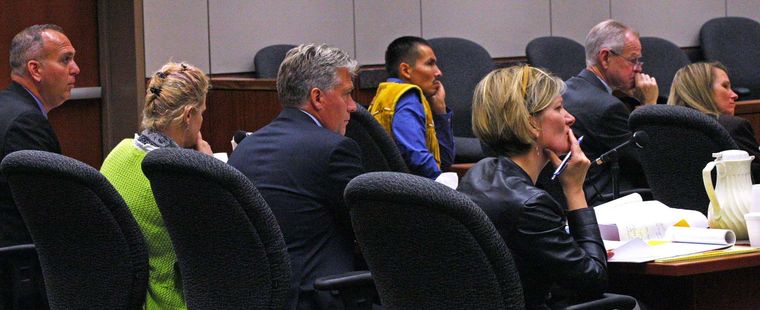
Inside the courtroom, Marvin Roberts was flanked by attorneys, his traditional beaded moosehide vest among the black suit jackets underscoring his singularity in the courtroom. His three – sat a few miles away at Fairbanks Correctional Center, where the State had been ordered to transport them. The court was, however, unable to force the State to transport them under guard the few remaining miles to the courthouse each day when the State refused. Equally alone, and every bit as tasked with the burden of representing those who could not be there in person, was Chris “Sean” Kelly, the elder brother of victim John Hartman.

Nearly eighteen years have passed since the last time this case was in court, and the years have altered many in the crowd. Accused man Marvin Roberts, the only one of the four to achieve parole, and Hartman’s brother Sean Kelly are middle-aged men now. Hazel Roberts, mother to Marvin, has gray streaking her hair now, and is on the doorstep of 60. The last time she sat behind her son proclaiming his innocence she was nearly the age he is today. Hartman’s mother is long deceased. Also present at court was George Frese’s daughter with her daughter on her lap. Today, she is twenty years old, and her daughter is three. In 1997 she was a three-year old on her mother’s lap and her father George was twenty. The years calculated in their alteration of the human beings involved are painfully visible. The rows of spectators listened carefully as the case began. Immediately prior to proceedings, journalist Brian O’Donoghue, whose investigative reporting first revealed the many issues with the original convictions to the public, was unceremoniously ejected from the courtroom. State prosecutor Adrienne Bachman deposed both O’Donoghue and blogger April Monroe, making them witnesses to the case, in what many suspect was an effort to execute control over coverage of the proceedings. The crowd shook their heads as O’Donoghue rose and walked from the courtroom, unable to cover the story for the first time since its inception.

During opening statements attorneys for the men and the State of Alaska outlined their respective cases. The Fairbanks Four, as George Frese, Kevin Pease, Eugene Vent, and Marvin Roberts have come to be known, are visibly well represented on this return trip to court. The eighteen years that have elapsed since their original conviction have virtually inverted the appearance of the courtroom – a reflection of the change in public sentiment about the case. The attorneys for the Fairbanks Four sat two tables deep, and opening statements were given in turn by the lead counsel for each of the men. The Fairbanks Four, their attorneys argued, are entirely innocent of the murder of John Hartman. In an opening bolstered by a series of video clips – William Holmes unemotionally confessing to the murder of Hartman in detail, his co-conspirator Jason Wallace implicated by both Holmes and his own statements cockily invoking his right against self-incrimination when asked about his role in the killing, and former star witness Arlo Olson recanting his original testimony – attorneys for the Fairbanks Four argued passionately that their clients were absolutely innocent, as they themselves have insisted since the first day of incarceration and maintained these many years.

Adrienne Bachman argued for the State of Alaska that jury trial is the “bedrock of the justice system,” that the judge had no business being a super-juror in the case, and went on to say she would call witnesses who bolstered the original case, including a cab driver who came forward in 2014 to claim she saw four “Asian-looking men” in the Barnette area the night of the murder, and “felt a catch in her heart.” She outlined a basic argument for countering the admissibility of anything she deemed hearsay, communicated her intention to stand by the boot print exhibit created by controversial figures Jeff O’Bryant and Aaron Ring, and exhibit repeatedly described as misleading and totally unscientific by experts, reiterated that alibi witnesses should not be called because if “they were not believable the first time, they are not believable now.” Bachman also revisited the testimony of Melanie Durham, a women’s shelter resident in 1997 whose testimony about hearing the Hartman beating has long been used as a reference for the time of the crime. Durham came forward when she realized the beating she heard had resulted in a death, claiming to have heard “dark” voices and a smaller voice plead for help. After the Fairbanks Four were arrested and she had a conversation with officer Aaron Ring, accused by supporters of significant misconduct in the case, Durham altered her story to be that although she was not close enough to hear audible words, and she saw nothing, that she was still able to identify the voices as Native due to an accent (as an aside – none of the Fairbanks Four have a “Native” accent, all are verified city boys). Durham’s  illogical but racially charged testimony was effective the first time, and Bachman argued that Durham did not hear a black man, despite Holmes’ having a classic “African-American speech pattern.” It was an interesting addition to the theory that witnesses can distinguish Natives in the dark distance by indistinguishable speech – the State expressed their stance that this is also true of African Americans.

In the end, both sides argued what is to be expected – the attorneys for the Fairbanks Four argued based on fact and witness testimony that their clients are actually innocent of the crime for which they have spent the last 18 years in prison, and Adrienne Bachman argued that she did not want to be there and did not think it was fair that her opponents were presenting this information in court. Oh, also that her witness has the superpower of identifying people by ethnicity without seeing them, and that she has a witness who may have seen four Asians in 1997, because that is close enough, right? In all reality, it is dismaying to say the least to hear bigotry presented as fact in 2015 as in 1997.

Opening arguments were followed immediately by the in-person testimony of one of the most critical and controversial witnesses in the current case – William “Bill” Holmes. The crowd sat in absolute silence as Holmes, in horn rim glasses, orange prison garb, and flanked by troopers, described with apparent ease his role in John Hartman’s death. He discussed attending a high school part at classmate Regent Epperson’s house, and leaving when it was “boring.” He described the plans to assault Natives, repeatedly referring to the Alaskan indigenous as “drunk Natives” as he relayed the series of attempted assaults that culminated in the fatal assault of Hartman. He described the other teenagers running back to the car, near hysteria because “little J was just trippin,’ stompin’ the old boy out.” He describes discovering a few days later that the assault proved fatal, that others had been arrested for the crime, Wallace showing off and laughing at Hartman’s blood still on his shoes, and how Holmes threatened the other teenagers present with murder should they ever come forward.

When describing his motivation, Holmes insisted that God had moved him, nothing more and nothing less.
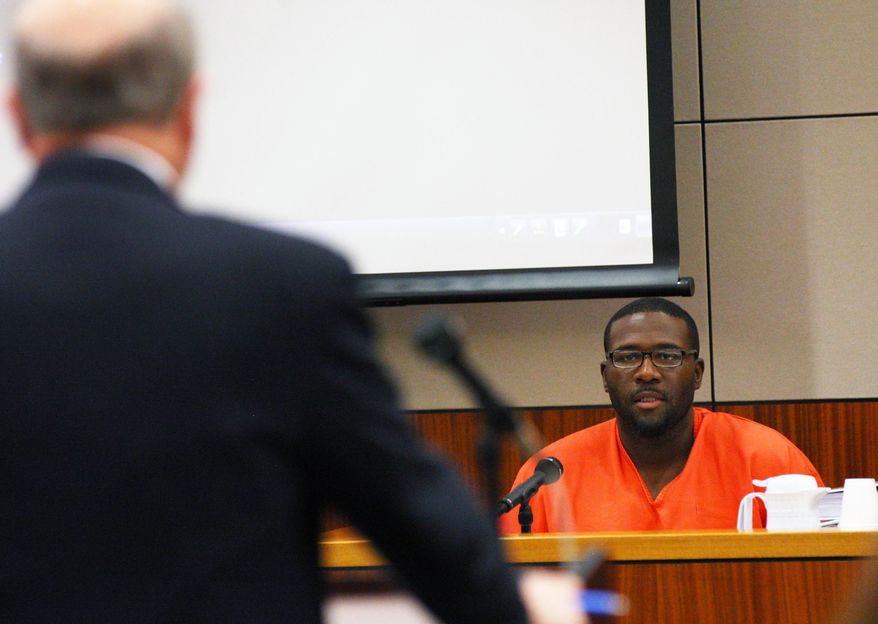
William Holmes TestimonyHolmes proved a difficult witness to undermine for Bachman, who focused heavily on his ability to identify his route through arial photographs and his definition of “U-turn.” The line of questioning ultimately backfired as Holmes described by landmark with great accuracy the corner of 9th and Barnette. Bachman also sought to undermine Holmes’ claim of faith by grilling him about sexual conversations had via contraband cellphone with a woman. Bachman insisted Holmes could not be both coming forward for spiritual religions and ‘talking dirty’ to a woman. She ended her cross examination with a brief commentary about his testimony being hearsay, prodding Holmes with the claim that he didn’t see anything or commit a crime. Holmes responded that he thought driving the car for premeditated assaults, driving the getaway car for a murder, threatening witness/participants with death if they came forward, and destroying evidence was indeed a crime. In the end, Holmes had the better end of that argument.

Most memorable in the Holmes testimony, however, was simply the easy demeanor with which Holmes reflected on Wallace “stomping the ol’ boy out.” For the many people whose lives were turned upside down when Marvin, Eugene, Kevin, and George were imprisoned for the killing, hearing the details of the brutal death of young Hartman for the first time were overwhelming.

FairbanksFourrallySpectators exited the courtroom visibly shaken by the Holmes testimony, and as Marvin Roberts and TCC President Victor Joseph stepped into the large crowd gathered to protest outside the courtroom, the mood turned somber.

“We need to pray for John Hartman, for this little boy, and his brother who is here today. We need to lift him up,” Joseph began, and continued to urge the crowd to support the Four and continue their work.

Marvin thanked the crowd, tears catching in his throat as he listed his co-defendants still in jail by name.

The crowd of supporters, which included the UAF chancellor and bishop of the Alaska Episcopal church, played drum and sang traditional songs in a circle around the courthouse steps.

“Two years ago,” Father Scott Fisher said in closing prayers, “we gathered in this same place, with faith, and insisted, the light is coming. Today, it is sunrise.”
Below are some of the many articles and videos about the first day of the Fairbanks Four proceedings. We will update you as trial continues.

KTUU – Fairbanks Four Hearing Begins (article/video)

KTVF – First Day of Trial

Indian Country Today ‘Fairbanks Four’ Seek Truth, Freedom

NPR – Dan Bross – Bill Holmes Testimony

Washington Times – Fairbanks Four Want Convictions Overturned

Big Bad Wolf VII – Rashan Brown and the Murder of John Hartman

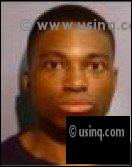
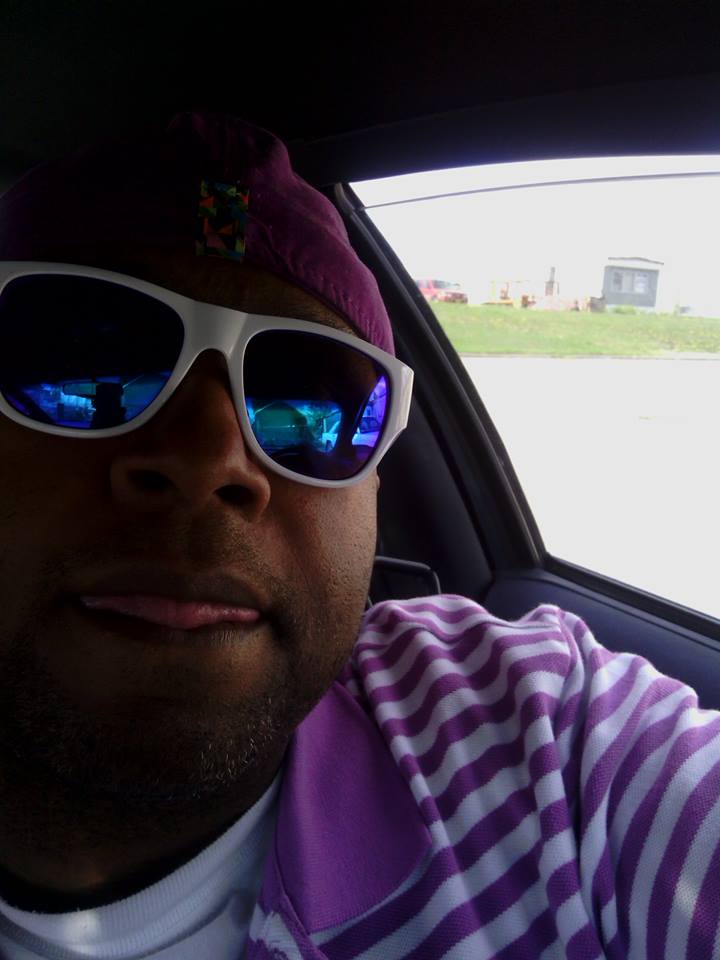
Rashan Brown, 1997 Lathrop High Yearbook

Rashan Brown, 1997 Lathrop High Yearbook

In 1997, Rashan Brown was, by all outward appearances, a typical high school student. He was a senior at Lathrop High School, where he at one point served on the school paper. Brown once published an interview with classmate William Holmes. Holmes would include Brown in his own nonficiton account some fifteen years later. In his written confession, Holmes named Rashan Brown as a fellow participant in the brutal kicking death of Jonathan Hartman. According to Holmes, he and Rashan Brown along with fellow Lathrop students Marquez Pennington, Shelmar Johnson, and Jason Wallace, left a house party on in the early morning hours of October 11, 1997, and drove to downtown Fairbanks and killed John Hartman for fun. Hartman was discovered draped across a curb, fatally wounded and comatose. He died the following day. Four other young men were swiftly arrested for and convicted of Hartman’ killing and remained imprisoned despite their unbroken insistence that they are innocent, no physical evidence linking them to the crime, and significant evidence to include Holmes’ own confession, that link the alternate suspects to the crime.

Rashan Brown was the son of a local community leader and city councilwoman and has no public criminal record in Alaska. What is known of Brown is that some months after the Hartman murder he is rumored to have had a mental breakdown of sorts. He was sent to live with his father in Oregon, where it seems things did not improve.

Rashan Brown was arrested on August 5, 2004 in Umat County, Oregon. Brown was charged on 10 total counts, including "MURDER AGGRAVATED", "", "MURDER AGGRAVATED", "", "MURDER AGGRAVATED", "", "MURDER AGGRAVATED", "", and ""

Brown was charged on 10 total counts

On December 13, 1999, Rashan Brown met up with Julie Ann Wilde and Victor Torres, aged 18 and 19, with the victims believing that the meeting was for the purposes of Brown purchasing drugs. Evidence indicates that Brown had planned a murder of this type for some time, and intended to kill Torres and Wilde to steal any drugs and money they had. Brown indeed shot both victims at close range and left their bodies where they fell. He threw away the bicycle he had been spotted on driving to and from the crime scene and reported it stolen. He went to the home of an acquaintence and offered him $20 to tell police he had been there all night. Brown became a suspect in the killing. His bicycle was found in a dumpster, a handful of witnesses came forward to implicate Brown in the crime, the murder weapon was recovered, and blood from the victims was found on his underwear.

Brown was tried for aggravated murder as well as conspiracy. During trial he was extremely disruptive. He engaged in many yelling and screaming courtroom outbursts, hunger strikes, was repeatedly removed from the courtroom, and his state of mind was debated back and forth by defense and prosecution. Although the defense asserted that Brown was mentally ill and not fit for trial, the prosecution believed he was, and not only that Brown was fit, but that his outbursts and behaviors were a farce.

Brown was ultimately convicted of his crimes and sentenced to life without the possibility of parole. He filed many appeals, all predicated on accusations of procedural missteps, but received no decisions favorable to his position and has exhausted his appeal process.

The blood spilled in the injustice that began with the killing of John Hartman and was followed by this wrongful conviction is incredible. Brown demonstrates well the ultimate price of leaving the guilty on the streets. Had the right men been arrested in 1997, many people who are dead would be alive. This includes the victims of Brown – Julie Ann Wilde and Victor Torres – whose families must live with incredible loss and grief, and may not even know how their personal injustice is interwoven with an injustice many miles north.

As to Brown, it is impossible to say who is was in 1997, and further impossible to know the contents of his mind and heart before the night John Hartman was killed. It is clear that his life took a dark turn. It is, again, sad to consider who Rashan brown may have been had justice found him in 1997. In the Holmes account of the Hartman killing, five high school aged boys left a house party with a plan to assault “drunk Natives” for fun. When they could not fund a suitable victim, they happened upon Hartman and said, “we got one!” Holmes pulled the car up to the child, and the other four young men jumped out and attacked him. They knocked him to the ground and kicked him. And, then, Jason Wallace kept kicking. And stomping. And kicking. The boy shuddered his last while Jason Wallace kicked and Marquez Pennington rifled through his pockets. And, once back to the car, Wallace sat silent while the other boys screamed.

What if? Those may be the two saddest words in the English language, used to number losses unknown. What if they had been pulled over just moments after they pulled away? What if John Hartman had gotten medical treatment in minutes, not hours? What if they had told the truth that night, and not lived under the burden of a terrible secret? What if Jason Wallace had been sentenced to life for the unimaginably brutal kicking death of a child? What if the others, with less involvement and still minors, had received sentences that reflected the gravity of the events, but included rehabilitation? Who might they have been? And who may still be alive?

We will never know if Brown may have grown up to be okay had he been caught that night. We may never know whether he became ill under the weight and trauma of a terrible secret and the fear of killers, or if he was destined to break. But we do know that had he been incarcerated in December of 199, as he absolutely should have been for his role in the killing for John Hartman, that Julie Ann Wilde and Victor Torres would be alive today. Our hearts are with those families. In a few short days the Fairbanks Four will have another chance in court. Someday, they will come home. There is no such relief for the families of the other victims, and the permanency of their loss is a tragic reminder of our blessings. May they heal, hope, and see a greater justice someday.

Big Bad Wolf VI – Marquez Pennington and John Hartman’s Murder

Marquez2

Marquez Pennington

When William Holmes confessed to his role in the brutal murder of John Hartman, he named four accomplices: Jason Wallace, Rashan Brown, Shelmar Johnson, and Marquez Pennington. The press, as a rule, has excluded mention of the two named by Holmes who are not in prison. Holmes, Wallace, and Brown are all serving time for murders they committed as individuals. Pennington and Johnson are free and residing at least part-time in Alaska. We do not see any reason to shelter them and have never excluded them from reference.

Mr. Pennington appears to have used the eighteen years that have elapsed since his alleged participation in the beating death of John Hartman to pursue other criminal activity. His criminal record is extensive. Marquez Pennington has been arrested more than 30 times between 1998 and 2012, or 2.14 times per year. His record can be viewed HERE. These arrests have often contained multiple charges, and his record exposes a long history of drug sales, use, and violence. Despite many significant charges being brought against him, including multiple drug related felonies, Mr. Pennington has apparently avoided harsh prosecution. He did serve some time in prison alongside the men currently incarcerated for the murder of John Hartman, and was apparently unmoved by the process of looking innocent men serving time for his sins in they eye.

Marquez

Marquez “QB” Pennington

In addition to his relatively brazen work as a drug dealer apparently conducted without significant law enforcement interference, Mr. Pennington has enjoyed a long if unremarkable career as an amateur hip-hop artist. When rapping, Marquez Pennington goes by the stage name “Q.B.” and “Q.B. of Choldhustle.” His work appears on Myspace, and a compilation album titled “Interior’s Most Wanted,” produced by Redd Dott studios, or Alaska Redd, the studio of Josh “Red” Silva, a Fairbanks rapper who has collaborated with Marquez Pennington as well as Bill Holmes and Shelmar Johnson. On this particular album, distressingly dedicated to both William Holmes and his slain ex-girlfriend Mahogany Davis, Marquez Pennington is featured as Coldhustle. Other self-imposed monikers associated with the middle-aged Pennington include Cube, Q, Quadruple, and so on.

Holmes is not the only source who links Pennington to the murder of John Hartman.

A source who spoke on the condition of anonymity relayed the following story about  Mr. Pennington:

“In 1998, early 1998 I think, I was in FYF (Fairbanks Youth facility – the local juvenile detention center) with Marquez. Everyone knew he killed Hartman. He told people, he bragged about it, that they curb stomped this kid. And here, we were doing time for little stuff. Curfew, weed, drinking. Nothing big. And he was getting out ahead of us, before all of us. We were there and he was leaving, and that’s when I remember hearing about it. Because that was what caused people to really talk, their frustration that a murderer is just walking out the door. Guys being like, man that’s messed up, killers getting out of here and we are stuck here. No one thought it was okay what he did, but we were just young and scared. Still scared. When a person will do that to a little for nothing what would they do to you?”

A recent filing on behalf of the Fairbanks Four revealed another source linking Marquez Pennington to Hartman’s murder. According to the filing, Fairbanks man Takory Stern contacted investigators in March 2014 and requested a meeting. Once there, he gave statements indicating that Marquez Pennington had confessed to his role in the murder directly to him in 1997. At the time Stern would have been 14 years old. The officer who conducted the interview recorded only small portions of the interview. In this article about the statement, Officer Avery Thompson alleges that it is normal practice to only record portions of interviews. It seems contrary to basic investigative skill to record a statement only partially, but it is safe to say that for this case at least, it is routine for interviews to be truncated, partially recorded, or missing altogether.

Takory Stern is reported to have killed himself during a police chase several months after giving his statement. Whatever his troubles, we are grateful that he chose to do the right thing and come forward with his information, and glad he was able to relieve himself of this burden before his time on Earth was finished. It was clear from his obituary that he was very loved and is missed.

holmesMarquez Pennington is a man with a long criminal record who has been named as the killer of John Hartman by one of his accomplices and other witnesses. He is a resident of Fairbanks and North Pole, Alaska, and remains entirely free in the community he has been harming since at least 1997. In the Holmes account of the Hartman killing, Marquez Pennington was rifling through John Hartman’s pockets when the young boy shook and went limp. In that story, a child’s soul fled his body during an act of unspeakable violence, and Pennington was there hoping to steal a few dollars. Someday, he will answer for that, and it would do him well to get right with his maker before that day comes.

Pennington was allegedly distressed at the events, screaming in the back seat as they sped away from the crime scene. It is sad, really, to consider he may have been a misguided but scared teenager in way over his head in 1997. It is sad to think about the man he may have been had he received the intervention as a boy he so clearly needed at the time, and the harm to others that it may have prevented. No one did Marquez Pennington any favors when they arrested the wrong men for the crime. As it stands, he has made no public comment about the murder of John Hartman. If the accounts of Stern and Holmes, who passed a lie detector when his claims were tested, are correct, then Marquez Pennington is also guilty of the murder of John Hartman, a 14-year-old young boy who was mercilessly kicked and stomped to death for no reason in October of 1997. If so, he has lived the last 18 years without a shred of decency or honor, failed to take responsibility for his actions, and sad idly by while innocent men do his time. It is way past time for Marquez Pennington to stand up like a man to whatever events took place in 1997, and it is our hope that he does. It is extremely unlikely that he or anyone will ever face charges for the killing of John Hartman – the State is unlikely to prosecute after 18 years of publicly taking the position that someone else did it. But Pennington and the others could still come forward like men and own their decisions, give peace to the family, and assist in justice for four innocent men.Time grows short. Please keep Marquez Pennington in your hopes, thoughts, prayers, dreams, or whatever you do. He still has time to come clean before the Fairbanks Four trial begins October 5, and if life is providing him a chance at redemption, let’s hope he takes it, steps into the light, and can live the remainder of his days out with some peace.

Marquez, if you read this, please look into your heart and ask yourself what the right thing to do is. Do that. Think about how 18 years would feel locked up for anything, let alone something you didn’t do. Think about George’s baby girl, 3 when he went away. George is a grandpa now, and he missed almost all of it. Trust that good does come from choosing the right thing. It is never too late to find forgiveness, and there is always more shame in hiding a truth than owning it. We are rooting for you, hoping for you, praying for you, believing in you. Please do what you believe in your heart to be right.

If you or anyone you know has information about Marquez Pennington and his role in the 1997 murder of John Hartman, please call Alaska Innocence Project at 907-279-0454, or Fairbanks Police at 456-2583. Please do ask that they record your entire interview.

Big Bad Wolf V – Adrienne Bachman

bachmanIn the 1990’s, when accusations of corruption and misconduct ran wild in the Fairbanks legal and law enforcement community, Adrienne Bachman had absolutely nothing to do with the Fairbanks Four case. But don’t get your hopes up that that is a good thing. She was busy engaging in misconduct on her own cases.

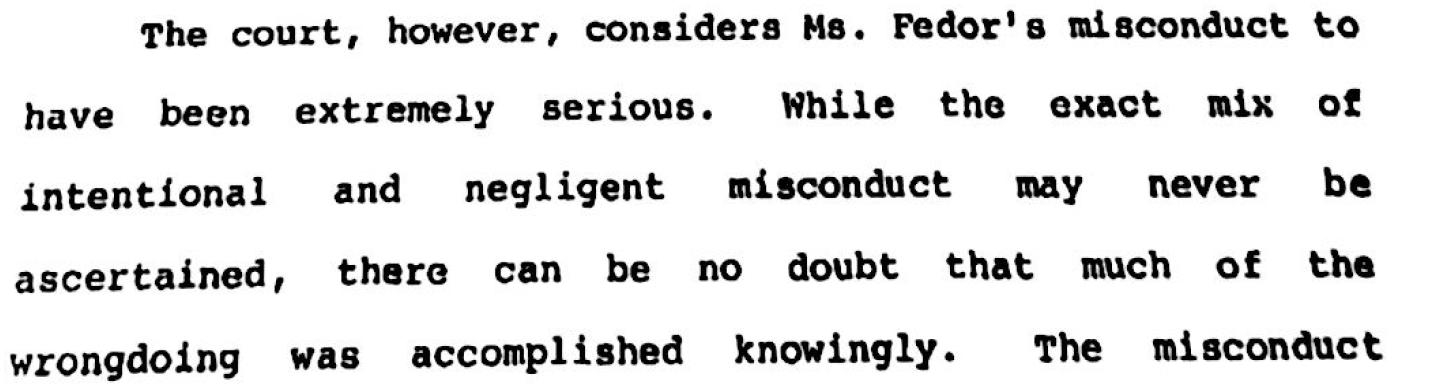
Ms. Bachman was a practicing prosecutor for the District Attorney in Anchorage. In the spring of 1990, Judge Joan Katz had the following to say about Ms. Bachman (The Ms. Fedor) and her work.

“While the exact mix of intentional negligence and negligent misconduct may never be ascertained, there can be no doubt that much of the wrongdoing was accomplished knowingly.”

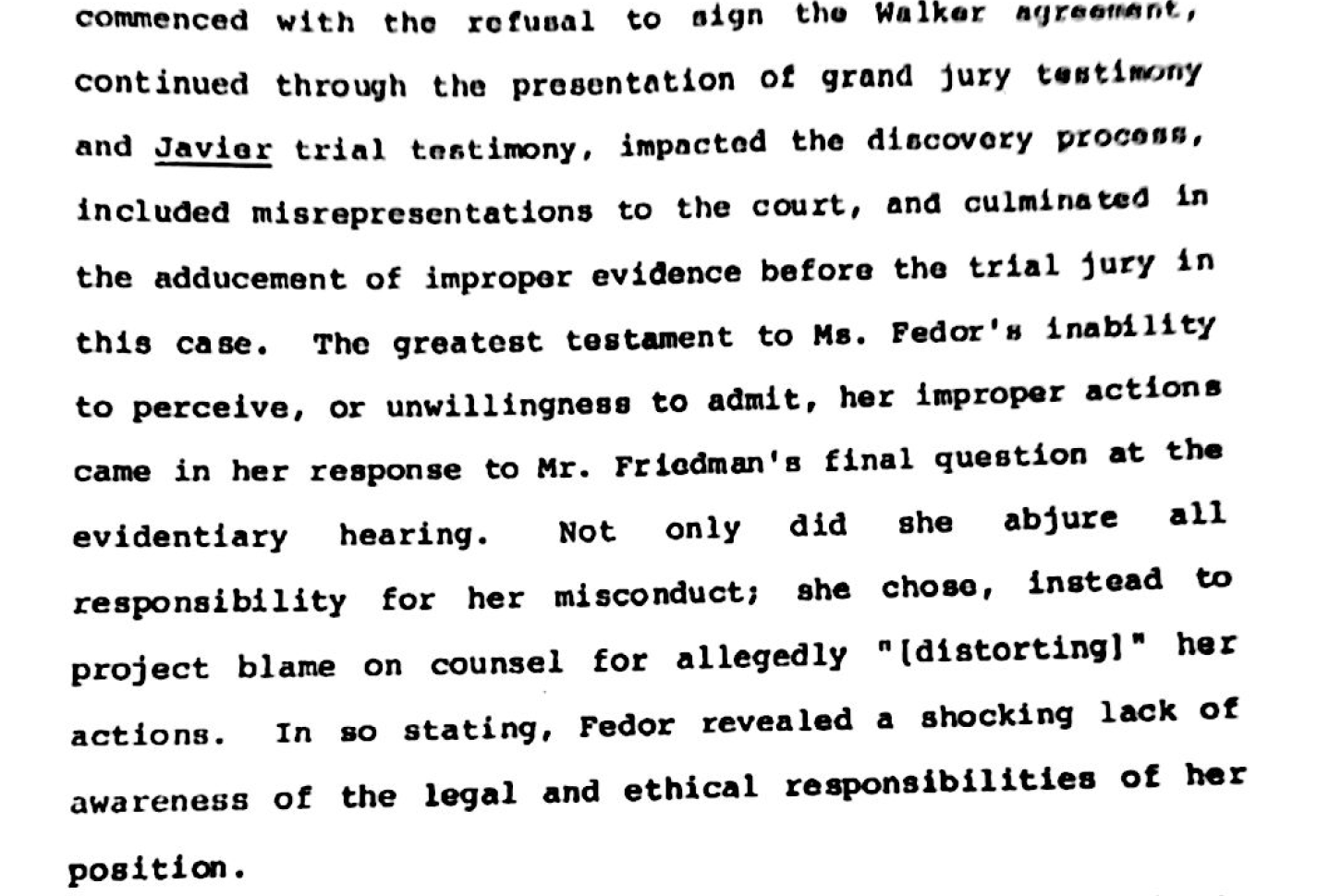
“She revealed a shocking lack of awareness of the legal and ethical responsibilities of her position.”

The judge’s commentary can be read in greater length below:

Bachman1

Bachman2

One can deduce from the document that Ms. Bachman knowingly engaged in misconduct which carried on through an entire legal process and resulted in false information being presented to a jury at trial. Then, when opposing counsel called her on it, she denied it, blamed it on them, and showed such a lack of awareness of her wrongdoing that the presiding judge called it “shocking.” Following this episode, Bachman was of course promoted and made her way steadily up the ladder within the District Attorney’s office in Alaska.

When the Alaska Innocence Project filed a petition for post conviction relief in September of 2013, the State of Alaska responded with this dismissive press release, at once promising the public an independent investigation and exposing the depth of their bias. The State then came under significant and immediate pressure from citizens, religious leaders, and politicians to act swiftly in the interest of justice. Senators Murkowski and Begich published open letters calling for a transparent and independent review of the revelations in the filing and pondering federal intervention. Letters to the editor flooded local publications across the state. The Alaska Federation of Natives, Tanana Chiefs Conference, scores of other Native organizations, and the Episcopal diocese all took public positions supporting the claim of innocence and demanding an actual investigation.

The State of Alaska ultimately responded to this outcry by assigning Adrienne Bachman to the case. Bachman is known as an aggressive criminal prosecutor – a conviction-at-all-costs attorney. There is no doubt she is both skilled and practiced at achieving and upholding criminal convictions. However, there is no indication that she is the right candidate for a thoughtful and unbiased examination of a civil petition for post conviction relief. The act of  choosing Bachman to head the State’s response on the Fairbanks Four case shows a shocking lack of awareness of the legal and ethical responsibilities the state has as an agent of justice. The apple, as they say, does not fall far from the tree.

To assign an aggressive prosecutor to a case where the convictions are in question and an independent review has been promised speaks volumes to the state’s intention with the case. To assign a prosecutor with a significant history of perjury and misconduct to an extremely public case so haunted by accusations of prosecutorial and police misconduct is…..confusing. Does the state not have access to a prosecutor who hasn’t engaged in misconduct? Is this the ultimate figurative middle finger to the petitioners, their attorneys, and every Alaskan whether a leader or citizen who asked for actual justice? They are attorneys, so they know to maybe be worried about getting sued later, right? Is this a joke? Like, a really inappropriate and poorly done joke? It defies explanation.

It would be wonderful to address the conduct of the special prosecutor as it relates to this case and assure readers that her “shocking” conduct is a thing of the past. However, this case began with Ms. Bachman’s request for a delay to accommodate, among other things, her vacation. That was followed by this fascinating interview with Indian country in which Ms. Bachman managed to tell enough lies that a post detailing them was longer than the interview. Then, there was this NPR interview where she boldly insisted that comparing Natives to unruly slaves lying ala Spartacus was not racist at all, following in the steps of original prosecutor Jeff O’Bryant (read about his controversial ‘Spartacus’ argument HERE),there was this insane attack on Scott Davison for having the gall to come forward without a bribe, the revelation that a murder confession was known and covered up in the case, and a virtually unending onslaught of offensive and dishonest statements, a fan favorite being when she made a filing attacking the credibility of William Holmes, AFTER she had administered and he had passed a lie detector test.

The counter-argument that some within the profession of law, particularly prosecutors, would supply to defend Ms. Bachman’s actions is that her actions fall within standard practice for prosecutors, or that she is ‘only doing her job.’ Although we can appreciate that people who do these kinds of things may need to tell themselves these bedtime stories to fall asleep at night, these excuses hardly make the choices acceptable.

Doing the wrong thing because other people do the wrong thing does not make it okay – it makes it a conspiracy. Doing the wrong thing for money is just gross. Do we really need to explain why receiving a paycheck for doing something wrong is probably even worse, but at best just as wrong, as doing it for free? The greatest travesties of humanity have been carried out by people who used the same excuses. Nazi soldiers did things like install new piping to gas chambers so as to more effectively murder thousands of innocent people, chatted over coffee while their victims clawed the  metal walls and begged for mercy, yanked screaming children from their mothers, and went home at night and told themselves, ‘everyone is doing this.” When the war was over and they were taken to trial in Nuremberg to explain how they perpetrated such atrocities, they all used the same defense so consistently that it has come to be known as the “Nuremberg defense.” The premise of this defense is “Befehl ist Befehl,” or “I was only following orders.”

It is hard to say whether the State of Alaska selected Bachman because they felt she was the woman for the job (the job, of course, being holding faith in these convicitons into delusional territory and without regard for actual justice), or if they just chose to throw her under the bus by handing her someone else’s impossible mess to clean up while those with meaningful power hid from the ramifications of this failing case. Either way, their selection of Ms. Bachman and her ensuing conduct since have made it entirely clear that the State is not interested in justice, honesty, or transparency. Some day, when this verdict is clear and this case takes its rightful place as an important moment in the civil rights movement of Alaska, this story will be told in its entirety for posterity. History will remember, and it will all be made clear. Until then, we can only hope the best for all, and that everyone involved will make choices they can be proud of later, because someday these choices will be examined by history and aired in a court higher than the one of man.

.

What IS Kevin Pease? Ethnicity vs. Culture in the Fairbanks Four Case

KevinMompicSince the beginning of this case there has been a tremendous emphasis on race as it pertained to the crime itself and its potential impact on motive. We have caught plenty of heat for not shying away from discussing that, but is worth mentioning that we didn’t bring that emphasis here we simply exposed the opposing vantage point on it. The first articles in this case and nearly every one written since identifies the races of those accused very specifically.

Kevin is fair-haired and blue-eyed. His family has Crow in its ancestry, but it is not his dominant ethnicity, and at the end of the day Kevin would easily and always be identified by appearance and ethnicity as white. Reporters have expressed ongoing confusion as to Kevin’s ethnicity, and one reporter recently asked, “What is Kevin? Some articles call him white, some American Indian, but all of my interviews with the supporters would lead you to believe his is Athabascan.”

It is an interesting element of the case and one to which Eugene and some supporters have spoken directly. Ethnicity and culture impacted this case from many angles. Although this is not the most pressing or urgent issue in this case, it is thought-provoking and deserves to be addressed. This post contains their well articulated thoughts on the topic.

“I don’t like this idea that  outsiders get to define who we are for us. That’s up to us. It’s like Kevin isn’t Native enough for the newspapers, but he’s Native enough for the Natives, and he’s enough of an Indian to be stuck in here with us, right? Blood quantum and all, I think that’s just a way to control people. Tell them who they are. Our words in almost any tribe for ourselves in our languages mean, the people. It doesn’t mean, the people who BIA says are of the people. It means, the people who are of, basically, each other. Us. Kevin was raised with us, around us, he’s one of us, he just is. He’s as Athabascan as anyone can be right that word just means “us”, and I don’t like reading different in the paper. Like why do they want to always make that a big point. And I don’t care they call him white there’s nothing wrong with it not like its offensive  I just care they always want to make it like, he’s different. They don’t get it. But it’s always kinda like bugged me.” – Eugene

“The idea of adoption, in Athabascan culture, is an old concept. A lot of people were adopted in. The historical and cultural fact is that Athabascans never defined themselves in the way of birth order or pedigree. That is the white man’s way of thinking. It was never ours. Our generation isn’t seeing this some new way, we are seeing it the old way.” – Ricko DeWilde

“There is a critical and misunderstood difference between ethnicity and culture. Kevin’s ethnicity and his cultural identity may be different. His perception of his place in a community or culture versus the perception of the community’s view of him may differ as well. As in, Kevin may not see himself as culturally Athabascan while the Koyukon Athabascan community may see him as a member. To Kevin specifically he grew up with Athabascans through a series of events which he did not control as a young person which is not much different than a birthright. We are born into cultural identity in the sense that we are born into a specific culture. For many and most people this may align with their ethnic makeup and for some it does not. Through experience and sustained contact he was raised culturally Athabascan. Kevin does not look at a Native person and see a ‘Native.’ Kevin sees a person and often a person he knows through a relational concept of identity (again a concept which he was exposed to culturally). This is a tricky concept to articulate but I hope at least some blog readers can and will follow.

Fundamentally, Kevin is a cultural Alaska Native. At least, that is my perception of Kevin and I know it is widely shared in the Interior Native culture of Fairbanks in particular. Kevin for example is far more culturally Athabascan than an ethnic Athabascan who was raised by Swiss Italian American parents in New Jersey and never exposed to our way of life. That person is ethnically Alaska Native and culturally not. Those adopted in are more culturally a part of a society than those adopted out.

I want to find a way to make the frustration when it comes up over and over in newspapers that identify him as white or outside Indian understandable to any random reader. When, while that may be true from a genetic or ethnic perspective, it is dismissive to us as a culture to instruct who we can consider part of our people, and further dismissive of our individual value as just human beings. The emphasis on race in these publications does not have the goal of identification although that may be the stated goal or the only motivation consciously known to the author, the categorization on this level has to do with othering the subjects. The ‘othering’ of Kevin in the beginning of this case was important. The media and community were hung up on this notion of the players. They couldn’t make a sound case for the guilt of innocent men in a crime so they had to attack their essence as a way to attack their credibility based on the social psychological perception of the situation. They placed them into roles that met the social normative and were therefore more readily accepted. They made these human individuals into archetypes – Eugene the stupid savage, Marvin the savage nature, underscoring the notion that even cloaked in apparent assimilation (valedictorian, etc) there is a savage nature; a difference which is past skin deep, George as the wild savage, and Kevin was the disturbed race traitor who associated with them.  Then there did not have to be actual motivation the public would accept the motivation was simply their nature, so different from the reader. In reality these identities were a construct which had almost nothing in common with who these people were as individuals and was only an articulation of  racial archetypes.

An attack on the identity of a cultural group weakens the position of the group. It is psychological genocide, it’s a way of eliminating a culture to take away the group’s own right to define themselves. Kevin likely views himself from many angles and in many ways, and probably has a cultural identity that is dynamic and made up of all of these roles and experiences. But from my perspective, and I know from the perspective of many within the Athabascan culture, Kevin is a member of our community and culture. He understands the traditions, the nuances of the language, the social strata, the modern history, the interconnection, he just is one of us as a people, as a specific group of people in the world. And being allowed to define yourselves does not in any way take from a person or group’s right to discuss discrimination. Quite the opposite because in fact these parameters put on a group from without are their own form of discrimination, and a under-discussed racial microaggression.” – Misty Nickoli

Big Bad Wolf IV – Who Killed Mohogany Davis?

Mahogany DavisWho would still be alive today if the right men had been arrested and convicted for the killing of John Hartman?

Often discussed in the realm of the innocence movement are the consequences of wrongful conviction on those who are wrongfully convicted. The pain and suffering, the damage to the justice system, the social ramifications for a false sense of justice, the difficulty of rebuilding a life after years of imprisonment – these are topics that the innocence movement gives great consideration. Less discussed is the effect it has to leave the guilty on the streets. As this case has progressed we have become more and more aware of that impact, and as the Fairbanks Four approach a trial date we want to recount as many of the damages as we can. The Fairbanks Four have lost pieces of their lives, years. But they have not lost all. Some have.

Three of the five suspects now believed to have killed John Hartman are currently serving long sentences for other murders. The other two have long criminal records for drugs and violence but remain on the streets. John Hartman was the first person they killed, but within five years the body count of their known victims had risen to five. Five murders which could not have happened if these men were arrested and convicted on the timeline that the Fairbanks Four were instead arrested and convicted of the crime. Teaka Bacote, Hakeem Bryant, Christopher Martin, Victor Torres, and Julie Ann Wilde would be alive today if the right people were arrested in October of 1997.

In addition to the known victims, there is the concerning list of the missing which surround these perpetrators. One crime to which they had distressing and memorable proximity is the killing of Mahogany Davis.

Mogohany Davis was a 21-year old mother of three, including a three-week old, when she ran bleeding and barely dressed into the parking lot of the Little Dipper apartments. She collapsed onto the pavement and a neighbor called 911. The call came in at 4:13am on May 11, 2002. Mahogany lived nearly two hours past the 911 call, and Fairbanks Police officer Jim Geier, who was instrumental in the Fairbanks Four arrest and convictions, was able to speak to Mahogany before she passed. An excerpt from a May 13, 2002 Juneau Empire article confirms that Mahogany did speak.

Sgt. Jim Geier said officers were able to talk to Davis before she died at Fairbanks Memorial Hospital about 90 minutes later.

“We did have the opportunity to obtain information from the victim,” Geier said. “We also obtained some information from witnesses and are pursuing leads.”

If Mahogany, barely clinging to life, was able to speak, what did she say? What would you say? Those unknown words have long unsettled her family, who believe she would have used her last moments on this earth to reveal the identity and motivation of her killer in an effort to protect her children as a final act. They are haunted by a troubling and lingering question – if one of the lead detectives on the Hartman crime heard deathbed revelations that named alternative suspects in the Hartman killing, would that story have died with Mahogany? If there were reputations at stake, would this young mother’s case be allowed to fall cold? It is a weighty accusation, and one that cannot truly be known. But what she said and why it did not lead to her homicide being solved weighs heavily on her surviving family. It is only know that she spoke, but because her murder investigation remains open, the contents of the file are confidential, and her family knows little more today than they did in the days after her death.

According to Davis’ mother, Rhonda Davis, the crime scene was horrific. The apartment opened to a short hallways that was splattered and smeared with blood.

Jason Wallace, 2004

Jason Wallace, 2004

The family believes Mahogany Davis was killed by someone she knew since there was no sign of forced entry. Mahogany was attacked in front of her three sons, aged 4 years, 20 months, and 3 weeks at the time of her murder. Mahogany’s youngest son was fathered by William Z. Holmes and she was a close associate of Jason Wallace. According to Mahogany’s mother, the oldest of the children described the assailant as a yellow-skinned black man. They also said her wounds were stabs, but did not appear to be from a knife. Wallace was arrested later in 2002 for attacking and killing a woman in her home with a hammer, and attacking and stabbing another man in his home with a screwdriver. They see parallels between these non-knife stabbing murders and the death of Mahogany. Rhonda Davis points out that Jason Wallace, longtime Holmes associate and convicted killer, has a “yellow complexion.”

Mahogany had a long relationship with William Holmes, was his ex girlfriend, and mother to his son. Her family believes Mahogany was killed by William Holmes or his associate Jason Wallace because she had information about them – either about upcoming large drug deals or their involvement with John Hartman’s murder, or any other incriminating information.

Today, Mahogany’s case is cold. No suspects were ever arrested, and if William Holmes or Jason Wallace were ever investigated, the Davis family was never informed. Local station KTVF 11 reporter Stephanie Woodard ran series on the Mahogany Davis killing called “A Look Into the Cold Case Murder of Mahogany Davis,” which we have linked to below.

Mahogany’s family yearns for justice and as much closure as that can bring. Please hold them and the families of other victims in prayer, because the wrongfully convicted may come home someday, but the victims of the wrongfully free will never return. They have paid a terrible price at the hands of wrongful conviction. In this regard the Fairbanks Four and their families are blessed, although their suffering has been significant and long, they woke up today with their lives, and although family may have to visit them through windows and in chains, they are still with us.

If any reader has tips about the murder of Mahogany Davis please do call Crime Stoppers at 907-450-6500.

Big Bad Wolf III – The Police Killing of Henry Kettendorf

badcop In 1994 the words “viral post” would have meant nothing. There was no status update, no like or share buttons, and to the common Interior resident, no internet. It was in this era that the Golden Heart City saw the height of city and police corruption and lived with violence against Native people by the police force as a social norm.

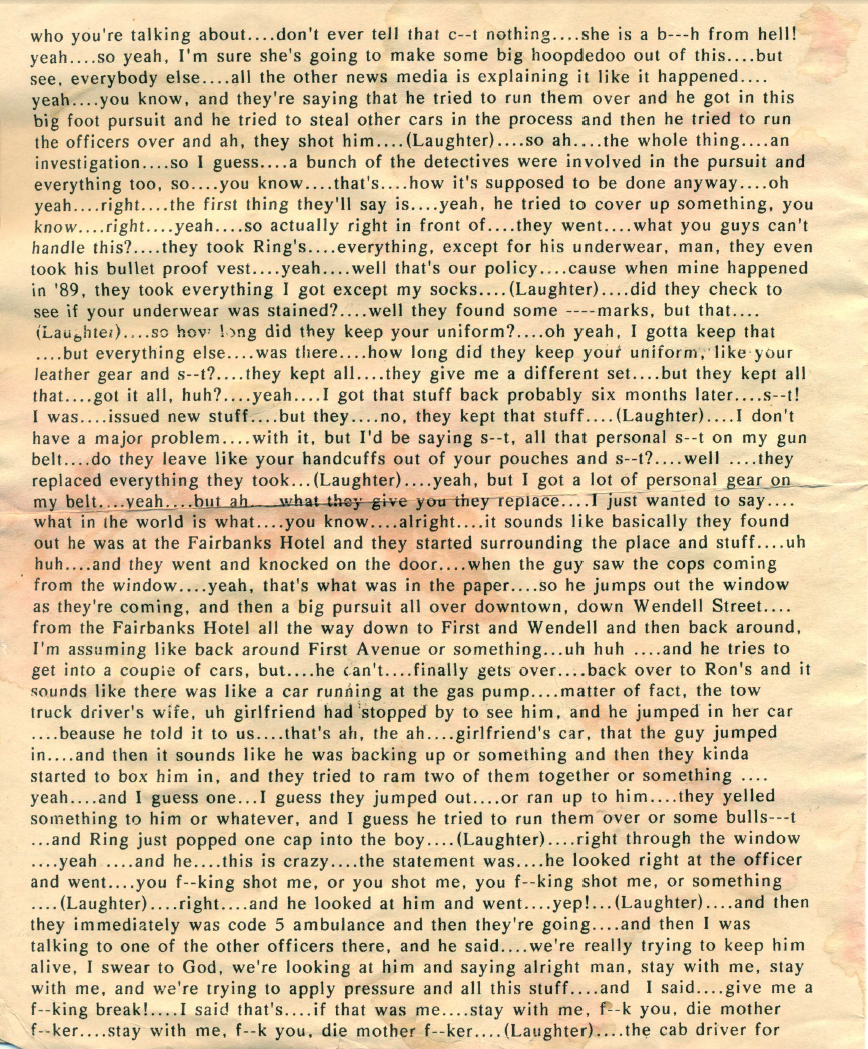
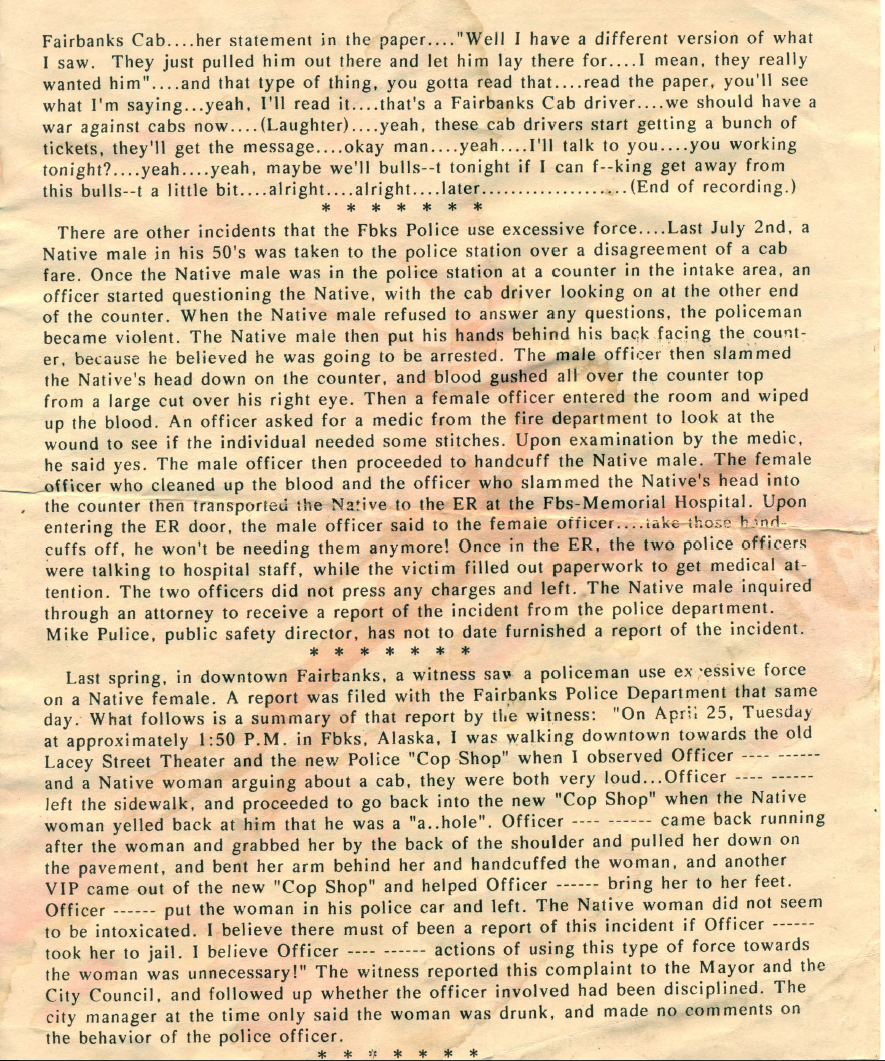
Activism and advocacy journalism in this time was not for the faint of heart. Gene George, then a resident of North Pole, Alaska, ran a small publication Athabascan Reports. He was known for reporting on controversial topics. Today we are posting Volume 5, Issue #1 of Athabascan Report titled “Fairbanks Cops Out of Control.” This issue contains a transcript of a conversation between two city police officers following the killing of Henry Kettendorf.

Kettendorf, a 32 year old Native male, was wanted on burglary charges out of Anchorage. He was unarmed and killed by a single shot through his heart fired by Officer Aaron Ring. Civilian witness accounts differed from the police report. Troopers investigated the shooting and concluded it was justified, although they also “declined to release their findings” according to a February 13, 1995 article in the Sitka Sentenial.

A coroner’s inquest was eventually held, and Officer Aaron Ring was represented by none other than former Fairbanks District Attorney Bill Murphy, who went on to represent Eugene Vent through a trial which ended in his wrongful conviction. If this constitutes a conflict of interest it was never disclosed. The death of Henry Kettendorf all but disappeared into obscurity after the coroner’s inquest found in favor of Officer Aaron Ring and FPD and has remained a topic of conversation largely through the efforts of a determined and controversial local activist.

Athabascan Reports published articles on this Kettendorf killing, but none were so controversial as the report below. In this issue, Gene George published the full transcript of a conversation between two FPD officers in which they berate the female reporter from the Daily Newsminer for publishing an unflattering article, calling her a cunt and bitch among other gender-specific slurs. They go on to make light of the shooting of Kettendorf, joking that they would not have tried to save him, but said “die, motherfucker” to him as he bled out. The two officers also discuss retaliation on the witness.

By this account, the last sight Henry Kettendorf saw while he was alive was Aaron Ring’s face, after Kettendorf cried out, “you shot me!” Officer Ring apparently answered, “Yep.” The men in the transcript think this is hilarious.

It is not fair nor logical for us to weigh in on whether the shooting of Kettendorf was justified. It appears that it was not – he was an unarmed man in a well-lit parking lot. But without complete information, which has proved difficult to find, we will withhold a conclusion. But the death of Henry Kettendorf certainly took place inside an unacceptable police culture. The fact that officers would speak about a person this way, talk of retaliation through inappropriate use of police power against witnesses, and that the climate in general was so destructive dispatchers felt the need to secretly record and expose officers, and that when they did, the tapes provided to the City Council and Mayor simply went missing, exposes a lot about the power structure in Fairbanks in the 1990’s. The events which led to the wrongful conviction of the Fairbanks Four took place on this same stage with all the same players. Rumor has it that shortly after this leak the dispatchers were fired and replace by the wives of Aaron Ring and Jim Geier.

Inside this climate people like Gene George reported these events when that was so much harder than it is today. We owe a debt to people like him.

Below, his work speaks for itself.

Athabascanreport1

Athabascanreport2

athabascanreport3

athabascanreport4

Big Bad Wolf II – Drug, Sex, Money, Guns, and a “Set Up” – Fairbanks Police Chief “Mafia” Mike Pulice

elephantsfight

There is a popular Swahili proverb “Wapiganapo tembo nyasi huumia.” 

Translated, it means, “When Elephants fight, it is the grass which suffers.”

It is a poignant reference to the structure of most societies. When kings fight, soldiers die. When the rich argue, the poor starve. Nearly all specific injustices take place inside a larger universal injustice. Every family who said heart-wrenching goodbyes today on the frontlines of wars did so inside the larger injustice of genocide, inside the even larger universal injustice of religious discrimination and hate as rhetoric for political gain. Which is to say, nothing happens in a vacuum, a specific injustice is always a symptom of a universal one, and this case is no different. Through discussion about the players and circumstances in the Fairbanks Four case we hope to shed some light on the bigger injustices.

By October of 1997 the Fairbanks Police Department Chief and his right-hand men were struggling to maintain control under the weight of a series of scandals that had rocked public faith in the system and had severe financial consequences. John Hartman’s murder was arguably the most notorious crimes ever committed in Fairbanks, and the public demand for swift justice was overwhelming. The men in power in the “golden heart city” simply could not afford another scandal.  It was in this climate that four young men were accused, arrested, and convicted of the murder of John Hartman.

All four men have maintained though nearly eighteen years of incarceration that they are innocent, and evidence mounts indicating that they are indeed innocent. The investigation and trials which led to their convictions are haunted by accusations of corruption and conspiracy, and as evidence exonerating the men continues to accumulate, so do accusations that their convictions are more than an unfortunate mistake. When considering the possibility of deliberate or negligent wrongful conviction, most citizens ponder motivation. It seems offensive to the concept of justice and even against personal interests of the players to wrongfully arrest or convict someone. But the state of the city of Fairbanks circa 1997 reveals a climate ripe for such a turn of events.

A critical and almost never mentioned player in the Fairbanks Four case is Mike Pulice. Pulice served as both the Fairbanks City manager and Police Chief for a number of years. Tracking down the exact positions and duties held by Pulice in October 1997 have proved difficult, but it appears he was still on payroll and may have been on leave. It is unlikely that he played an active role in the investigation, but he was highly involved in creating the climate in which it happened. If the series of events which took place following the Hartman murder were a play, Pulice would be the set designer. It was his stage on which these events played out.

The Pulice scandal is almost a parody of itself in its extravagant inclusion of the most cliché scandal elements – allegations involving sex, drugs, public corruption, money, conspiracy, and organized crime.

Mike Pulice – colloquially referred to as “Mafia Mike” by critics – was the man at the center of a controversy centered on money, drugs, and weapons that went missing from the Fairbanks Police evidence locker during his tenure.

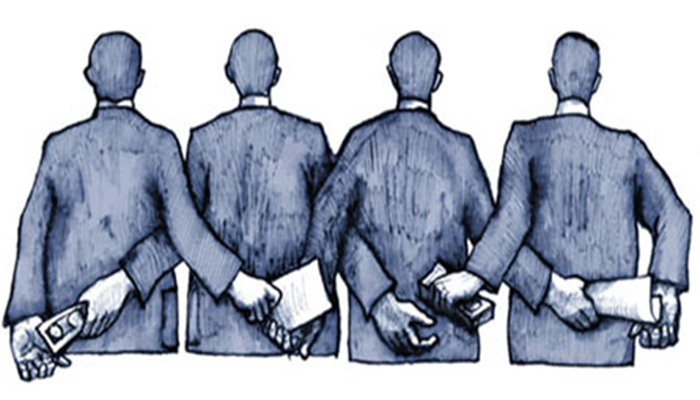
CorruptionAccording to court records, two firefighters employed under Pulice, Jimmy Rice and Lee DeSpain, came forward as whistleblowers in the evidence locker thefts and pointed fingers at Mike Pulice. They believed that Mr. Pulice was engaged in an extramarital affair with his employee, that he was running a criminal enterprise openly and preventing information leaks by threatening those in the know, and that he was responsible for the thefts. Mr. Pulice responded to this turn of events by threatening to have the men “set up” if they proceeded with their complaints. One such conversation occurred when Pulice called an attorney for one of the men. The two firefighters resigned from their positions, citing “intolerable” working conditions and fear of retaliation. A police officer who had spent some twenty years with Fairbanks Police testified that he cautioned the men to take the threats by Pulice seriously. What ensued was a long and drawn out litigation which the city ultimately lost, and an investigation into the corruption that went nowhere.

An AP article in the December 5, 1996 Sitka Sentinel made mention of the events and a dollar figure – “With the disappearance of $510,000 from a police evidence locker still a mystery; the Fairbanks City Council has agreed to conduct its own probe into the matter.”

Over half a million dollars in cash was missing, along with an untold amount of cocaine and guns. Hearsay accusations of a local gun dealer pulling up to the old “Main School” building, where evidence was housed, and departing with weapons abounded. In an executive session meeting of the city council, transcribed and published HERE, the city’s approach was clear – the sitting Mayor Jim Hayes (himself later arrested and imprisoned for fraud after stealing money from his own church) and other local leaders pontificated about how, despite not having read the 45-page investigation into the thefts, they felt certain that Mr. Pulice wouldn’t steal money. Mayor Hayes suggested Mr. Pulice step down from Chief of Police into a higher paid position as a high ranking officer, but Mr. Pulice declined, expressing that he was willing to take a “harsh” letter of remand and two weeks off.


By 1997, Rice and DeSpain had already filed a lawsuit and as the case progressed through the system it revealed more and more disturbing details about the inner-workings of the FPD and City of Fairbanks at the time. The accusations of financial mismanagement and corruption at both the FPD and City shook public faith tremendously, and also took a lite out of their respective budgets. When John Hartman was murdered, the community demanded swift justice, and demanded it inside a climate where distrust and anger toward the local powers were at an incredible high. The bottom line is that this was NOT a typical crime in a typical climate. This was a horrific crime at a time that the citizens of Fairbanks were already outraged. Careers and more were at stake, and decisions about what came next were made by people under the employ and influence of a man who is on record using wrongful conviction as a threat against a colleague. One can only imagine how little the lives of strangers, let alone children of a lower class, would have meant in this high stakes game.

We do not know if Pulice had any direct involvement in the Fairbanks Four case, and in fact there is no indication he did. However, the officers who ran the investigation were the same men that worked closely with Pulice for many years. Some were trained and promoted by him into the positions they held. They came up in a professional climate where the kind of behavior revealed in the DeSpain and Rice suit was normative, This case came into the scene of a terribly corrupt and messy police department right at the moment they most needed a victory. And it was, indeed, applauded as an incredible victory. Within a handful of months the Hartman case was cited directly when the FPD requested more funding.

Rice and DeSpain went on to be awarded $1.6 million in 2000 by the Alaska Supreme Court in their suit against the city and Mike Pulice, although both men allege that the damage to their lives was irreparable. Neither are employed as firefighters. Pulice slipped quietly into retirement, and no one was ever held accountable for the evidence locker thefts.

In 1997 the city of Fairbanks was being run by a man who ultimately served significant prison time for corruption and fraud, a police chief who cost the city 1.6 million after openly threatening whistleblowers who accused him of activities that if true and pursued criminally would spell out many felonies and a long prison sentence. The FPD was being lead by a man who threatened wrongful conviction as retaliation for exposing him. There should be no debate as to whether there existed sufficient motivation and moral capability to wrongfully convict the Fairbanks Four for the murder of John Hartman, it is clear that there was both.

When elephants fight, it is the grass that suffers. Yet, the grass remains.

Introducing The Big Bad Wolf I – Officer Clifford “Aaron” Ring

justicequoteThe decision to fight for the Fairbanks Four has not come without hardship. Many of us who chose to take a stand have, and will continue to, come under attack. One of the hardest things to do is speak out against people who we know are powerful, at least in the worldly sense. However, it is also one of the most important things we have done and will do. This is one of those difficult posts.

We are not fighting against an accident. We are not rallying against an injustice of coincidence. The Fairbanks Four were not the unfortunate four harmed by chance. They were the victims of deliberate actions taken by human beings. We do not believe that means they were forsaken by their maker or tossed aside. Instead, they came under the hardship they were born to bear, and we were given the responsibility of freeing them and exposing the anatomy of injustice in our hometown so that a greater good could come of it.

We have discussed some of the noteworthy corruption in a previous post HERE  and we do not plan to stop talking about corruption in this case until it is fully revealed, until those who committed the crime of deliberate injustice are exposed, and until amends are made to all who were hurt.

We will never be able to make a completely comprehensive post about the players in this case whose mistakes or deliberate actions led to this injustice. It is not possible to know the heart and mind, and therefore the intentions, of another human being. But we can tell you what we know and what we have been told about the men and women whose actions and choices paved the road to this injustice. It is not our wish to enact revenge on them. It is only our wish that the whole truth be known someday so that there may come a time when there is indeed justice for all.

We will post a series of pieces on individuals who played a critical role in the arrest, investigation, wrongful conviction, and illegal incarceration of the Fairbanks Four.

Clifford “Aaron” Ring

aaron ringIt seems fitting to make Aaron Ring first in the “Big Bad Wolf” recounting of the key players in the wrongful conviction of the Fairbanks Four. If this was a movie, he would be the bad guy. He was extremely active in the case, from the initial arrests to the court trials, and touched almost every aspect of the case.

George Frese, Marvin Roberts, Eugene Vent, and Kevin Pease have spent most of the last 18 years in 5X8 concrete prison cells, often for 23 of 24 hours in a day. For the duration of their time in prison, and indeed since their arrests, all four have procalimed their innocence in a case that has long been one of the most contested and controversial in Alaska’s history.

AaronRingsHouseBy contrast, Aaron Ring lives here. The only thing these accommodations have in common is, of course, that both are funded by the State of Alaska. The retired FPD officer lives in Florida now on a comfortable pension where apparently he can wake up every morning, put his shoes on one at a time, eat breakfast, and apparently go about life with no outward betrayal of regret, if it is there at all.

The goal of this case-specific wrongful conviction blog has been to tell a wrongful conviction story in great detail to create a broader awareness of the issue at large and this case. We have long implored the public to come forward with any information related to this case and enter a public dialogue. What we receive in response to that request perhaps more often than anything else is information on or complaints about Officer Aaron Ring. We have had multiple source accusations of race-based hate crimes by Aaron Ring as a juvenile and young adult at Lathrop High School, two accusations of sexual assault on an underage victim, one while a uniformed officer and one not. We have had many unsolicited reports by people who had contact with officer Aaron Ring as juveniles that they consider abusive. These range from actual assaults (being thrown on the ground, hit, tripped, knocked off a bicycle, slammed on a car door, etc.) to pseudo-assaults (being cuffed in the back of a police car while the breaks are repeatedly slammed), to psychologically abusive contact. Keep in mind, these accusers all have one thing in common –  they were CHILDREN when these events occurred.

This is not the first time that dozens upon dozens of alleged adult victims of child abuse have come forward to finger an individual who held a trusted position in the community. The Catholic Church had a whole scandal. Teachers, boy scout troop leaders, favorite coaches, priests, pastors…….this is recognizable territory. A scandal tends to deepen as more and more alleged victims surface with their claims. In general, mounting accusations are often perceived as confirmation that there is after all “something to it.” We have all seen that before, and on our side of the internet we are seeing it again here.

We are neither qualified nor prepared to evaluate or determine the veracity of these statements. But we want to acknowledge that they have been made.

What we can document and verify is the conduct and speech on record by Officer Aaron Ring as he investigated the Fairbanks Four case, and we have. These pages ultimately together just tell a story, and Aaron Ring is a character that appears over and over. Here are some of the more stand-out moments of his conduct.

  • Aaron Ring lied to the people being interviewed and threatened them. He made up evidence, told people that their friends or families had placed them there or told the officers they were lying, threatened people with jail or other harm if they failed to agree.
  • Aaron Ring, according to multiple witnesses, turned the tape recorders off and on during police interviews. Ring used the times the recorder was off, according to these witnesses, to threaten them more directly, provide more extreme false information, or reassure them that if they just said what he wanted them to say it would not be a big deal. Alaska law requires interrogations be taped in their entirety.
  • When George Frese said, “I want to go home,” Aaron Ring claimed he had said it alone in an empty room. Ring would have been obligated to stop the interrogation if George (which he indeed did) asked to go home.
  • When Eugene Vent, drunk and only seventeen, said “I want my mama,” Ring downplayed the statement and continued with the interview.
  • Played the major part in some of the most harrowing interviews in the case, including Shara David, Edgar Henry, Antonio Sisto, Eugene Vent, George Frese, Kevin Pease, Marvin Roberts, and conducted the first interview with Chris Stone, which is “missing,” and with EJ Stephens, likewise “missing.”
  • Aaron Ring made a damning and misleading exhibit with the help of prosecutor Jeff O’Bryant. This exhibit was called “totally unscientific” by the only expert who saw it in trial, but he was not called to testify. The exhibit was not to scale, and consisted of an overlay of George Frese’s boot print overtop of a photo of the victim. The size had been adjusted to create an appearance of a match. The lab logo was left on the boot print, creating the misleading impression that the exhibit had been created by scientists.

We must preface the following with a statement that we have no comment as to the veracity of the accusations made below. We have no idea if the accusations below are valid, but can only report that the following accusations have been made against Aaron Ring in statements to us by others.

  • A woman contacted us to tell us that she had known Aaron Ring as a young man, from adolescence to his late teens. She was substantially younger than him and claims he sexually assaulted her on multiple occasions.
  • Several individuals claiming to have known Ring in high school have contacted us to claim that Ring was widely known as a racist, and was extremely and overtly racist against Native students.
  • A woman contacted us to tell us her now-deceased daughter claimed to have been sexually assaulted by Aaron Ring as a teenager and while Aaron Ring was on duty as a police officer. According to this woman, Ring made contact with her teen daughter and picked her up for underage consumption of alcohol, but agreed to let her go in exchange for sex acts, and threatened her with severe legal consequences if she did not comply. Her story was apparently taken and preserved by a local journalist.
  • A man contacted us to tell us that as a young person he was arrested by Aaron Ring and was physically assaulted during the arrest. The man claims that while he was in the back of the squad car Mr. Ring repeatedly and deliberately slammed on the breaks to cause injury to the him.
  • More than a dozen individuals have contacted us to report that Aaron Ring used unnecessary force.
  • A Fairbanks resident alerted us to the existence of the Henry Kettendorf case – a young man named Henry Kettendorf was shot and killed by Aaron Ring in downtown Fairbanks. The case created some controversy at the time. An eyewitness to the shooting described it very differently than the officers at the scene. A transcript was later published by reporter Gene George of “The Athabascan Report,” in which officers can be heard mocking Kettendorf, his death, and threatening to conspire against the witness to the shooting. After years of searching for this particular edition of the publication and finding it was removed from nearly every library in the state, we finally procured a copy.

There was a time when we believed, or at least wanted to, that this was all one big mistake. But the more information that surfaces about the case, the more it seems that the wrongful conviction of the Fairbanks Four was not a mistake so much as an event on a timeline of terrible deeds committed against the young and vulnerable of Alaska for minimal personal gain. We can choose to believe, and for now we will, that the actions that harmed so many were not so much intentional as they were the byproduct of a kind of thinking so ingrained that it produced great harm. If someone as a young person believes an entire race to be animalistic or below them it is not hard to imagine that deep seeded thought growing into a tree of injustice as the person’s schemas hardened and their power grew. Whether a source is corrupted or bad is impossible to say, but there is wisdom in the verse that says “Ye shall know them by their fruit.”

To change the landscape of our community or country as it relates to biased thinking inside the justice system it is not enough to attack the tree or judge the fruits, we have to ensure that the seeds of racism and bias are not sown into the minds of the next generation and find a way to articulate their visibility in our current social structures. There comes a point where an individuals intentions in a series of actions do not matter nearly as much as the fact that they were capable. In other words –  maybe didn’t know better. And if that is the case perhaps the people most responsible for the damage he did are those who surrounded him, knew better, and stayed silent.

Many children were harmed in the making of this wrongful conviction. The players in this game who moved them like pawns failed to calculate the outcome now at hand – they didn’t crush ALL of those children. Some persevered. Some found self-worth against the odds. Some of those kids didn’t fall into addiction,early graves, fold into the small town inside a small town and disappear into the familiar. Some did not bow down under shame. Some of them grew up. And they remembered.

As for Aaron Ring, accountability is not ours to assign. As is often the case, there is probably not as much peace inside the beautiful Florida home as there appears to be from outside. All we can do is wish him well, hope that if he indeed struggles with the demon of pride or racism or rage that he wrestles it and prevails, and that if he is guilty of any actions that were illegal that the justice system may find him and treat him fairly. After all, our wish is the same for him as it is for you, or for the Fairbanks Four. Justice for all.

Race in the Case – The Hartman Murder was a Hate Crime

bookertwashingtonJohn Hartman was killed in the commission of a premeditated racial hate crime.

 “A hate crime is a traditional offense like murder, arson, or vandalism with an added element of bias. For the purposes of collecting statistics, Congress has defined a hate crime as a ‘criminal offense against a person or property motivated in whole or in part by an offender’s bias against a race, religion, disability, ethnic origin or sexual orientation.’” – F.B.I.

According to William Holmes who confessed in detail to his role in killing John Hartman, he and four friends went out onto the streets of Fairbanks the night they attacked Hartman to physically assault Native Alaskans.

Holmes and his fellow conspirators “decided to go downtown and have some fun.” Their idea of “fun”?

Harassing “drunk natives by throwing eggs at them, or 2 or 3 guys from the car would jump out with the driver still in the running car and punch them. We’d laugh at them falling or a cigarette flying from their mouth upon impact. The thrill came from running away, speeding off and messing with these drunks barely able to walk.”

holmesletterOn the night that they killed John Hartman, Holmes describes patrolling downtown looking for Native victims. The group found at least one victim, but their attack was thwarted when others appeared on the scene. When they were unable to find the victim they were looking for – a vulnerable Native person walking alone – they decided to end their “fun.” Sadly, as they were driving out of the downtown area they spotted “a white boy” walking alone and decided he would have to do. The group fell on the young boy with no warning, knocked him to the ground, and kicked him into a coma that would prove fatal.

John Hartman was kicked and stomped to death with violence so callous it defies explanation. He was killed because five young men carried with them a racial hate so strong and dehumanizing that group beatings of vulnerable Natives was a form of recreation. John Hartman was killed by hate directed toward a race of people he did not belong to in life. But in death, he joined a long list of the persecuted. He is not the first boy to die at the hands of race-based violence, but he may be the only white child to die in the cross-hairs of racism against Alaska’s first people.

In the days after Hartman was killed, when his face and the faces of the young men wrongfully accused of his murder appeared on the front page of the local newspaper, someone bought that paper and brought it back to Midtown Apartments, where a group of people acquainted with the four accused gathered around to read in disbelief. An elderly woman looking over our shoulders said, “I bet they were looking for a Native boy, I wish they had found one.”

For the majority of Fairbanks residents the idea that a young person could be attacked at random and assaulted simply for walking alone was unfathomable. Yet, for another sector of the community, it was routine. The other side of the story in a community where violent beatings are a form of recreation, and a person’s ethnicity is what makes them a target, and in turn makes them invisible to the rest of the community, was that there was a legion of kids who were familiar with the attacks. Scores of boys who were on guard, who slipped into the bushes when a car approached, who ran like hell when they heard the sound of tires slowing down behind them because those kids knew it was the cops or the people who jumped Natives, and that both were dangerous. Kids who curled into a ball and protected their heads if they didn’t run fast enough. If they had found the victim they meant to find, maybe no one would have died.

Eugene. Eugene was walking alone that night. They wanted Eugene, but the timing was off.

George. George walked downtown the very same evening, and George was exactly who they were looking for.

Pick a name off the witness list. Pull a name from the wedding guest book. Nearly every person whose life would intersect with the wrongful arrest, trials, conviction, and decades long fight to overturn it was guilty of the crime of being Native that night, and it was hate directed at them that motivated the men who killed John Hartman. It was that same hate, woven into the fabric of the community and its institutions, which allowed for the immediate arrest and wrongful conviction of people who were guilty of nothing besides being Native.

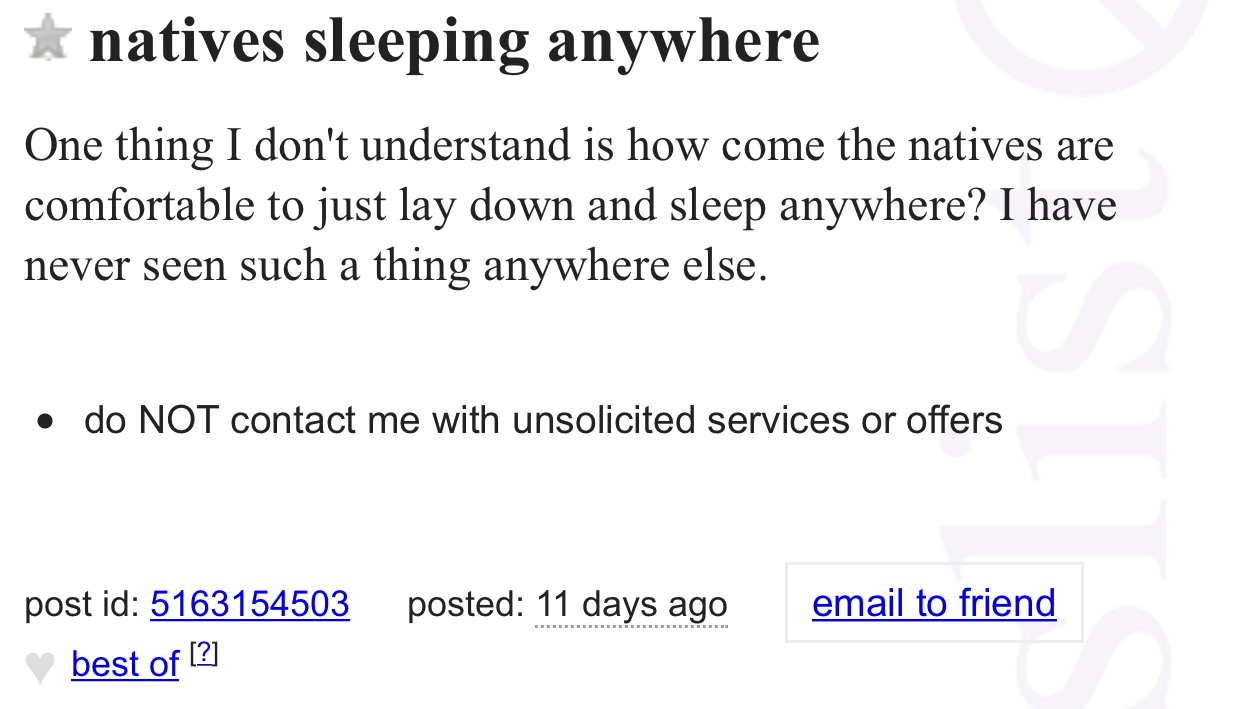
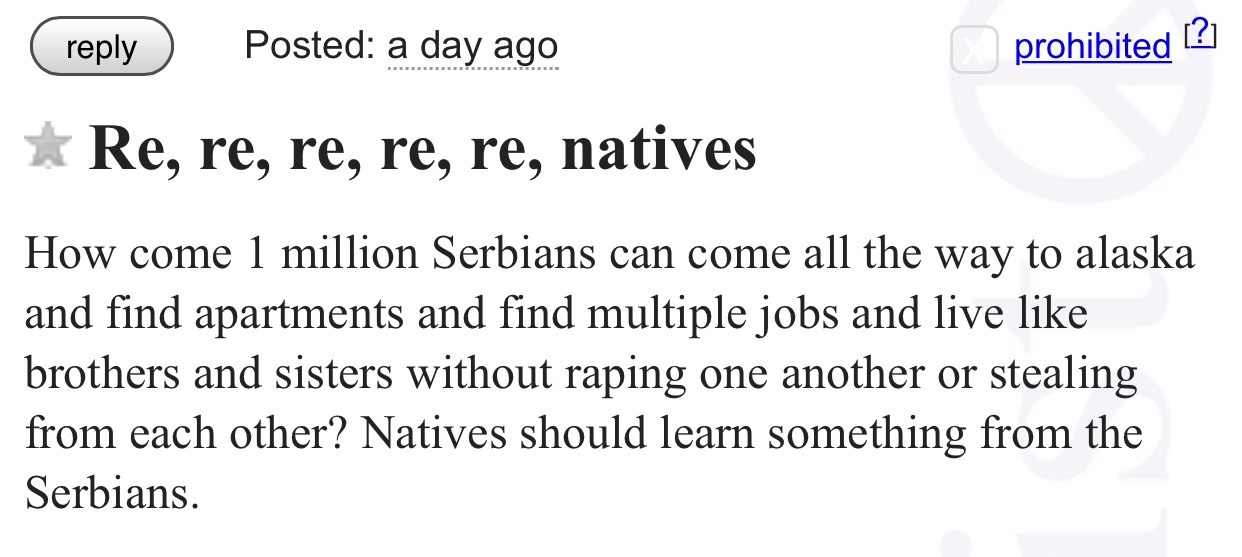
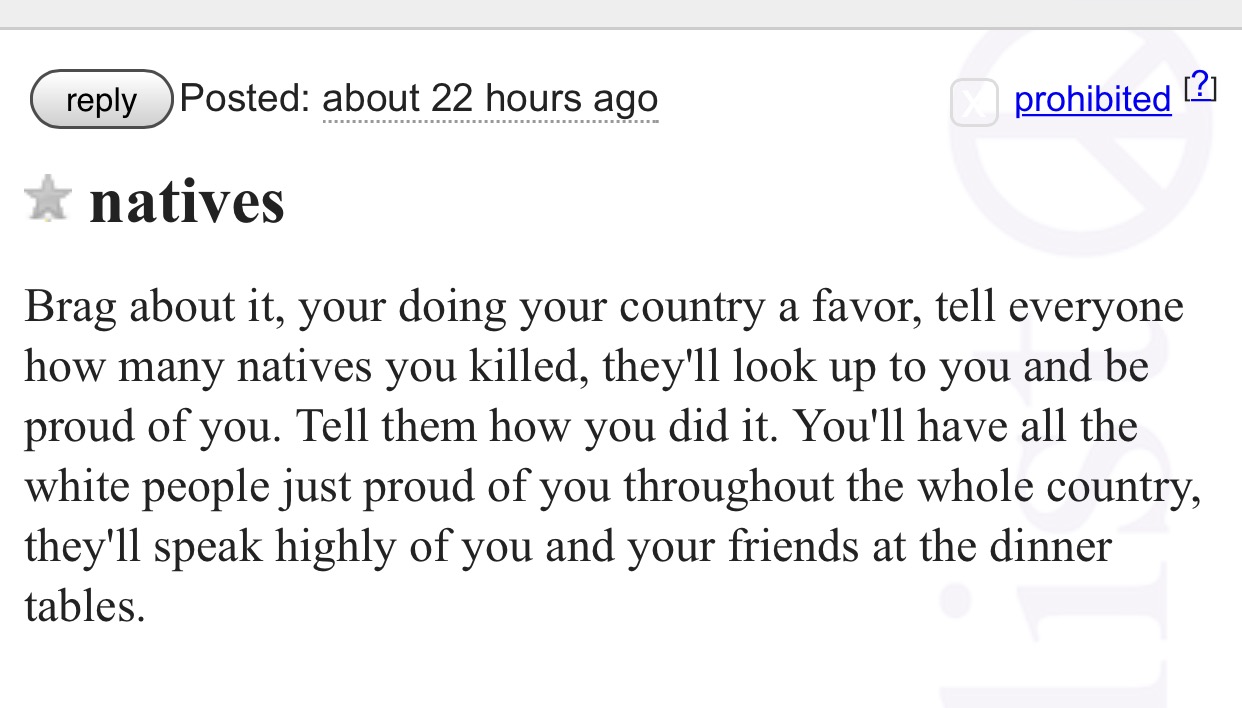
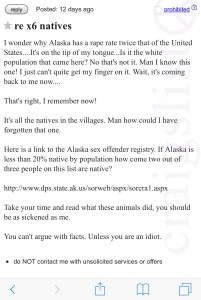
This hate is alive and well, virtually unchanged since 1997. Ask any Native man if they have been physically attacked in the streets of Fairbanks at random, and you will hear the stories. Read the crime statistics, sexual assault statistics, human rights reports. Read. Open your eyes, look. Open any Alaskan Craigslist and word search the term “Natives,” and you will read the thoughts of the community members who carry this hate. The posts below are chosen at random, and simply some of the most recent posts on the topic in the local Craigslist. We include them simply as a reminder that this hate remains, and offer it as “proof” of racism to those readers who believe that racism does not exist, or that conversations about race undermine the credibility of our cause. We are not playing the race card. We are playing the had we were dealt.

CL1

CL2

CL3

CL7

The newspapers continue to describe the assault as random, when in reality the assault that killed John Hartman was premeditated, and the motivation was racial hate. The fact that he was walking at that moment, at that intersection, that the men responsible had not been able to find their ideal victim, that the assault proved fatal – perhaps all of that can be considered the product of coincidence. But his murder was not random violence – it was very specific and intentional violence.

The two most common pieces of advice we receive in writing this blog are to avoid writing about race or John Hartman, because it makes people uncomfortable. But we are not here to make anyone comfortable, we are here to tell the truth. And the truth is, race was a huge factor in this case.CL6

Racial hate motivated the crime, it motivated the wrongful arrest and conviction of innocent young men, and it was the overtly stated factor used to dismiss the testimony of many witnesses.

John Hartman deserves justice. He was killed in hate and denied justice in hate, and that is not an acceptable legacy for a loved and innocent child. Nearly every person who speaks of this young man in life emphasizes his kindness and open-mindedness. He deserves better than this. His family deserves the truth. The community that rallied around his memory and his family to demand justice deserve the truth.

The answer to hate is not silence. The answer to hate is not fear. The answer to hate is not regret, grief, shame, and it certainly is not hate. The only counter to hate is love. So with love, we think it is time to start an honest conversation about race in this case, race in our community, and what we can do to change the future for the better.

Readers, we want to hear what you have to say. Leave a comment, tell your story, share your thoughts.

We heard the advice loud and clear to stay away from the topic of race so that people feel comfortable, and it reminded us how very important it is to make people uncomfortable. This post will mark the first in a series about race in this case, because if we can’t even say the words, we will never be able to change the story. We welcome contributors.