Day 16 – State of Alaska Calls Margaretta Hoffman, Others

Day 16, October 27 2015

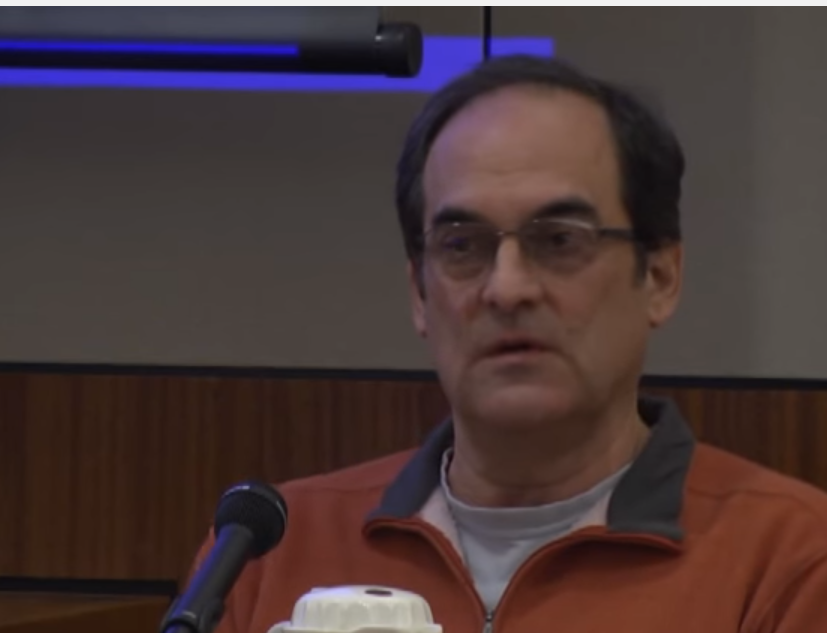
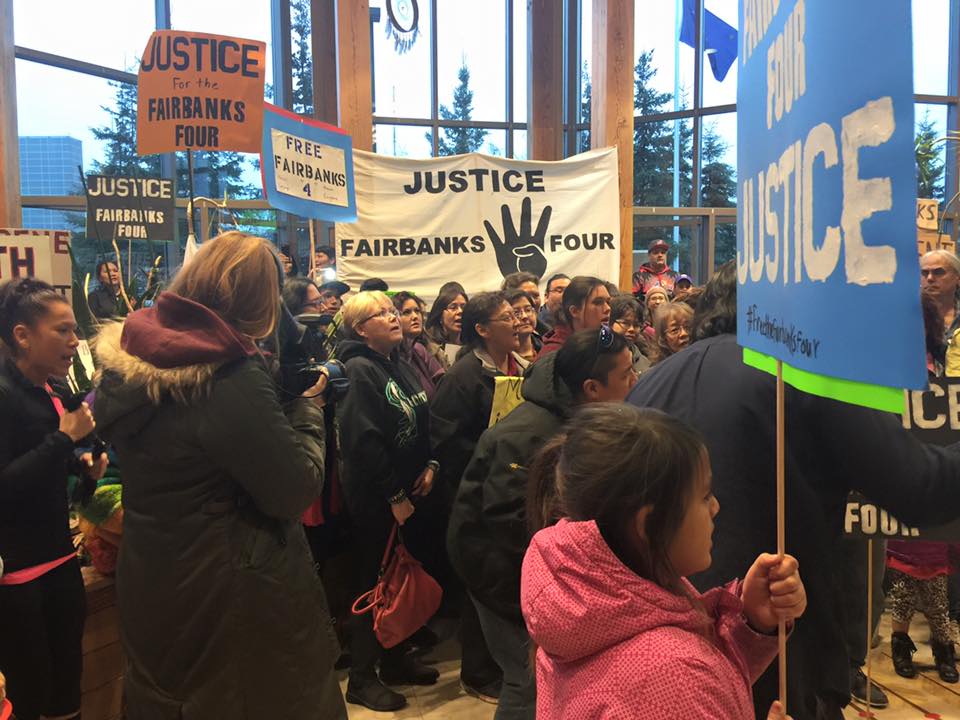
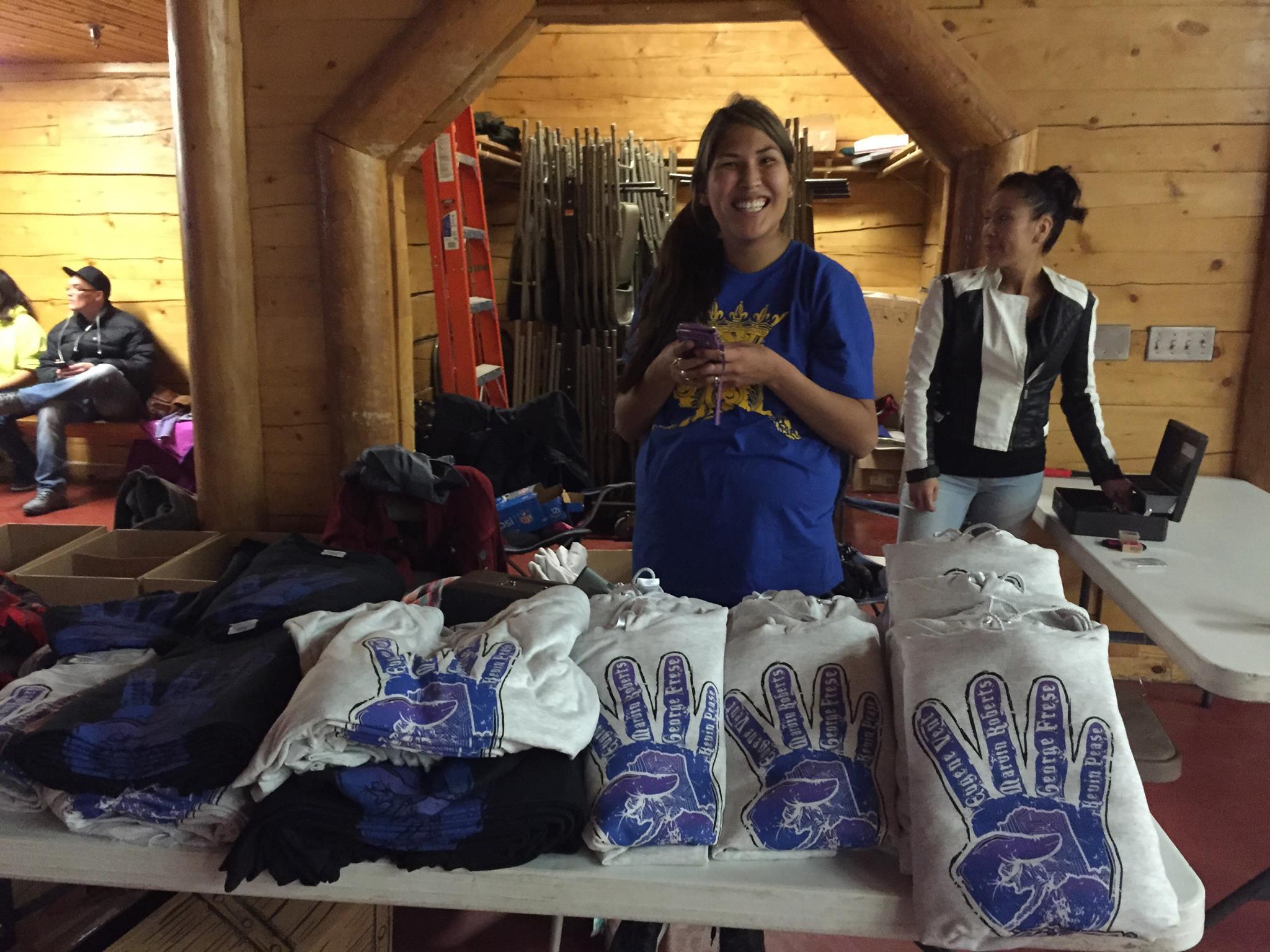
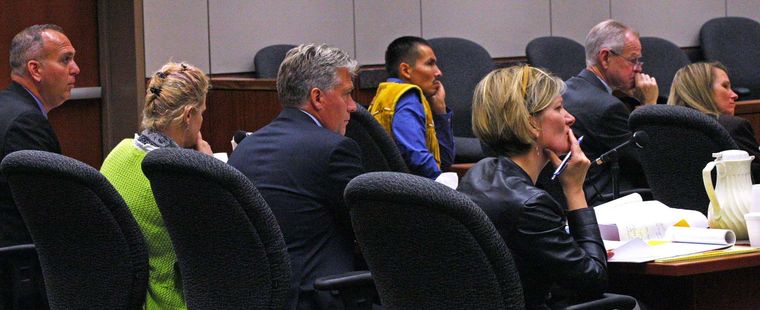
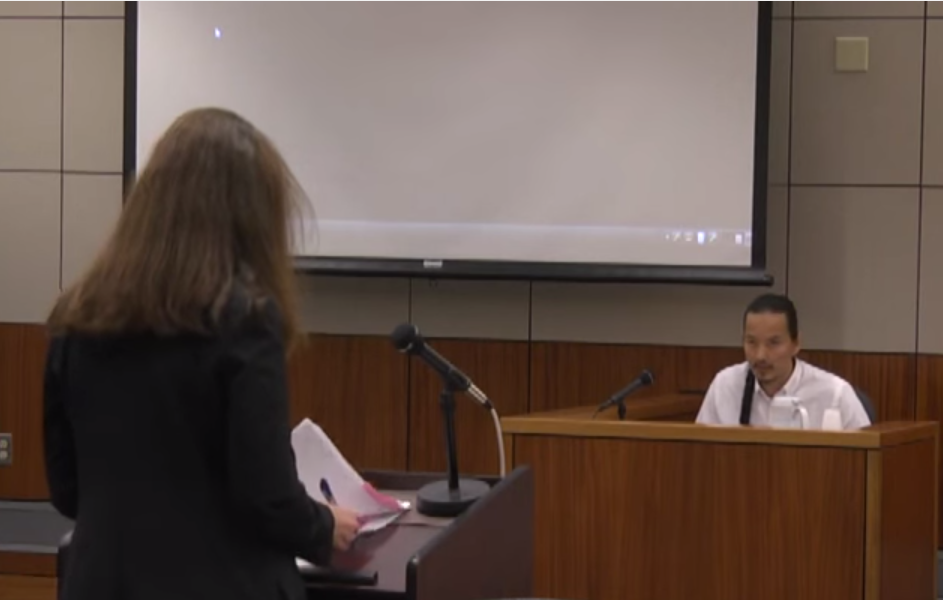
collage2The third day of the State of Alaska’s case against the exoneration of the Fairbanks Four featured the completion of the videotaped Veronica Solomon testimony, Margaretta Hoffman, Jason Wallace’s wife Michone Wallace, Harold Lundeen, and Brent Ledford. The testimony generally brief. The only witnesses thus far who have incriminated the Fairbanks Four – Veronica Solomon and Margaretta Hoffman – did not testify in person and were therefore not available for potentially impeaching cross-examination on the stand.

The remaining half of Veronica Solomon was played, during which Solomon contradicted much of her earlier testimony, acknowledged that she had no information regarding the guilt or innocence of the Fairbanks Four, but insisted, “I saw something, and that something meant something.” Solomon acknowledged a summary of what she saw was a tan four-door car at the corner of 9th or 10th and Barnette on a day she thought could be October 11, 1997. Precisely what Solomon saw was difficult to discern, and discussed in detail in our previous post.

The State of Alaska has sought throughout the proceedings to undermine the credibility of the Holmes and Wallace confessions by arguing that the fact that they did not confess during other specific windows of opportunity somehow casts doubt on the current confessions. Wallace, Lundeen, and Ledford, appear to have been called simply to say that Holmes and Wallace had not confessed to them.

Jason Wallace’s wife testified that Wallace never mentioned killing John Hartman. She further testified that neither Jason Wallace nor William Holmes ever divulged their longstanding plans to commit the murders that ultimately landed them in jail. If the goal of the testimony was to establish probable innocence based on Jason Wallace not confessing to some people closer in his life than the friend, attorney, and public defender’s investigator he did confess to, it certainly fell short. Michone Wallace’s testimony only established the men in fact have a history of committing murders without discussing it with many people.

Harold Lundeen testified that he saw Scott Wallace and Davison enter the car named in the Davison testimony. It was inside that car, Davison previously testified, that Wallace confessed to killing John Hartman. However, it was clear that the State did not call Lundeen for the corroboration, but to demonstrate another person they believe Wallace would have told. Lundeen testified that he also didn’t have any knowledge of the his high school friend, Jason Wallace’s, involvement in the Hartman murder. In what earlier witness Scott Davison claimed was simply a typo, “Holmes” was referred to as “Harold” in the account of a confession Davison heard from Jason Wallace in 1997. Harold Lundeen, who knew Holmes, Wallace, and Davis in high school, simply testified that he did not know anything of significance.

Retired California Shasta County district attorney who prosecuted William Holmes in the murders and conspiracy that sent him to prison, Brent Ledford, provided conjecture and essentially a cost-benefit analysis on whether or not William Holmes should have disclosed the Hartman killing and turned informant on Jason Wallace at the time Holmes was arrested in 2002.  He described how it may or may not have been advantageous for Holmes to confess to the Hartman killing and implicated Wallace. Mr. Ledford ultimately implied it would not have proved advantageous Holmes to confess at that time. In his testimony, Holmes simply said he did not believe that confessing to another murder would be of any benefit to him while being prosecuted for another murder.

devildealWhen Mr. Ledford was asked about negotiating leniency for Jason Wallace in exchange for his testimony against Holmes he stated, “Sometimes we have to make a deal with the devil,” referencing Wallace.

Ledford’s also testified that from 2002-2006, a time period during which he worked on prosecuting William Holmes, no one to include public defender Jeff Wildridge and investigator Tom Bole, brought up allegations of Jason Wallace’s involvement in the beating death of John Hartman.  So far the “devil” has received leniency on murder, arson, and attempted murder charges from his 2002 arrest. He was most recently granted immunity in the beating death of John Hartman in exchange for his testimony for the State of Alaska.  The “devil” knows how to work the judicial system to his benefit – he’s only honest when he can benefit from doing so.

State prosecutor Bachman  built on her consistent assertion that no one tells the truth without benefit to themselves.  Holmes did not receive any leniency or personal gain for telling the truth. Coming forward without incentive has consistently been cited by the state as a reason to doubt Holmes’ credibility.  Holmes testified earlier in the proceedings that the decision to come forward was about his own spiritual journey.

After a string of witnesses who were largely forgettable or did not testify to any substance, the most outrageous testimony of the day was given by Margareta Hoffman aka ‘Crystal’  – an ex-girlfriend of Kenny Mayo. Hoffman’s testimony contradicted all police interviews from the original investigation and previous trial testimony regarding the time or circumstances when Marvin Roberts returned to his home the night of the Hartman murder. The testimony of the occupants of the home and Marvin Roberts himself has consistently been that no one was awake when Roberts returned home. Kenny Mayo is Marvin Robert’s step father’s brother. Hoffman claimed that the night Hartman was killed she was at Marvin Robert’s home with her then-boyfriend and contrary to all previous testimony, that there was a wild party afoot at the home. Hoffman provided a hearsay account of a conversation allegedly had between Roberts and Mayo. Petitioners attorneys countered that Kenny Mayo, whom the state was reluctant to call, must be called and was expected to testify that none of the events described by Hoffman took place.

Hoffman has a long history of drug an alcohol abuse and a significant criminal record. She went by “Crystal,” a nod to her significant crystal meth use, for years. Hoffman testified that she did not come forward until 2013 after seeing coverage of the Fairbanks Four exoneration efforts on television.  She expressed extreme difficulty remembering even general times of significant events in her life stating, “I have a hard time remembering years.”  When asked how long she dated Mr. Mayo she replied, “Six to eight years, give or take a year.”  Mrs. Hoffman isn’t sure if she dated Mr. Mayo five to nine years, which exhibits the kind of extreme memory loss associated with heavy drug use. Yet, testimony that Hoffman could provide details of a specific date in 1997 were submitted by the state as reliable.

Mrs. Hoffman testified that on the night in question she was drinking alcohol and using cocaine at the home of Art and Hazel Mayo, whom she said she had only met a handful of times, while her boyfriend Kenny went out to a dance.  She testified that Kenny Mayo returned some time between 12-2am and that Marvin Roberts returned an hour or two after Kenny Mayo.  Hoffman’s testimony claims that Marvin Roberts returned home between 1-4am.  Hoffman testified that when Roberts came in, he and Kenny Mayo went into a back room to talk.

Mrs. Hoffman asserts that Kenny exited Marvin Roberts’s room with some black leather “professional-looking” shoes and told Hoffman they had to go.

“It was daylight/twilight when we left.”  According to Mrs. Hoffman’s time line the very latest she would have left the Mayo house was at 4:30am. National weather records indicate that sunrise would have been after 9:00am. Hoffman further testified that Kenny Mayo told her they had to get rid of the shoes because Mr. Roberts and some friends had beat up some kid.  She reported seeing dried orange brown blood on the black leather shoes. This piece of testimony elicited immediate public skepticism, as it is impossible for a person to see an orange stain on a black shoe.

In addition to impossible visual descriptions, memory issues, and time frame inaccuracies, the questioning directed to Hoffman by the State often seemed leading.

Bachman asked, “How long was this before Mr. Roberts was arrested?”

Hoffman answered, “It was the morning before.”

Bachman quickly corrected her, “It was a day or two before.”

Without pause for thought Hoffman immediately replied, “Yes.”

Bachman routinely uses behavioral and linguistic manipulations in her questioning. This was particularly apparent in the videotaped deposition of Hoffman.

Hoffman asserted that Kenny Mayo made mention of John Hartman being sodomized with a lightbulb or a flashbulb, testimony that does not comply with the forensic findings of the case.

addupHoffman was asked on cross-examination about her drug use and testified that she started using cocaine in 1994 or 1995 and began using methamphetamines in 2004-2005.  Mrs. Hoffman reported recent sobriety on a timeline discredited by arrest records.“I’ve been sober a couple of years – yeah, two years.”  Petitioner’s attorneys also cross-examined Hoffman about her criminal record, which included three DUI’s, harboring, aiding, and abetting two individuals in escaping Fairbanks Youth Facility, an assault against Kenny Mayo in 2001, and theft. It was ultimately revealed that Hoffman has an extensive history of drug and alcohol abuse, was most recently charged with a probation violation in May of 2014 (which the prosecutors declined to prosecute), and exhibits memory issues. The most significant factual issues with her testimony were:

  • Hoffman testified that the latest they could have left the Mayo’s home was at 4:30am, and that it was daylight out when they left. This is factually impossible, as sunrise was many hours later.
  • Hoffman testified that she was at the Mayo residence, but the statements of all others in and around the home state Hoffman was not at the Roberts/Mayo residence during the time frame she describes.
  • Hoffman had a volatile relationship with Kenny Mayo, which ended for the last time when she was arrested for assaulting him. There was the undeniable “scorned woman” element to her testimony. Her testimony would, it is important to remember, implicate ex boyfriend Kenny Mayo in a serious crime and therefore is a vehicle for both public condemnation and accusation.
  • Hoffman testified that she has been sober for “two years” when in fact she has been arrested for crimes related to alcohol or drug use as recently as May 2014.
  • Hoffman claimed that the night in question she was using cocaine and alcohol, and that she was a regular user of cocaine and crystal meth from 1994 to 2013. Both substances alter brain chemistry, amnesia, psychosis, extreme paranoia, hallucinations, mood disturbances, changes in brain structure, and more, casting doubt on the general cognitive functioning of Hoffman given her prolonged use.
  • Hoffman has a history of crimes of dishonesty and abuses of the justice system for personal gain.
  • Hoffman testified that she saw orange stains, presumed to be blood, on black shoes. As readers can extrapolate themselves, it is not possible to see a colored stain on black leather.

In the end, it was clear that the State of Alaska strategy is to muddy the waters at any cost, including on the backs of those with altered functioning, ulterior motives, and the trick not yet seen but as common and likely, the bargained-for testimony of criminals.

The proceedings should have citizens asking big questions. Why do we “have to make a deal with the devil?” Is using the testimony of the incapacitated a form of institutional abuse? Does our justice system seek justice? And most importantly, what can we do to change it?
Day 15 – The State of Alaska Begins Their Case Against Exoneration

October  26, 2015

Prosecutor Adrienne Bachman

Prosecutor Adrienne Bachman

After a brief continued cross-examination of Marvin Roberts and yet another sealed hearing, the petitioners rested their case and asked the judge for an expedited verdict. This is standard legal practice, and essentially says, our case is so strong the court should just make a ruling right now. Judge Lyle denied the motion. The State of Alaska then asked the same – that the judge make a ruling before even hearing their case – and he denied their motion as well. Apparently the intention behind the state making such a move is essentially the state saying, their case was so weak just go ahead and rule in our favor. That said, the idea of asking for a ruling before even presenting your case, particularly the serial killer whose testimony they deemed so critical that they fought for him to receive immunity from prosecution in this murder, seems really strange. All motions were denied, and the State of Alaska began their case.

For those not in a reading mood, here is a quick summary: The State of Alaska called a former bar owner who is very buddy-buddy with the cops responsible for this wrongful conviction to testify that Eugene’s mom told him that Eugene told her he never got out of a car, then they called Eugene’s mom Ida who said that never happened, and then they played video tape of a crazy woman who wouldn’t testify in person telling a really long and incredibly strange story about seeing some Asian/dark-skinned/ light-skinned/ running/ sitting/ yelling/ tire-changing/ men maybe on October 10 while God spoke to her, she changed lanes, rolled a window down, and all in the dark.

For those of you who want all the details, here they are:

Ida

Ida Hogue

The first witness called to the stand was Eugene Vent’s mother, Ida Hogue. Ms. Hogue took the stand and testified that she had not had any conversation about Eugene with the next scheduled witness, Steve Paskvan, that she did not know him, and that she did not get a ride to the airport from him in 1997. Her testimony was brief.

Ida Hogue was followed by witness Steve Paskvan. Paskvan is a former bar owner in Fairbanks, Alaska. He testified that within days of Eugene Vent’s arrest he drove Ida to the airport, and that on the way she told him that Eugene had told her he “didn’t get out of the car.”

paskavan, steve

Steve Paskavan

On cross it was revealed that Paskvan owned a bar which Detective Aaron Ring frequented and that the two were friends. Paskvan admitted to having a history of criticizing the case with his detective friends. It was further revealed that Paskvan came forward with this testimony quite recently after having Fairbanks officer Peyton Meredith, whom has served as the Fairbanks Police spokesperson on this case in media during recent years, as a guest speaker in his class. While Officer Meredith was there speaking to the high school students, Paskvan told the class about his alleged conversation with Ida Hogue, and Peyton Meredith asked Paskvan to come forward. It was also pointed out in cross that Paskvan did not appear to know who Ida was in relation to Eugene Vent, sometimes calling her his mother and at other times his stepmother.

The next witness was Veronica Solomon who appeared in videotaped deposition, not because she lives out of the area as with some previous witnesses, but because she has been avoiding subpoena and therefore in-person testimony.

In the video Solomon gave a disjointed and wandering account of what she says she saw while driving by the intersection of 9th and Barnette a night she is pretty sure was October 10, 1997 around the time Hartman was killed. Solomon said she rode by the intersection while driving a cab, and saw two men who she believed were Kevin Pease and Marvin Roberts, who looked light-skinned, or dark-skinned, like Asians, “half-breeds,” white, and Native. She says the men were in a brown four door car (Marvin drove a bright blue two door car) and that there were others inside the car. She said the men were getting a tire from the trunk, getting in the car, out of the car, running around the car, ducking, and shouting “freeze.” She says she considered stopping but didn’t because she felt what she calls a “check” – her word for a message from God instructing her not to do something.

“They were both coming around the car, going toward the trunk,” she said. “The one on the right side went back to the right side. The one on the left side went to the left, came back to the back of the car, ran to the left again like he didn’t know where to go, like they were scattering. And then he jumped inside the car and I don’t know if he came out the other side or if he ducked. I don’t know what he did,” Solomon said.

All of this, Solomon testified, happened while she was changing lanes on a one way street, rolling down her window, and driving by an intersection in the dark. It was, to say the least, not very credible because it is impossible for her to have seen what she claims to have seen. Solomon testified, in explaining why she had not come forward, that she did not see any news coverage of the Hartman case until 2005. She testified that she was so sure of what she had seen in 1997 that she wanted to keep the images in her mind pure. However, in 2005 she apparently sought news coverage and was then able to identify that the ducking, running, sitting, standing, tire-changing, light-skinned, dark-skinned, Asian, half-breed, white, Native men she saw in a brown four door car probably in 1997 in the dark were Marvin Roberts and Kevin Pease. She returned to the scene at 3:30 and 6:30 in the morning, per her testimony, and did not see any police cars or crime scene tape. Solomon also provided criticism of the supporters of the Fairbanks Four’s innocence, saying “They think those boys are innocent and they’re fighting for that, without knowing whether they are innocent or not.”

The nature of her testimony was such that it left a listener wondering if she was in sound mind. The other half of her videotaped deposition is expected to begin the 16th day of proceedings.

Following the State’s first day of arguments social media and newspaper comments in the small town were ablaze with commentary about the individuals called.

Ida Hogue, commenters said over and over, lived in Fairbanks and had three small children, including her twins who were babies in 1997. She lived in a busy public housing complex and her neighbors remember the days and months following her son Eugene Vent’s arrest. “This doesn’t make any damn sense,” one commenter said, “everyone knows Ida was in Birch Park staying right by my mom, and at that time she didn’t go anywhere. This is something you remember. This was a difficult time.” Other commenters indicated the same.

As to Steve Paskvan, comments focused on his political aspirations, the clear hearsay nature of the testimony, and the improbability that the circumstances it was described to have taken place in could have existed. His close relationship with the detectives who investigated the original case was discussed as well.

Veronica Solomon

It was, however, the testimony of Veronica Solomon that elicited the most public discussion. We received multiple messages within the first hour after her taped deposition was played from people who knew her alerting us to her mental illness and brain injuries. Two relatives also indicated that they were not sure if she was driving a cab then, but did not think so. A friend said quite kindly that Solomon “thinks differently” and that she found it concerning that anyone would take her testimony in such a serious situation.

The impossibility of the testimony is perhaps of more interest. Solomon testified that she was traveling at five miles per hour (one fifth the speed limit) when she drove by the intersection. The average two lane road is 9-15 feet wide, and a car driving 5 miles per hour travels 7.5 feet per second, which means that she would have had about 2 seconds in which to make all of her observations. Given expert testimony in the case regarding the limitations of human sight, especially eye-witness identification, it seems unlikely that she could have identified anyone in the circumstances described. Her testimony sounds impossible because it is clearly made up, which leaves the question of why someone would make it up. The most plausible explanation for motivation would be mental illness.

It is tempting to be angry with Solomon for what seems to be some really wild and  fabricated testimony. The idea that someone would fabricate such absurd testimony ostensibly for attention or the gratification of some small power with other human beings lives at stake is hard to stomach. However, we urge readers to look a bit deeper than the surface. If the accounts of those who know her are true, she may be mentally unwell. When people who are not well engage in behaviors that are attention-seeking or harmful to others it is not okay, but it is often a manifestation of their imbalance. The real travesty is that such testimony would even be entered into consideration by the State of Alaska. Even though it is utterly ridiculous, testimony like that of Solomon’s can absolutely impact the outcome of criminal cases. One has to look no further than Arlo Olson, a man who struggles with mental illness and whose impossible testimony was the cornerstone of the original convictions. Olson has since recanted, but his original testimony was pivotal. Nothing is as powerful as an eyewitness. It is a sad testament to the condition of our justice system that prosecutors will use the same unethical tactics in 2015 to keep innocent men in jail as they used in 1997 to put them there. It is evidence of a disturbing lack of progress. We hope to see these convictions overturned, and through them, forced progress in a sick system.

NPR Story on Day 15

channel 11 Day 15

Newsminer Article day 15

Day 14 – Another Beating Victim, Marvin Roberts, State of Alaska’s Attack on the Press

October 23, 2015

The fourteenth day of proceedings opened with the testimony of Joshua Sorenson who testified on a videotaped deposition about watching Wallace assault his now deceased brother just a few months prior to the Hartman murder.

Sorenson’s brother was assaulted in a fashion disturbingly similar to the assault that took Hartman’s life. Sorenson described how, after a verbal altercation over Wallace accosting someone else at the Tanana Valley State Fair, his brother and Wallace went outside the fairgrounds to settle the argument with a fight. But, according to the testimony, Wallace sucker punched Sorenson, got him on the ground, and was kicking him “as hard as a person can hit another person” until Sorenson lost consciousness.

Sorenson testified, “This isn’t like a normal fist fight, he hurt my brother really bad…broke his nose, smashed a bunch of sinuses in his face, I mean he beat him. You couldn’t even recognize him on one side of his face.”

Sorenson’s brother was hospitalized. The assault was reported to police who took no action. “The (officer) literally told me my brother got what he deserved for going out there.”

Another notable element of the Sorenson testimony was the repetition of unusual slang, which was also heard from witnesses who described the Hartman assault. Sorenson testified that during the altercation Wallace kept saying, ‘I’ll stole on you, nigga, I’ll stole on you,’ whatever that means. That one statement because he said it over and over stands out.”

MArvinMarvin Roberts also took the stand, and is the last of the four men seeking exoneration to take the stand. Despite an aggressive and manipulative line of questioning throughout cross-examination, Roberts stood his ground and testified to the same events he described at 19 years old the day he was first contacted and has repeated over and over in the last 18 years. Roberts described attending a wedding reception. Scores of guests came forward after is arrest to affirm he indeed spent the night at the wedding reception. Roberts described dancing through the night, giving friends a few quick rides to the Mapco gas station a couple blocks down the road to buy pop, and leaving the reception well after the Hartman assault time frame, stopping briefly by a teenage party, then heading home. Roberts testified that he was not drinking, that he did not hang out with the other accused men that night, that they were not in his car, that he did not assault John Hartman or anyone else, and that as he has maintained for an unbroken 18 years, he is innocent of the charges he was convicted of.
marvinletterDuring cross-examination special prosecutor Adrienne Bachman revealed that Marvin Roberts had, on her request, supplied her with every single piece of documentation from letters to prison records that he had saved through the last 18 years of incarceration. The incredible irony here is that according to the Alaska State Troopers who provided testimony damning to the state’s case and the conduct of its prosecutors, when Bachman was asked for emails as part of the investigation in the case she refused to turn them over. Roberts, on the other hand, apparently complied and provided Bachman with all of his written records and communications. With the letters and records in hand, Bachman proceeded to launch one accusation after another at Roberts, all based on far-flung and unsourced conspiracy theories. Bachman used a series of letters that did not contain any mention of Arlo Olson of any kind, that did not mention any gangs or gang activity of any kind, including letters between he and his pastor, in a vague and baffling attempt to accuse Roberts of witness intimidation. Bachman openly admitted to the court that the four men have had no contact with Arlo Olson and have not had any altercations with him. Arlo Olson testified that he has not been intimidated by the men, their supporters, or anyone claiming to represent them. “But,” Adrienne Bachman said, Mr. Olson was nonetheless intimidated, nonetheless assaulted, nonetheless spit on.”

Arlo Olson testified that he has never directly or indirectly been harassed by the four men. One by one, under cross examination questions about how the four men felt about Arlo Olson, each of the Fairbanks Four testified that they forgive him. When Bachman said to George Frese, “You hate Arlo Olson, don’t you?”

Frese replied, “No. He’s a victim, just like us.”

Olson, however, did indicate that he had been subjected to poor treatment in jail, and that the poor treatment escalated when the 2008 “Decade of Doubt” Newsminer series by investigative journalist Brian O’Donoghue was published. The series revealed Olson’s improbable testimony could have been influenced by grants of leniency in his own court cases, that it was likely scientifically impossible for the testimony to be true, outlined his back and forth attempts at recanting and unrecanting his testimony, and widely identified Olson as an informant.

Arlo Olson has some things going against him in prison – things which only he is responsible for. He is a snitch, and on the prison scale of snitches it is hard to imagine that fabricating testimony is even as acceptable as providing factual testimony. He has essentially made a criminal career of committing crimes against women and children. It does not seem outside the scope of reason that in the facilities where he as served time prisoners may have been unkind to him, but it also does not seem reasonable to ascribe responsibility for the quality of his life in prison to any of the petitioners.

If Arlo Olson, like any person, was treated inhumanely, that is sad. None of his life choices excuse violence or intimidation or threats or harm. Yet, the only people whom Arlo Olson is on record saying intimidated him, threatened him, or attempted to coerce his testimony are Detective Aaron Ring and Prosecutor Jeff O’Bryant, who did so on behalf of the State of Alaska. In fact, the proceedings have been rife with substantiated claims of witness intimidation in the original case done by the state, and those can be read here, here, here, here, here, here, here, and here. Are you not tired of links pertaining to claims by witnesses that they were threatened and intimidated in this case by the state of Alaska? Good! Because we have plenty to go around. You can also read these accounts here, here, here, here, here,here, here, here, and here. Still not enough? Sadly, yes, we have more. How about reading here, here, here, here, here, here, here, here, here, and here? Are we out of links? No! But we are tired of typing the word here. So use Google if we have somehow failed to satisfy you.

In the end, it does matter that eighteen years after this injustice began the State of Alaska is still employing lies, threats, intimidation, and behavior so poor that it violates ethics guidelines and rules of conduct, and the law. That matters. It matters that they are slandering citizens, attacking the press, and trying their best to keep four innocent men in prison with a web of deliberately crafted falsehoods. It matters that they are muddying the water not in the interest of justice but in the interest of preventing people from seeing clearly. It all matters because justice matters. Be outraged because this is not okay and what you have to say about it matters a great deal as well. It matters that the state granted immunity to the man that killed Hartman in what appears to be yet another attempt to uphold the convictions with influenced testimony. It matters that the leader of our state has sat idly by, endorsing this conduct with his silence, because injustice of this type is an indictment of the justice system, and we are all beholden to it. Its corruption can touch us all.

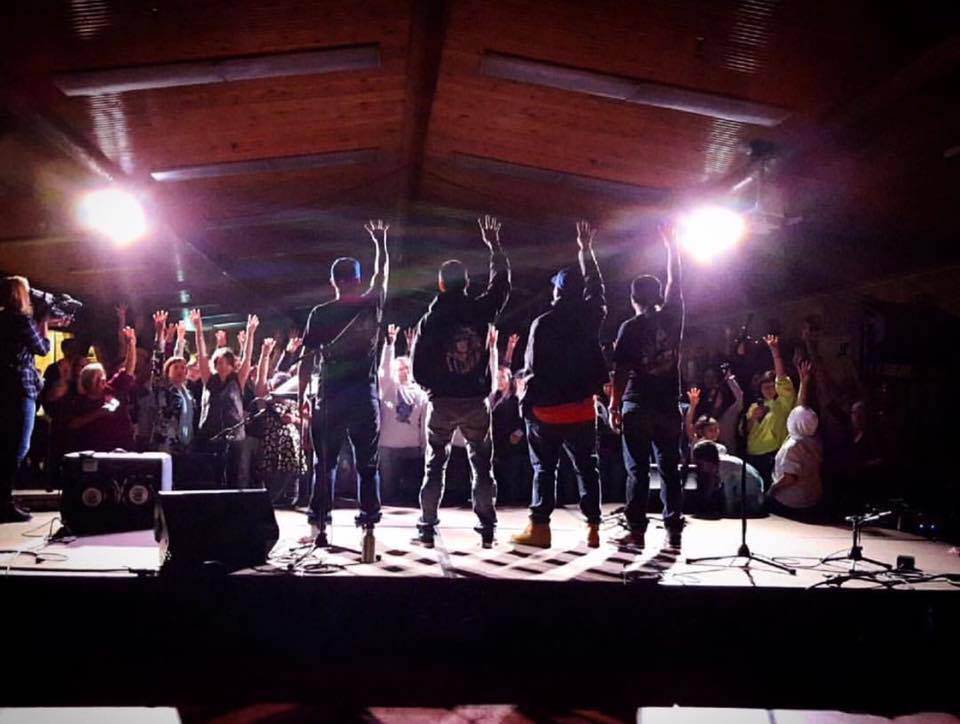
antone42But do not be discouraged, because here is the beautiful truth: in this same community, weary and with every entitlement to bitterness after eighteen long years of fighting, where agents of the State of Alaska rallied against justice, fought to keep the innocent imprisoned, fought to set the guilty free, fought to humiliate and degrade those who would speak out, where all week-long the onslaught of injustice exhausted and baffled those who used to believe in the system, the sun set Friday on a week of outrage and hurt. Yet, on Saturday, these same people gathered. They laughed, they prayed, they dug into their pockets and contributed to fund the fight against their own government for justice and freedom. And they were good, and happy, and they chose to create light rather than dwell on the darkness. Young men from other tribes joined them with messages of strength. They sang the songs of their language and the dances far older than the injustice brought upon them these hundreds of years ago. They sang fight songs. Warriors, they said to the people, don’t go backward. They do not go in circles. They do not give up. And there beside the river, laughing and dancing and remembering, the injustice was triumphed again as it has been many times before and will be many times again. The State of Alaska has deep pockets, the have the keys, the have the guns, they have the courthouses, they have the police, they have the attorneys, they have all this worldly power. But the don’t have the kind of power that was alive and well inside the people, and they can’t put that light out no matter how hard they try.

HERE is the one link you should definitely take a look at. Pictures of people responding to this injustice by being amazing and kind and brave and so good it will make you believe in people completely.

LOVE Gonna Bust Me Out – Alaskans Fight Back in Fairbanks Four Case

People always ask us how it is we can do work around this case and wrongful conviction without becoming bitter. And the answer is really simple – this case has given us the gift of seeing this world as it truly is – and it is so much more decent than you could ever guess. To have witnessed that is a beautiful gift.

IMG_7092It is discouraging to watch a few people with a lot of power fight for injustice. But it will bring you to your knees in admiration of the grace in this world to see the legions of ordinary people fight back.

LETTERPHOTOPeople send us hate mail once in a while. But people send us messages of encouragement nearly every day.

elder4

We have seen some powerful and scary people wield that power as weapon. And then we have seen strength so much greater than that we are reminded the battle is already won.

billfairbanksofurWe have seen people perpetrate injustice for personal career gain and we were disappointed. But we have also seen one man turn from more profitable practices to run a one man nonprofit Innocence Project not because it is profitable or safe but because it is scary and still the right thing to do. And then we have seen people risk their jobs, even lose them, to answer to a higher power and we were brought to tears at their bravery and goodness.

We have seen people cry and break under the weight of persecution. And then we have seen them speak the truth through their tears.

Scott Davison, Newsminer Photo

Scott Davison, Newsminer Photo

We have a person or two who would rather injustice prevail and lives end rather than they be embarrassed. We have seen people set things right. We have seen people confess their sins and humble themselves. We have seen others forgive them.

f42007We have watched as most politicians ignore their people. But we have watched a few do the right thing, and more importantly we have watched the people keep speaking up even against that silence.

We have seen four young men who have the right to be bitter choose to forgive. Who have dwelt in the dark and still seen the light. One of them sent a letter to this blog some years ago and quoted Reuben Carter. “Hate put me in prison, but love gonna bust me out.”

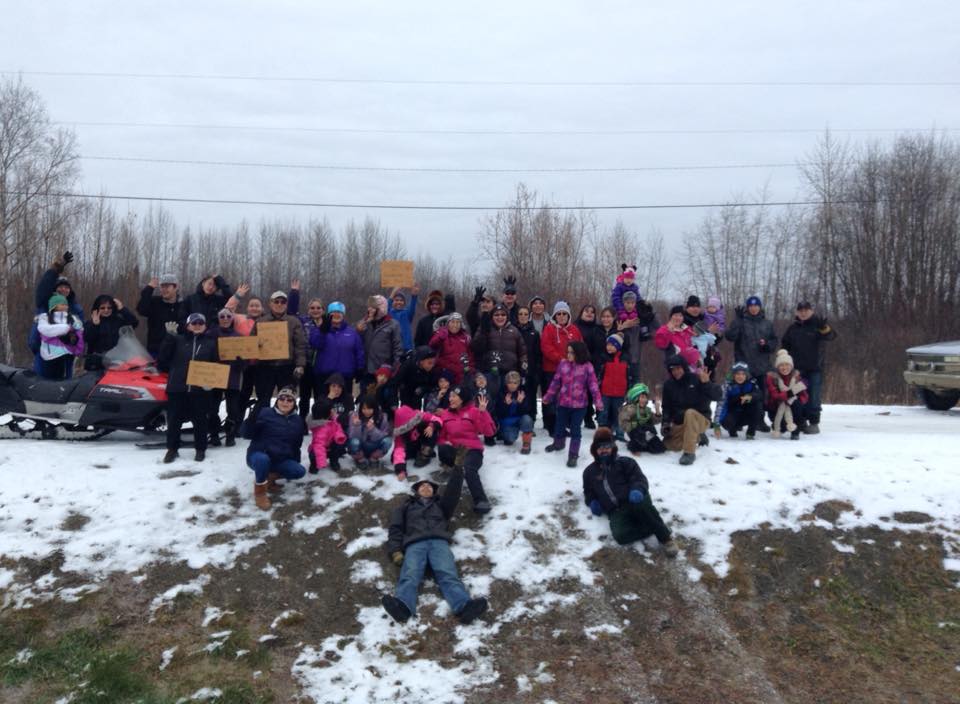
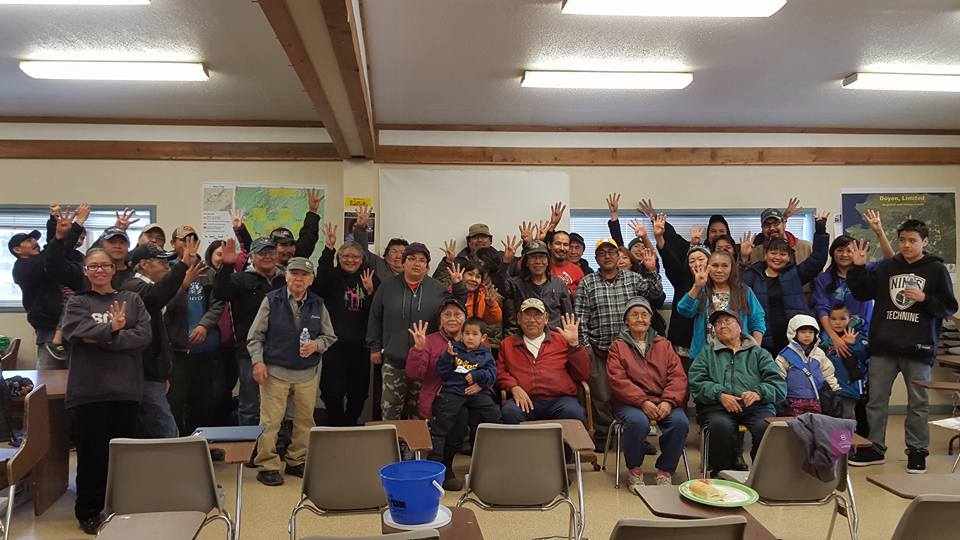
Look at the pictures in this post. See what we see. The world is a beautiful place! Let the shadows you see be ever a reminder of the sun. Love wins.

elder4

fairbanks4

pastors4

galena4

HolyCross4

Hughes4

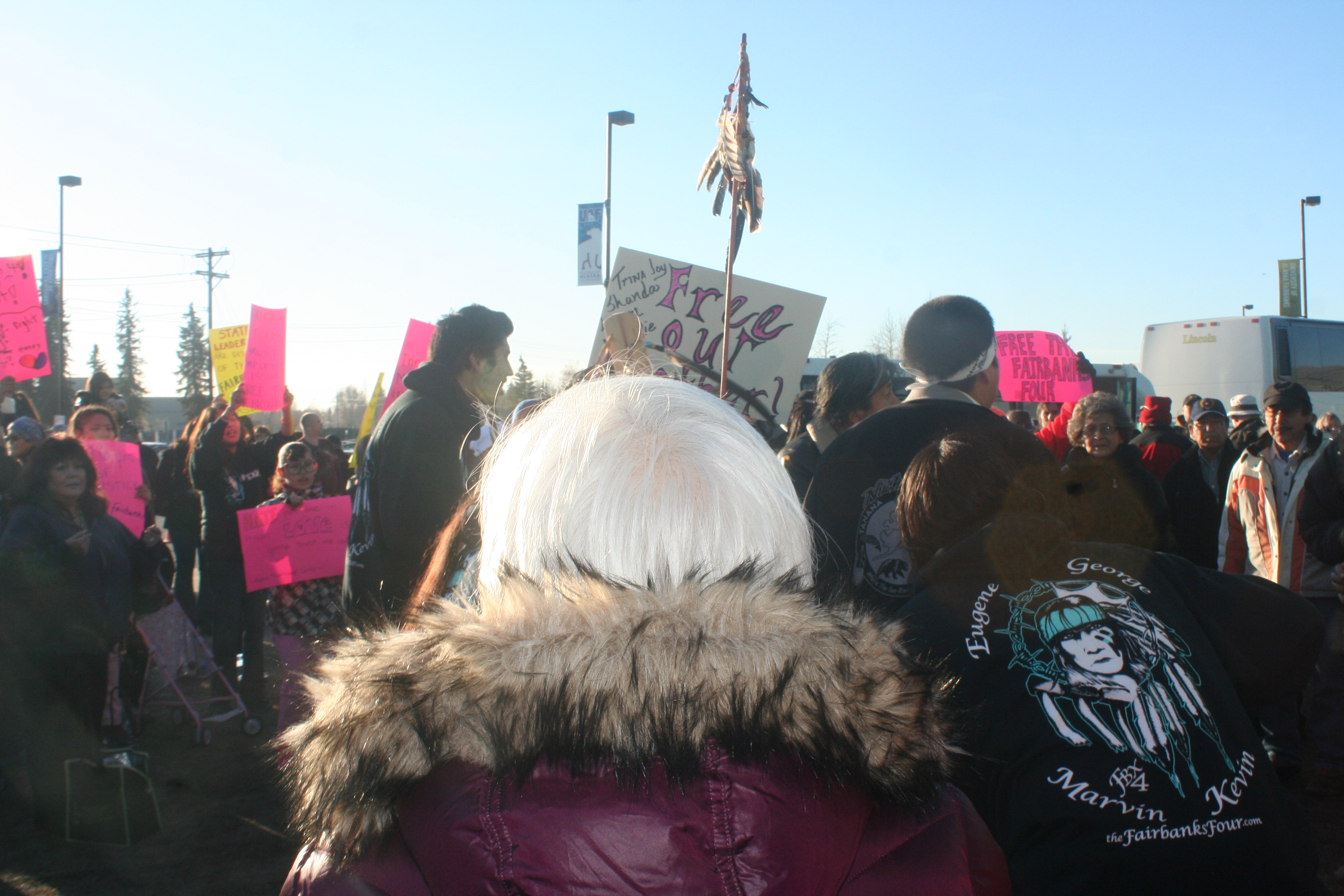
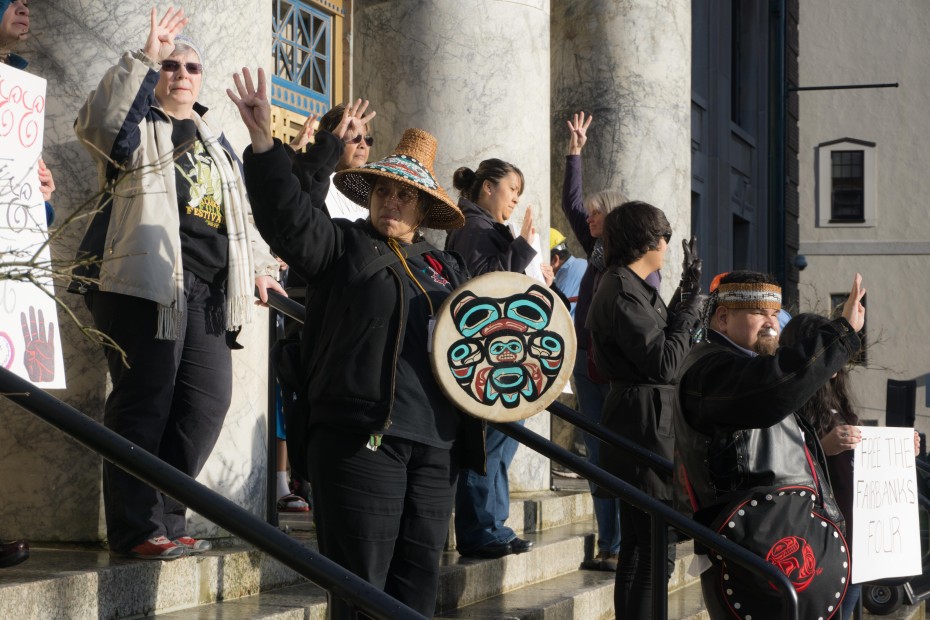
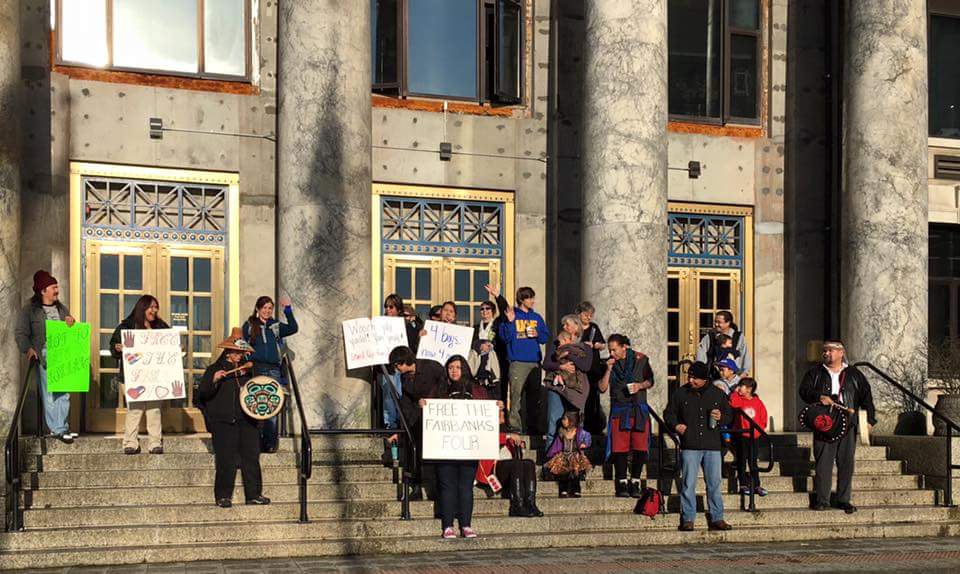
Fairbnaks Four protesters at the Capitol, Oct. 24, 2015. (Photo by Jeremy Hsieh/KTOO)

Fairbnaks Four protesters at the Capitol, Oct. 24, 2015. (Photo by Jeremy Hsieh/KTOO)

four4

Hughes4

Huslia4

clara

Franklin Harvey James Jr. shows off his protest sign in support of the Fairbanks Four, Oct. 24, 2015. (Photo by Jeremy Hsieh/KTOO)

juneau4

Koyukuk4 Nikolai4

FairbanksFourrally

secrethearinghazel

IMG_7093

367

secrethearing1

fairbanksfour5

fairbanksfour4

billfairbanksofur

Day 13 – Lie Detector Confirms Roberts’ Innocence, Holmes’ Guilt

October 22, 2015

pinocchioThe thirteenth day of proceedings was consumed largely by the testimony of Dr. Raskin, one of the preeminent experts in the field of polygraphs in the United States of America. Dr. David Raskin is a leader in the field, professor at University of Utah and has administered lie detector tests for so long that he gave one to Patty Hearst in her high-profile 1976 trial. Raskin is one of a handful of experts testifying in the case who greatly surpass the quality of expert routinely offered in Alaska courts. His testimony, as with the bothers, resoundingly points to the innocence of the Fairbanks Four.

Marvin Roberts, the only one of the four out on parole, was administered a lie detector test and not only passed, but greatly surpassed the scores necessary to establish truthfulness. Roberts scores, he said, were “very strong” and “way beyond the minimal requirement.”

“You have to have a -8 or lower to fail the test; a +8 or higher to pass the test,” Raskin said. “Mr. Roberts produced a score of +47.”

MArvininCourtRoberts was asked if he killed John Hartman, if he assaulted John Hartman, if he had been at 9th in Barnette on the night in question, if his co-defendants had been in the car, and so on. Roberts answered “no” to each of these questions and all of the physiological cues we are able to evaluate, Raskin testified, indicated that he was telling the truth.

The state, predictably, objected to the admission of the expert. The state has a standing objection on nearly every witness and piece of evidence presented by the petitioners, and would apparently prefer an evidentiary hearing devoid of evidence, including the testimony of Dr. David Raskin.

Raskin was cross-examined by Bob Linton, one of three prosecutors on the team led by Adrienne Bachman for the State. Linton’s cross-examination was difficult to follow at times but essentially focused

“Do we have to take your word for it?” Linton asked.

Raskin explained that, indeed, that is how science works.

“I’m the expert, I’m the one who’s done this science for 45 years. I am the person who can tell you as an expert what the purpose of this test is and how it’s used,” Raskin replied.

And Raskin continued to explain that the science of polygraphy demonstrates that Marvin Roberts is telling the truth when he says he is an innocent man. The state continued to attack Raskin on cross, with a line of questioning that insinuated that although the results pointed to Marvin Roberts telling the truth, Raskin may have manipulated the test.

“That’s a pretty serious accusation, and I reject it. I find it offensive,” Raskin said.

The admissibility and reliability of lie detector results remains a heated and as of yet unsettled issue in Alaska courts. As the science has progresses polygraph tests are being more frequently admitted into courts. The largest remaining issue with lie detectors is the quality difference between one test and the next and the skill of the administrator, allowing for a high variability in the reliability from once scenario to the next. That said, Raskin is about as reliable as they come.

The State argued four hours against the reliability of lie detector tests. Yet, when William Holmes first came forward and confessed to the killing of John Hartman, the state went to California and administered a lie detector test. Holmes passed. Alaska State Troopers and police officers are administered lie detector tests prior to hire, as are most federal law enforcement officers. So, when it benefits the state, they use polygraphs. In this case, despite two lie detector tests given to a man who says he is innocent of the crime he was convicted of and the man who says he committed the crime both pointing to the same conclusions, administered by different experts on different machines at different times, the state is adamant that the results should not be considered.

Since the State of Alaska is so confident that lie detector results are meaningless, certainly they will be as willing to administer one to Jason Wallace as they were William Holmes – right?
Whatever the ruling on polygraph results, we do not need one. It is not hard to tell who is telling the truth and who is lying inside that courtroom.

http://www.alaskapublic.org/2015/10/23/polygraph-results-debated-at-fairbanks-four-hearing/

Day 12 – FBI Agent Attacks FPD Methods and Eugene Vent Under Cross Examination

October 21, 2015

Gregg McCary took the stand on the twelfth day of proceedings in the Fairbanks Four bid for exoneration and testified that the original police interrogations were deeply flawed. McCary is a former FBI agent, who was with the burea from 1969-1995. While with the FBI McCary worked as a criminal profiler and was a contributing author to the FBI’s primary manual – Crime Classification Manual. McCary’s resume is lengthy and he is considered on of the country’s leading experts in criminal profiling and false confessions. The petitioner’s attorneys pointed to McCary’s testimony to argue that the statements of Frese and Vent, the cornerstone of the convictions, were classic false admissions produced after flawed and unethical interrogation. McCary attacked the original police interrogations from nearly every angle, asserting that the tactics employed in the investigation were so troubled that the flawed outcome was predictable.

“They didn’t hunt for any other suspects,” McCary said, “They limited the universe of suspects to these four individuals and never went beyond that.”

McCary focused heavily on the flaws in, and overemphasis upon, the interrogations conducted by Fairbanks Police. He noted that Eugene Vent and George Frese were both in a suggestible state with suggestible personality attributes, and reiterated that the aggressive interrogation style know to lead to false results was essentially the bulk of the investigation.

“The investigators here substituted an interrogation for an investigation,” McCary said.

McCary noted that the interrogations were based false-evidence ploys, and that the interrogations were conducted with intoxicated and sleep deprived subjects. Throughout his testimony he essentially listed the known factors in false confession, explained them, and identified how every single one of them impacted this case.

Prosecutor Ali Rahoi  on behalf of the state objected to the admission of the testimony on the grounds that McCary (the guy who literally wrote the book) was not a qualified expert, that behavioral criminology is not a real profession. So….we cannot really mock that. It kind of does the job itself.

EugeneVentCourtEugene Vent took the stand for his extended cross-examination by special prosecutor Adrienne Bachman. Ironically, after a morning of testimony by a renowned expert in the field that aggressive false evidence based questioning is not effective, Ms. Bachman essentially took that approach in her cross-examination of Vent. Bachman stacked compound leading questions on screaming accusations on disjointed lines of questioning.

Vent maintained a calm demeanor, even as questioning escalated to a level some observes found so unbearable they left the room, one describing it as the most horrific bullying she had ever seen.

Vent seemed less rattled by the behavior than most others in the courtroom. Here are few highlights from his interrogation  cross-examination:

  • Bachman accused Vent of being too drunk to remember whether or not he was scared during interrogation based on his blood alcohol test, yet maintains he was sober enough for interrogation.
  • State introduced some notes that Eugene Vent passed to a girlfriend while he was a sophomore in high school. In once, Vent said of his weeked that he and his “boyz” got “smoked out and loced out.” Bachman insisted that the “boyz” referred to were his codefendants and that “smoked out and loc’ed out” means to smoke marijuana and carry a gun. Bachman has tried her hand at gangsta slang quite a few times during the proceedings and the results are mortifying to watch. Like one of those moms who shops in the junior’s section and says “OMG” too much. Vent clarified that loc’ed out does not mean to carry a gun. Eugene’s writings were a trip down 90’s-slang memory lane. For those of you who missed the decade, “loced out” was a term derived from the Spanish word “loco” and was used essentially to mean….well chilled out? Stoned? Super stoned? Maybe crazy? We don’t know. We didn’t really know then, either, we were pretty far away from the rap scene that proliferated the expression but it was a cool thing to say in a time when we were trying really hard to be cool, and so we used it, almost always associated with getting stoned. And it definitely had no relationship to guns of any kind. Through introduction of this evidence the state reminded us all of a time when people didn’t have text so they wrote notes, and when people got “blazed” and this line of questioning would be called “bunk” and we could give “mad props” to anyone who kept a straight face through that, and of a time long past where apparently Eugene wrote some super dorky notes. Make that hella dorky.
  • Bachman established that while Eugene Vent was being interrogated in 1997 he burped without saying excuse me. The audio introduced reflects that Eugene is likely guilty of the crime of burping without saying “excuse me” in 1997, but we feel that eighteen years of hard time may be a tad overboard for the crime of mediocre manners in a seventeen year old drunk boy.
  • Bachman hammered Vent on his poor manners. “I wasn’t being respectful,” Vent answered, then referring to Detective Aaron Ring, “Neither of us were being respectful.”
  • Bachman also established through a gotcha-vibed series of questions that Eugene Vent had gum in the night in question. “And you left that gum at murder scene at 9th and Barnette, didn’t you?” she said. In a serious anti-climax, Vent replied that no, the gum was collected from him at the police station, and logged in his property report.

The cross-examination was not funny. Human lives are at stake here. If this wasn’t so horribly, tragically, relentlessly tragic, it might be funny. At the least it is a parody of itself because the conduct of the state attorneys is just so painfully ridiculous. What is becoming evident is that these tactics are probably effective on juries (a scary thought) but play poorly to rooms filled with professionals.

Day 11 – Testimony of Kevin Pease and Eugene Vent

KevinCourtTwo of the Fairbanks Four, Kevin Pease and Eugene Vent, took the stand during the 11th day of proceedings. The two men spoke to a packed courtroom and recounted the events of the night of October 10th, the early morning of October 11th, and the series of interrogations and events that lead to their wrongful arrest and conviction for the murder of John Hartman,.

Pease and Vent joined Marvin Roberts at the petitioners table, dressed in street clothes and flanked by attorneys. It was clear the three were happy to see each other, but the mood quickly turned somber. Pease and Vent were chained at the waist, and barely able to lift their hands high enough to be sworn in. They are aged. Both men look old enough now to be the fathers of the boys pictured in the photographs the last time they appeared in a Fairbanks Courtroom some eighteen years ago.

Pease took the stand first and described, as his alibi witnesses described in initial 1997 police contact, the original trials, and recently on the stand again, a night spent mostly at a party across town. Pease also described his background, life in 1997, and the police interrogation.

In initial questioning about family background Pease testified that he is an orphan. His father was murdered some six months before Kevin was sent to prison. His mother passed away while he was in custody. In 1997 he was living with his mother in downtown Fairbanks and both of them were grieving the sudden loss of his father. The mood in their house, he said, was tense. Different. Kevin was spending most of his free time with girlfriend Jessica Lundeen, who had to babysit the night of October 10th. So Kevin agreed to attend a party with friends, among them Eugene Vent, Kevin Bradley, Shara David, and Joey Shank. Kevin testified, as have many others, that they remained at a party in the Bradley residence until near 2:00am, then returned to downtown. Kevin was dropped off at home. When he went inside he woke up his mom, who was angry at him for making noise, and even angrier when she saw he was drunk. In his testimony, Pease described an argument that escalated into yelling, with Pease eventually punching the wall. He took off on his three-wheeler and his mother called the police on him. It was this call that led police to bring Pease into the investigation.

Pease described riding the three-wheeler to the home of friends Conan and Shawna Goebel, who both testified to the same series of events and the police behavior during their eventual questioning.

A large amount of testimony and cross-examination was spent on Kevin’s interrogation – specifically his initial choice to lie to detectives. By the time the police picked him up late on October 12, 1997, Pease had already heard rumors that Vent had been implicated in the a serious crime and that police wanted to speak to him about it as well.

“I was scared. I didn’t know what time I came back to town, I didn’t know what time this happened to that kid, I didn’t know what time it was when I walked home alone,” said Pease, his voice cracking into tears. “I was scared.”

It was fear, Pease testified, that motivated him to lie and deny having been out drinking or driving around that night. His girlfriend Jessica Lundeen had suggested he say he was with her all night, and he did. She testified to as much just days before Pease took the stand. Much of cross-examination focused on what State Special Prosecutor described as Pease’s “big whopping lie.” Pease remained adamant that he had lied to detectives out of fear, knew right away it was a mistake when he understood the seriousness of the charges, asked for an attorney, and corrected it.

As cross-examination continued, Pease was asked if he knew a James Wright. Pease testified that he did not, but that he saw that he was aware of his reputation as a snitch due in part to the words “James Wright is a snitch” being carved into the wall of Fairbanks Correctional Center.

Bachman used this line of questioning to accuse Pease of understating his understanding of prison politics.

Pease countered that he understood but preferred not to take part in prison politics, and that it was “common knowledge” that snitches are thought poorly of in prison culture. The line of questioning was interesting in that it likely points to an upcoming snitch witness for the Sate. Perhaps they found him after reading of his snitching abilities on the prison walls.

Kevin Pease was followed by Eugene Vent. Vent was seventeen and had a blood alcohol content of twice the legal limit when Officer Aaron Ring interrogated him for nearly 12 hours. Vent eventually agreed that he “probably” assaulted Hartman. Eugene Vent’s interrogation was the focus of cross-examination by Bachman.

EugeneVentCourtVent testified that a lack of confidence in his memory due to intoxication, police insistence that his “footprints were in the blood” and fingerprints at the scene, that witnesses placed him there, and other lies police used in interrogation eventually persuaded him he could have been there.

“I was listening to everything he told me. And eventually, I just believed him, Vent said. “I was feeling terrible, guilty.”

“Why?” Vent’s attorney, Whitney Glover, asked.

“Because I believed I had done something real bad,” Vent said, breaking into tears.

Vent went on to describe in greater detail how the Reid Method interrogation he endured led him to a state of such confusion he didn’t know what happened. Although he maintained innocence for many hours, he said, by the end of the process he was confused, felt obligated to help the officers any way he could, and ultimately followed their lead in agreeing he had “probably hit and kicked” a young John Hartman, and that he “guessed” he had been with George Frese, Kevin Pease, and Marvin Roberts.

“I’m responsible for dragging Marvin and Kevin and George into this and there’s not a day that goes by I don’t think about that,” Vent said, again becoming emotional.

Adrienne Bachman made it clear that she expects his cross-examination to be long and continue through the twelfth day of proceedings.

Although Vent’s eventual acquiescence to the police officers and subsequent implicating statements are often touted by the State of Alaska as the smoking gun in this case, experts in false confessions have called his statements a “textbook false confession.” Experts on the Reid Method, the method of interrogation used on Vent, caution that the method should not be used on minors, people who are intoxicated, or people who have any gaps in their memory. Under any of those circumstances, of which Vent had all three, the method is known to lead to false confession.

Vent’s attorney is expected to call a false confession expert to testify as to the psychology behind Vent’s statements. Continued cross-examination of Vent and the false confession expert testimony are likely to consume the twelfth day of proceedings.

Although revisiting imperfections and bad decisions is embarrassing – discussing a decision to lie to the police, a decision as a teenager to drink, and all the small sins that surface in this case – it is necessary. Because the whole truth is that no one is perfect. The whole truth is that being drunk, poor, Native, and in the wrong place at the wrong time made this possible. The whole truth is what needs to be told, even in moments that it makes the Fairbanks Four or their alibis look imperfect, because the whole truth is that no one is perfect. It is high time for the courts to recognize the truth, for the family of John Hartman to receive the truth, and these men to have opportunity to tell it. Nothing but good will come from that.

truth

Jason Wallace Granted Immunity in Hartman Murder

devildealThe State of Alaska has offered Jason Wallace immunity in the murder of John Hartman in exchange for his testimony as a witness for the state. According to Adrienne Bachman, the Attorney General’s office simply sent a letter to all parties to the case stating that Wallace had been granted immunity and would be testifying, although the conduct of those involved hints to a more complex series of events.

“The attorney general forwarded a letter to the parties, the lawyers, that Mr. Wallace will be granted immunity for his important testimony in this case,” Bachman said.

Wallace has been implicated by many, including his former attorney, high school classmate, and William Holmes, who confessed to his own role in the 1997 beating death of Hartman and fingered Wallace as the primary aggressor. William Holmes passed a lie detector test and provided chilling but credible testimony under oath to the details of the killing. Public Defender Investigator Tom Boles testified that he would “never forget” the tearful confession Wallace made to him about having killed Hartman. High school friend Scott Davison described how Wallace confessed to him as well just days after the murder, and reiterated that although he was relieved that he came forward, believed his testimony against Wallace would ultimately cost him his life. Considering that those who have testified against Wallace believe the retribution may be death, it is likely that there are many more witnesses opting not to come forward.
jason wallacWallace currently sits in maximum security prison for stabbing a friend with a screwdriver, charges related to his part in the conspiracy that left two men dead, the interrupted plan to kill an entire family, and the murder of Teacka Bacote. Wallace beat and bludgeoned her to death with a hammer, then returned to her apartment to set her body on fire in a fully occupied apartment complex. Murder victim Mahogany Davis‘ family believes he may have killed her or participated in her murder. Wallace’s pattern of past behaviors and crimes indicate that he suffers from psychopathy and is a true danger to society. He is already serving an extremely lenient sentence because he has been an informant and testified for the state in the past. It is morally reprehensible that the State of Alaska would offer him immunity. Multiple individuals have testified that he killed Hartman in a frenzy and went on to laugh and brag about it. If any of the individuals involved in Hartman’s death were to receive immunity, Wallace seems like the last pick. He should never be out of prison. John Hartman deserves justice, and denying that in pursuit of anything in this case is not okay.

In a perfect world, Wallace would confirm his role in the Hartman killing, implicate Rashan Brown, Marquez Pennington and Shelmar Johnson as William Holmes did, the State of Alaska through the attorney general would dismiss charges and release the Fairbanks Four and charge every single one of the men who actually killed Hartman with the murder. That would be the RIGHT THING TO DO. It would also represent an illogical and sudden reversal of the State of Alaska’s position, and we think the intentions with Wallace are far more likely to be sinister.

nepotismThe attorney general for Alaska, Craig W. Richards, is our Governor’s former law partner. He did not come to the position through experience or promotion, and certainly owes his appointment to his close relationship with Governor Walker. Walker perpetually hints that he knows the Fairbanks Four were wrongfully convicted but doesn’t know what to do about it. Given Walker’s close relationship to the sitting attorney general they have likely discussed the case and options. Walker recently commented to Anchorage station KTUU, “I really am anxious to see what comes out in the testimony under oath, it’s really what they’ve been fighting for, their day in court. So for me to reach in the middle of a process and sort of influence that process inappropriately, I’m gonna wait until the end of next week and see.”

Walker has been hinting in commentary and rumors abound that he is waiting for the Wallace testimony. Based on that we can hope that Wallace gets on the stand, repeats the confession he has been repeating to others since he killed Hartman in 1997, the Governor and/or Attorney General take action, and the case is over. That would represent an absolute turnaround of the state’s position. However, we tend to see a lot of business-as-usual from the state, and no meaningful indication that we will see anything else.

Captain_ObviousIf the state tactics continue as they have since 1997 it is easy to guess how Wallace will be used. The State may not have honesty, ethics, or the law on their side, but they really shine in predictability.

Our prediction?

  • That Jason Wallace is going to provide “snitch testimony” – information given in court to bolster the case of the prosecution which is received in exchange for some kind of reward for the witness, often sentencing leniency or immunity.
  • That the State of Alaska has been in below-board negotiations with Jason Wallace directly and through his attorney and has negotiated exactly what Wallace will say for that incentive.
  • That when Adrienne Bachman sat through the deposition of Wallace and was gag-worthy sweet to the killer as he answered “I plead the 5th” over and over, effectively providing no information beyond an unwillingness to incriminate himself, she already knew what Wallace was willing to testify to in court.
  • That Wallace will not be made available for deposition to the petitioner’s attorneys.
  • That Gazewood, as the Wallace attorneys before him, has shopped Wallace’s testimony around for a while hoping to broker a deal.
  • That the State of Alaska would rather make a deal with a psychopath and set him free knowing that more people will be killed than admit they made a mistake in this case.
  • That Wallace will have very rehearsed and groomed testimony that deflects as best as possible the testimony of the witnesses who have already spoken. He will have a story that attempts to dodge every piece of information which incriminates him – a reason Holmes would lie about him, a rehearsed denial of confessing to the high school friend, a denial of confessing to the public defender, his investigator, the other witnesses, and all others.
  • That what Wallace gets out of this is immunity in this crime (already given), that he has been assured that his cooperation with authorities will help him come parole time, and that ultimately his psychopathy which put him in jail, enables him to lie convincingly and with small incentive, and will propel the violent crimes he commits when free again, will again assist him in securing minimum punishment for his crimes. That a system where bribing child killers with the offer of time, and the opportunity to kill again, is business-as-usual needs to be brought to its knees and overhauled.
  • That the state is desperate and delusional enough to think this will work.

We are sitting here hoping and hoping that our prediction is dead wrong. Perhaps the State of Alaska as had an incredible change of heart for the first time in eighteen years and are offering immunity to seek the truth not an advantage at any price. Time will tell. Whatever story Wallace tells on the stand, he would have to be very creative to outrun the evidence of his involvement. Below is a timeline of the evidence against Wallace.

  • October 11, 1997, Wallace attends a party at a high school acquaintances apartment with Bill Holmes, Marquez Pennington, Shelmar Johnson, and Rashan Brown. Epperson testimony, Holmes testimony, Duty testimony, Nutt testimony.
  • The five youth leave the party to “beat up drunk Natives,” commit a few attempted assault, but ultimately find and beat Hartman instead. Wallace goes into a frenzy during the assault and stomps the young boy to death. Holmes testimony
  • 1:30 am October 11, 1997, Hartman is beaten into brain death at the intersection of 9th and Barnette.
  • October 13, 1997, Wallace shows Holmes a newspaper story about Hartman’s death, and they see that their victim has died and that “four Natives” have been arrested. Holmes testimony.
  • October 13, 1997, Wallace and Holmes approach the others involved in the Hartman killing at school (Marquez Pennington, Shelmar Johnson, and Rashan Brown) and threaten to kill them if they ever discuss the Hartman murder. Holmes testimony.
  • October 13, 1997, Wallace confesses to killing Hartman to high school friends Matt Ellsworth and Scott Davison. Davison testimony.
  • December 2002, Wallace is arrested for murdering Teacka Bacote, attempted murder of Corey Spears, his involvement in the murder of two more men, the conspiracy to murder a family, and setting an occupied apartment building ablaze. State of Alaska v. Jason Wallace
  • Spring 2004. Wallace snitches on his co-conspirators and provides snitch testimony against them. He turns informant on many other past criminal associates. In an attempt to trade the information for leniency, he confesses to killing John Hartman to his public defender. The public defender sends his investigator, Tom Bole, to interview Wallace. He confesses again. Bole testimony.
  • September 2013. Innocence Project files a post conviction relief on behalf of the Fairbanks Four. It contains a sealed element for consideration of the court that contains “statements made by Wallace” about killing Hartman. With the assistance of attorney Jason Gazewood, Wallace fights the release of the statements for two years. Attorney Gazewood accidentally  leaks the statements to the press. Roberts, Pease, Vent, Frese v. State of Alaska
  • September 2015. Wallace is deposed and refuses to answer any questions, invoking his fifth amendment right against self-incrimination. Wallace deposition.
  • October 15, 2015. Midway through proceedings for exoneration in the Fairbanks Four case and on the eve of the State’s opportunity to present, Adrienne Bachman announced for the state that Wallace had received immunity and would be a state witness.

Although Wallace could muddy the water, it is hard to imagine coming up with an excuse for all of that. Prayers and good thoughts as always for all involved. May a desire to tell the truth for redemption and the sake of the truth strike Jason Wallace and the leadership of Alaska’s justice system. Until that day comes, may the truth ever find a way to shine through the clouds cast by lies.

Day 10 – Bootprint Exhibit from Original Trials Debunked

October 16, 2015

On the tenth day of proceedings in the Fairbanks Four bid for exoneration, George Frese again took the stand to finish cross-examination. Frese was followed by former State crime laboratory forensic expert Lesley Hammer.

Frese22Special Prosecutor Adrienne Bachman asked for early recess the previous day and to recall George Frese in the morning so she could “que up audio” to complete his cross-examination. When Frese was back on the stand for a large part of Friday’s proceedings Bachman did not play any audio, despite having cited her need to do so as the reason for recall and delay. Instead, she relentlessly asked Frese about the false confession he made to investigators and his level of intoxication that night. Frese, who had provided very emotional testimony the previous day, was very composed and clear on the stand during cross-examination. Frese testified, as multiple witnesses testified to in the original case and as he stated during all original police contact, that he drank heavily with friends the night in question and that although he can thoroughly account for his whereabouts until around 2:00 am, his memories of the last hours of the night are compromised by blackouts and extreme intoxication. During original interrogations officers capitalized on his level of intoxication, and after hours of questioning and threats from detectives that if he failed to acknowledge some involvement they would use his lack of memory to ascribe more severe involvement,  Frese eventually admitted that it was possible he had been involved. On the stand, Frese reiterated claims of innocence and rehashed the events October 10 and 11, 1997 through a prolonged and aggressive cross-examination.

bachmanvfreseBachman focused heavily on the same tactic as original investigators, insinuating throughout her cross-examination that because Frese could not account for his movements during the entire night, he could not make a claim to innocence.

“Because you didn’t know what your motive was that night, did you?” Bachman demanded.

“Because there isn’t any, because I didn’t do it.” Frese countered.

“Well, you don’t actually have a memory of whether or not you did it, do you?” Bachman said.

“I know the facts of the case, I know this boy was attacked between 1:28 and 1:33 am, and that I left my house at 1:30.” Frese replied.

Bachman also focused on the original interrogation and the statements made by Frese implicating himself.

“What you are trying to say is that I broke down and started confessing to something,” Frese said to Bachman’s leading line of questioning. “I just started agreeing to whatever they were telling me the entire time…I just started agreeing to it.”

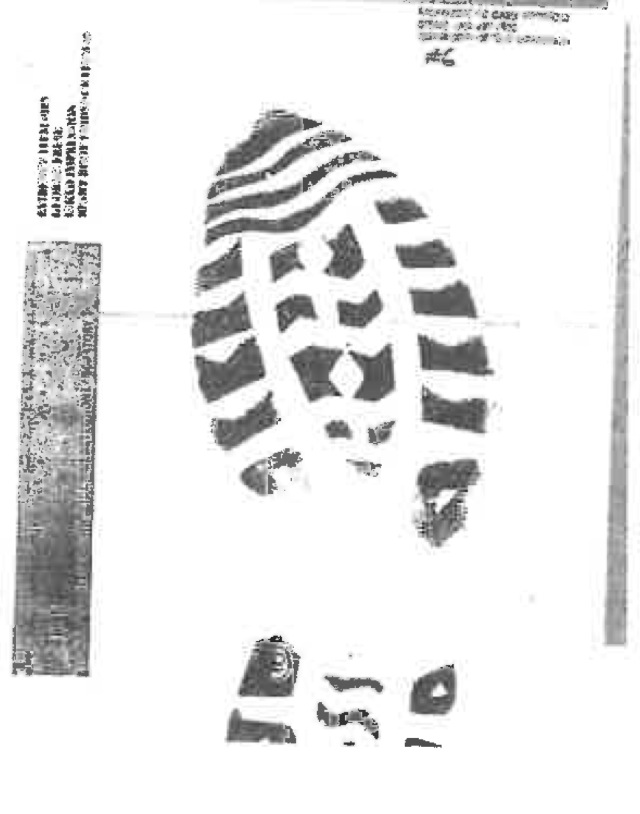
bootpost1Frese was followed on the stand by Lesley Hammer. Hammer is a forensic scientist, and expert in causative instrument forensics. Her testimony related to a court exhibit used to convict the men in their original trials. The exhibit, created not by a crime lab but by Detective Aaron Ring and Prosecutor Jeff O’Bryant, has long been in question, and reporter Brian O’Donoghue’s investigative reporting on the case unearthed significant issues with the exhibit in 2008. Hammer confirmed that the original exhibit was totally unscientific. Dr. Falico, the state medical examiner at the time of the original trials, bolstered the perceived validity of the exhibit used to obtain convictions. Hammer testified, however, that Falico did not appear to understand “even the most basic” tenants of forensic science, including the importance of scale, the elastic nature of skin and basic examination of markings, and was entirely unable to evaluate the nature of the victim’s injuries. “There didn’t appear to be some of the basic understanding of the discipline itself,” Hammer said.

Hammer went on to discuss the nature of footwear impression comparisons to injuries and her own evaluation of the case evidence. She pointed out that skin’s elasticity and the motion involved in kicking or stomping make it generally impossible to identify the causative instrument in as simple a fashion as was described in the original trials (holding a boot up to a face).

Hammer’s testimony then focused on the injuries sustained by Hartman and what caused them. She testified that the “I found no correspondence between the injuries I observed, the feature shapes of the injuries, and any of the shapes of the shoe lugs on that partial impression.”

Hammer was able to entirely debunk the original exhibit, plus testify definitively that none of Hartman’s injuries matched the footwear of the Fairbanks Four. The original prosecutor argued that the exhibit proved the injuries to Hartman had been caused by Frese’s boot, but Hammer testified that not only were the injuries not caused by Frese’s boot, they were not caused by any boot. Tennis shoe type footwear could not be excluded.

Hammer was a longtime employee of the State of Alaska Crime Lab and now owns an independent forensics consulting firm. Her testimony, much like the brave testimony of the Alaska State Troopers, represents some significant dissention in the rank and file of the prosecution’s own people. Hammer has made a long career testifying FOR the State of Alaska, which makes her testimony all the more compelling.

Kevin Pease is expected to take the stand Monday, October 19 2015, with Eugene Vent and Marvin Roberts to follow in the days afterward. The case was originally scheduled to only take a month, but as prolonged cross-examination and procedural bickering instigated by the state continue it is becoming clear that proceedings will last longer than anticipated. It is also worth noting that the State has a standing objection on record to the admission of Lesley Hammer, based on the idea that the information presented is not new, and that the exhibit was already questioned during the original trials.

The Friday proceedings were interrupted twice for closed hearings on an undisclosed matter, though likely related to the testimony of Jason Wallace. It was disclosed this week that Wallace was granted immunity and is expected to testify for the state. We will make a separate and more detailed post about the unusual developments surrounding Wallace, a man and an issue long surrounded by secrecy in this case.

Day after day, the proceedings in the exoneration efforts of the Fairbanks Four function as not only a resounding demonstration that four innocent men have been imprisoned for perhaps the most infamous murder in Interior Alaska, but also as a scathing expose of the misconduct and conspiracy on part of agents of the State of Alaska both then and now that led to the wrongful convictions. It is strange, although in the end perhaps a good thing, to see the State of Alaska continue to flounder so desperately to defend the convictions. The movements of the State, precise and exacting during the original trials, are as seemingly random and impossible to pin down as a fish out of water. Indeed, in a court where truth has been admitted, purchased witnesses exposed, and misconduct unearthed, the State does find itself in foreign territory. They are clearly accustomed to operating with less transparency and accountability. However poorly positioned the State seems now, the case is far from over, and if the past is any indication we can expect a flood of snitches, pretend science, and plenty of smoke and mirrors in the weeks to come.

Newsminer article

Day 9 – George Frese’s Tearful Testimony, and a Massive Demonstration of Solidarity

October 15, 2015
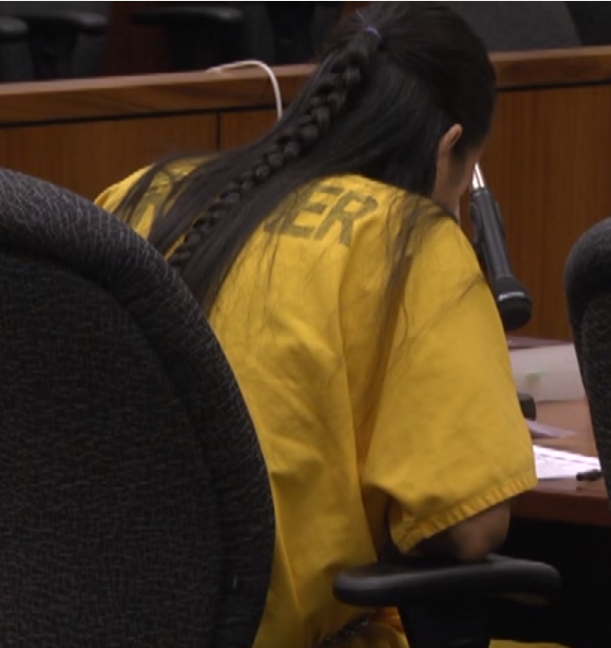
george3Fairbanks Superior Courtroom was packed Thursday as the first of the Fairbanks Four to testify, George Frese, entered the courtroom with his hands cuffed to a chain around his waist. George Frese was dressed in bright yellow, the word “prisoner” in block letters across his back in faded black. His hair, streaked with sparsely with gray, was half braided and fell past his waist. After some opening proceedings he excised under guard to another room to change his clothes, and returned in white to take the stand

George Frese’s own pro bono attorney, Bob Bundy of Dorsey and Whitney, opened questioning. Frese answered questions about his background, upbringing, and life prior to the days in October of 1997 when he was arrested for the killing of John Hartman. Questions eventually led to the night of October 10, 1997, and George recounted a night at home drinking with friends, a clear memory of leaving his apartment around 1:30 am for a wedding reception and party, and ultimately how he drank enough that night that his memories of the early morning hours of October 11, 1997 are hazy. Frese recounted stopping in at a reception, a bar, a party, and getting a ride part of the way home. During that walk, he said, he injured his ankle. When questions turned to the later morning, when a nurse examining his foot fingered him as a potential suspect in the Hartman beating and police began an interrogation that would last many hours and ultimately lead to Frese’s false confession. The attorney asked Frese a handful of questions about how the interrogation felt, and Frese said repeatedly that he was scared.

“Why were you scared?” Attorney Bob Bundy asked.

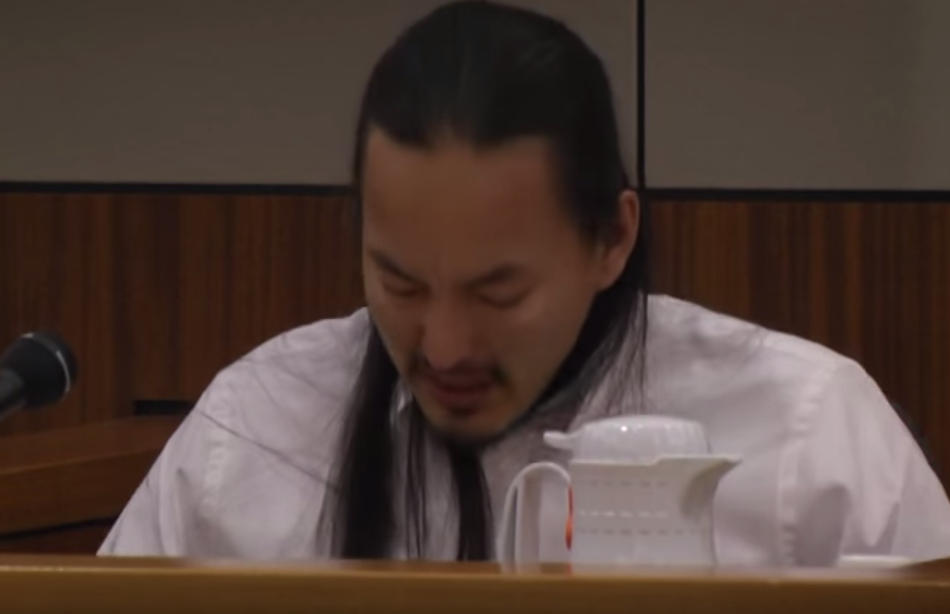
george2It was at this point that Frese hung his head and began to weep. With his head down and amidst sobs he said, “They said I did all this shit that I didn’t do. You motherfuckers know we are innocent,” Frese said between sobs,” I’m so tired of this, I did not do this shit.” His voice trailed off as he broke down into unbroken sobs. As Frese struggled to stop crying and regain some composure, he sobbed with his back to the gallery and Judge Lyle called a recess. Many in the courtroom were overcome with emotion as well, and cried as Frese continued to collect himself. After a few minutes he stood up and walked out of the courtroom with a guard.

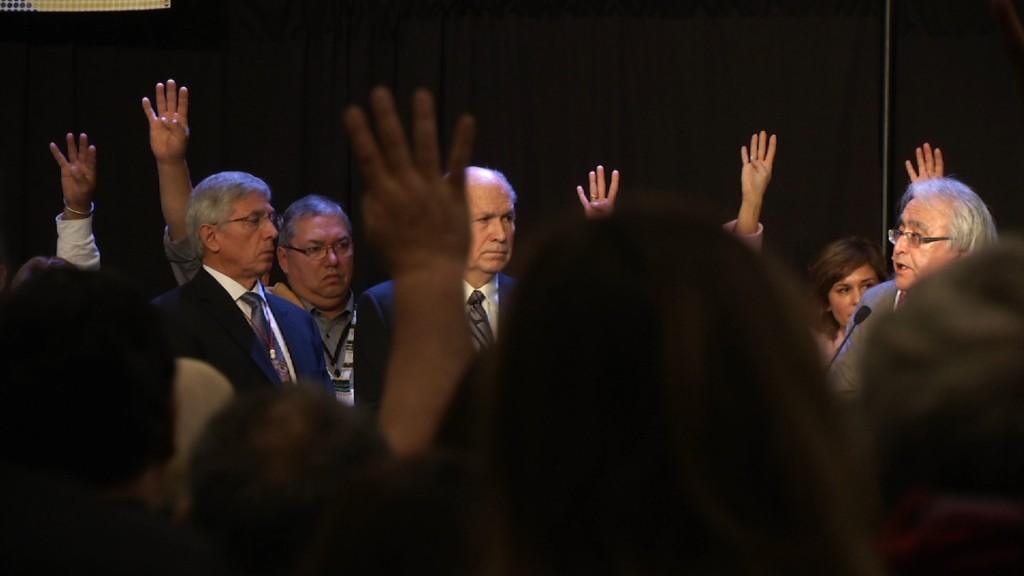
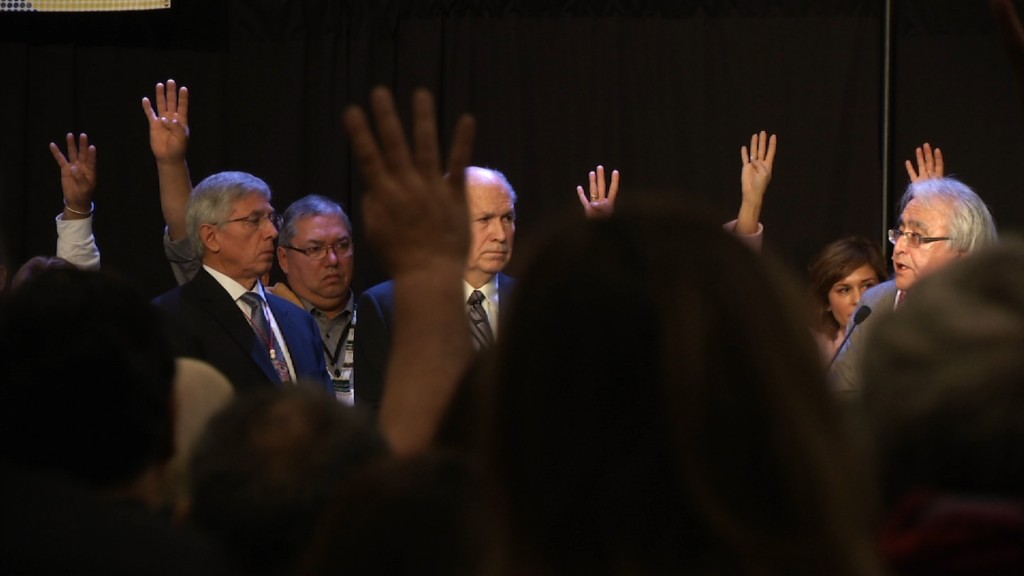
Hundreds of miles away in Anchorage, as George Frese struggled for composure, many hundreds of Alaskans kept theirs in a powerful peaceful demonstration of solidarity with the Fairbanks Four. The crowd was gathered for the Alaska Federation of Natives (AFN) – the largest annual gathering of indigenous in the state, during which tribes from all regions meet on common issues. Alaska State Governor Bill Walker appeared the same morning on stage at AFN to address the delegation.

four7Walker has not responded directly to the many resolutions and requests from tribal entities like Tanana Chiefs Conferernce or the Alaska Federation of Natives asking him to intervene in the wrongful conviction case and examine disparities inside the justice system. Walker did, however, make a brief and nearly mandatory mention of the case during his speech, saying “On the Fairbanks Four, we’re not where we need to be on that,” Walker said. “I’m so impressed with your passion on that. I sense your frustration toward me; I applaud your passion.”

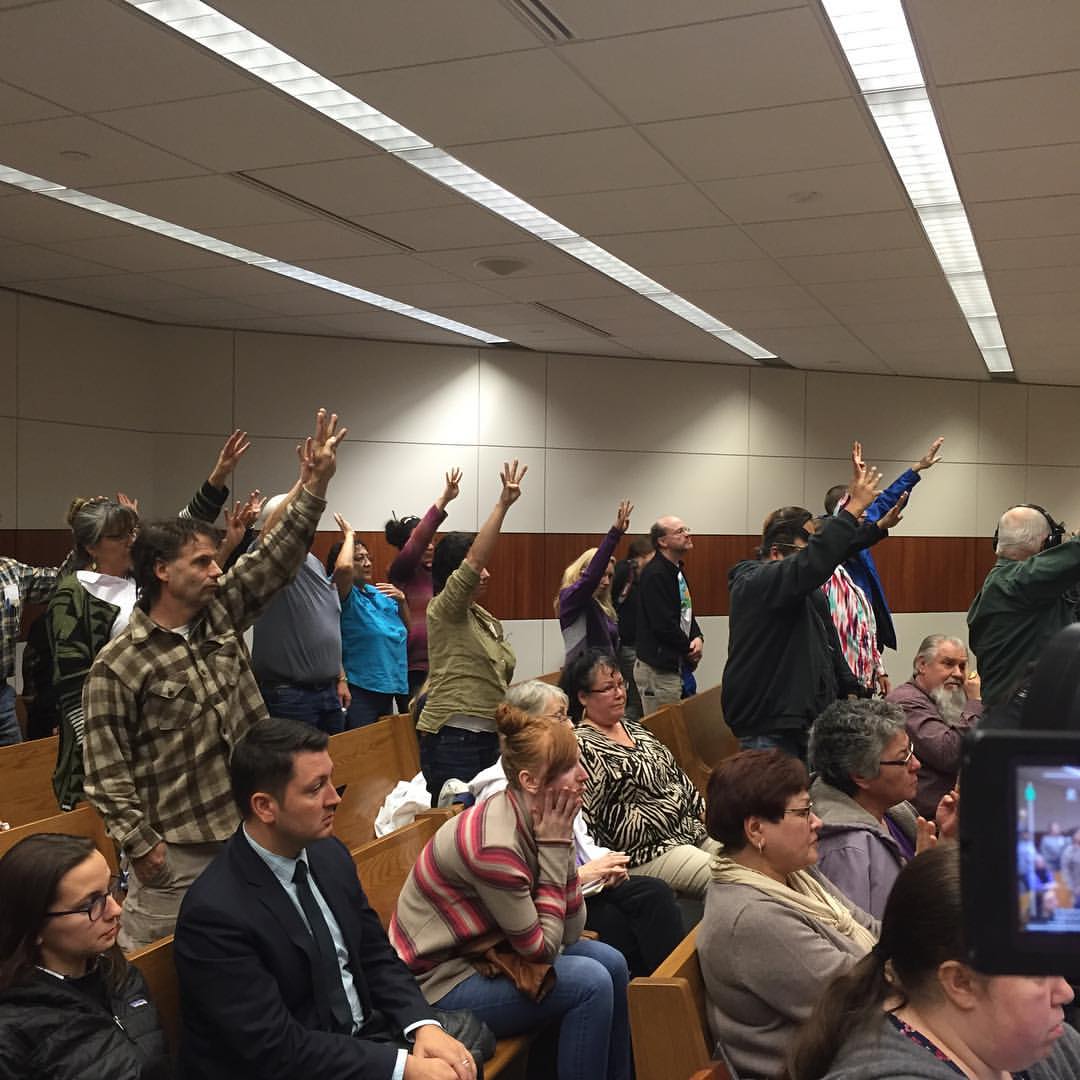
As Walker spoke a group of attendees in the back quietly unrolled a banner that read, “Justice for the Four.” They held their arms high, and four fingers up. The gesture spread through the silent crowd until the room was filled with citizens holding four fingers up, looking at the governor.

f4111Traditional chief Jerry Issac joined Governor Walker at the microphone. Isaac asked the elders of his village Tanacross, and neighboring villages, to forgive him for using a grief song. He told the Governor, “In our native way when a death suddenly happens we are shocked, and saddened, and we grieve. In this case there is no physical death, but the forceful and sudden taking of our young men…and we are shocked, and saddened, and grieving…because the facts prove them innocent. The longs years of shock and sorrow, and a want for freedom, inequality in justice, the grieving…our only way to express our frustration, our sadness, is to grieve, with a song that expresses sorrow.”

<script>(function(d, s, id) { var js, fjs = d.getElementsByTagName(s)[0]; if (d.getElementById(id)) return; js = d.createElement(s); js.id = id; js.src = “//connect.facebook.net/en_US/sdk.js#xfbml=1&version=v2.3”; fjs.parentNode.insertBefore(js, fjs);}(document, ‘script’, ‘facebook-jssdk’));

Jerry Isaac sang. We cannot tell you how the song sounded, because it will never sound again the way it sounded then. It sounded like a song written before you were born. Like a song in a language you knew long ago or in a dream. It sounded like a song that has echoed inside rooms thick with grief for many years, seeped into the log walls of many tribal halls and caught in the soundproof ceilings of hospital rooms. It sounded like the cry of the wounded, and it sounded like a song in which the screams of grief and get lost inside the notes. We cannot tell you of Governor Walker heard it – truly heard it. But the people heard it, and tears streaked their faces with their hands.

In the courtroom, George Frese returned after a brief break. The gallery of observers rose to their feet, arms high in the air, and holding up four fingers. Frese teared up when he saw them, tears running down their faces. All those miles away, they heard that song too, and he heard it.

George remained calm the rest of the day. He reiterated and reiterated his innocence, his whereabouts, and answered question after question. Under cross-examination special prosecutor Adrienne Bachman tried to insinuate that Arlo Olson may have recanted due to pressure or threats from George or the four.

“You hate Arlo Olson, don’t you?” She asked.

“No,”  Frese answered plainly of the man whose testimony led to his conviction and eighteen years of incarceration. “He’s a victim in this, just like us.”

Since the testimony of Frese and the demonstrations, Facebook has flooded with users changing their profile pictures to “fours.” There, in the song, in the hands held high, in the exasperated testimony between sobs, in the tears, and in the day, was a simple reminder – we are all in this together.

Hey Aaron, Hey Jeff, Hey Adrienne – can you hear them now? I think that song goes, I am Spartacus. And thank you. Because it takes injustice sometimes to teach us how important justice really is.

collage

four4four1four6

collage2NPR Coverage of AFN Protest

Anchorage Daily News – Protest

KNBA Protest Coverage

Frese’s Emotional Claim of Innocence – Newsminer