Day Four – Scott Davison vs. Adrienne Bachman

October 8, 2015

Scott Davison, Newsminer Photo

Scott Davison, Newsminer Photo

The fourth day of proceedings in the Fairbanks Four case focused largely on the testimony of Scott Davison, who testified that Jason Wallace confessed his role in the Hartman killing just days after the murder to Davison and another student.

According to Davison’s testimony, he and a friend were sitting in a car in the Lathrop High School Parking lot just days after Hartman was murdered when Wallace jumped in and the three ditched school to smoke weed. When they were parked near the bowling alley a few blocks away, Wallace produced the local newspaper and told Davison and driver Matt Ellsworth that he and his friends were the ones truly responsible for killing Hartman.

Davison talked about his struggle to come forward, and that he believed Wallace’s threat to kill him if he did, then and now. In previous videotaped deposition, Mr. Davison said he felt blessed that the Innocence Project had tracked him down and allowed him to unburden himself of a secret that had tormented him for years. Davison  also outlined other attempts to come forward, most notably when he disclosed the Wallace confession to Officer Avery Thompson, who failed to record only that portion of the interview and did not pursue the information. Thompson blowing the information off, Davison said, was discouraging.

Officer Thompson took the stand briefly and denied much memory of the Davison statements, but came up stammering when the Fairbanks Four counsel produced a string of emails between he and his supervisor (as well as original investigator) Jim Geier to counter his claim that the one-time conversation was never expanded upon. He defended the failure to record the interview its entirety.

Davison’s former girlfriend and mother of his children took the stand as well to confirm that Davison had told her about the Wallace confession during their relationship, which spanned the late 1990’s and early 2000’s.

During cross-examination, State prosecutor belabored Davison’s inability to remember small details of his day or life in 1997 – how many credits he was taking that semester, for example, or small inconsistencies in his story – in one interview he described a man he confided the confession to as a friend, in another he described the man as an acquaintance. Davison defended his inability to remember such distant minutia, stating simply that perception is like that – that he had forgotten small details of the day but that Wallace’s confession was “tattooed into my mind.”

Bachman has previously attacked Davison from all angles, including rather dishonestly in the initial state response to the post conviction filing, and during questioning Davison was frank at his distaste for her tactics. “How is that relevant?” he asked when questioned about his children. He was consistently vocal about her questioning, and at one point when referring to a previous meeting with Bachman he stated that he hadn’t recognized her because she “had her nice face on” then. Judge Paul Lyle had to quell laughter from the public at the remark. In the end, Davison acknowledged his inability to remember some details, but was adamant about his testimony regarding the Wallace confession.

“I am not lying. He confessed to me.” Davison reiterated.

Judge Paul Lyle is taking the approach of hearing everything and considering admissibility when proceedings finish. This leaves his decision solidly unpredictable, as it is possible that any of the witnesses will have testimony excluded from the decision. However, for the time being it allows for the testimony to be heard and as such become public, and Davison proved a powerful addition to the discourse.

A few links for news coverage:

Newsminer

Day Three – Assaulted Man Comes Forward, Wallace Pleads the 5th

October 7, 2015 –

SHpostergrayOn the third day of the legal proceedings which the Fairbanks four believe will lead to their exoneration, the court heard from witnesses who corroborated the Holmes account that he met up with Rashan Brown, Shelmar Johnson, Jason Wallace, and Marquez Pennington, and that the five went on from there to fatally assault John Hartman, from the elderly Robert John who was assaulted by Holmes, Wallace, Brown, Pennington, and Johnson the night in question, and viewed the Wallace deposition, where the convicted killer invoked his right against self-incrimination on nearly every question.

The first witnesses all discussed the events of the high school party where Holmes and the others met up. Regent Epperson testified that she had thrown the party in her mother’s apartment. The party was typical high school fare – with a parent away on a business trip, high school students flooded in and out of the small south side apartment. Epperson denied that Holmes would have been at her party, as she distinctly remembers disliking him for dating two girls at once (although he did not begin dating either of the girls named until some months later) but acknowledged that he could have been in the other room our outside. Two of Regent’s part guests confirm having seen Holmes at the party.

Jennifer Nutt placed both Holmes and Brown at the party, additional witness Phil Duty placed Holmes, Wallace, Brown, and Johnson there. One small detail that is confirmed across witnesses are the undergarments of Rashan Brown, which apparently attracted a great deal of attention. According to Epperson, Holmes, and Duty, Rashan Brown was extremely intoxicated and while he was on the floor his leopard print underwear were visible to other party goers. This was a source of great amusement for the teenager, and is a detail some eighteen years later that remains consistent and fresh.

The Fairbanks Four counsel elicited significant information about the departure of the maroon ford tempo Holmes was driving and claims in his confession was the car used in the assault of Hartman. Philip Duty testified that he wanted to catch a ride with Holmes, but wasn’t able because the car was full. They were, according to the Duty testimony, “riding five deep.” He was able to identify Holmes as the driver, and the passengers as African-American men. The witness testimony confirmed the presence of Holmes and the others he named on the night in question, and placed Holmes leaving with a full car. Bachman, special prosecutor for the State of Alaska focused on the lack of time-specific information. It is absolutely the case that most of the witnesses can testify to the order of events, confirm the events and the date, but eighteen years later are not clear on time.

The party-goers were followed by a feeble and ailing Robert John, an elderly man who persisted through clear physical discomfort to relay the assault he suffered on the same 1997 night that Hartman was killed.

Before we knew that Holmes would confess, had heard his name, knew who really had killed Hartman, or any of the details which have now become central to the case, we knew that there had been a significant number of similar crimes committed that evening. One of the assault victims was Robert John, who was attacked outside Past Time Card Room in Fairbanks. John’s assault was witnessed by a man named Raymond Stickman, who did not know who John was, but reported the attack to Fairbanks Police. In his police statement, Stickman described an “older” Native man attacked near the card room by four African-American youth. He described their car as a four-door full size car, perhaps a Ford.

Robert John testified that three African-American youth attacked him, hitting and kicking him, but ultimately retreated when he fled for the card room. In Holmes’ confession he described an identical assault, and described how as they drove away the group saw “twenty drunk Natives” down an alleyway, and joked that had they chased the man into the alley they would have “got their asses whooped.” Past Time Cards was next to a long alley, and it was into that alley and Past Time cards that John escaped.

Jason Wallace, 2004

Jason Wallace, 2004

Jason Wallace, implicated by his own 2003 confession and the 2011 and 2013 confessions of associate Bill Holmes, made his debut as a witness in the case as well. A videotaped deposition of Wallace showed the man blithely answering various versions invoking his fifth amendment right against self-incrimination. He did answer questions unrelated to the Hartman crime, including confirming that he is in prison now after bludgeoning a woman to death with a hammer, driving across town to stab a friend with a screwdriver many times, then returning to the first crime scene to light to woman’s body and fully occupied apartment complex ablaze. The only thing that was made clear by Wallace’s answers to the questions in deposition was that Wallace cannot answer any questions about the murder of John Hartman without incriminating himself, which bolsters the argument that he is criminally responsible for the killing.

liar2The day’s proceedings ended with multiple requests from the State of Alaska to suppress testimony regarding Wallace’s 2003 confession to his public defender and the public defender’s investigator. Judge Lyle struck down the effort, citing the leaked information as an obvious breach of sealed proceedings, and reiterating his desire to consider admissibility only after hearing information in the case. Judge Lyle also declined to keep testimony of the public defender and the public defender’s investigator closed, citing the same reasons.

“I couldn’t stop the press from publishing what 18,000 people had already seen. This information is out in the public, and if the only place it cannot be public is in this courtroom, in this case, where it’s relevant, then there has to be something wrong with that law,” Lyle said.

Adrienne Bachman, on behalf of the state, cautioned the judge that he should warn the witnesses about their potential criminal liability should they choose to testify. Judge Lyle challenged Bachman to validate the threat with either law or through the constitution, and she was unable to do either. So, to clarify, Bachman made a thinly veiled threat of prosecution toward these witnesses once they were admitted against her wishes, despite clarity on their testimony not being illegal. If that doesn’t sound familiar, revisit any of the original witnesses who gave testimony against the state’s interest and were threatened with criminal prosecution. It is a trick, but not a new one.

The prosecution’s theory is that the Holmes confession is entirely fabricated. For this theory to hold water, that would mean a lot of people secured a time machine and went back to 1997 to fabricate corroborating details and police reports to match the Holmes account. The petitioner’s attorneys continue to argue steadily and convincingly that George Frese, Eugene Vent, Marvin Roberts, and Kevin Pease are, as they have claimed to be since their arrests, innocent of the murder of John Hartman, and that William Holmes, Rashan Brown, Shelmar Johnson, Marquez Pennington, and Jason Wallace are responsible for the crime. The proceedings to present the evidence for each theory will continue until the end of October, and the ultimate outcome will rest in the hands of Superior Court Judge Paul Lyle.

Day Two – A Prison Guard Bolsters an Inmate’s Confession, State Denies Courtroom Access

October 6, 2015 –

During the second day of the Fairbanks Four hearing, two witnesses and one argument over the right of the petitioners to attend proceedings dominated the day.

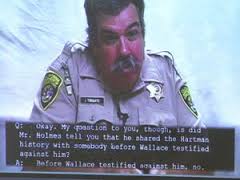
torquatoCalifornia Prison employee Officer Torquato and his supervisor’s video taped depositions were played in the courtroom. Torquato is the correctional officer, working as chaplain and educational officer in 2011, who first alerted authorities to Holmes’ involvement in the Hartman murder. Holmes confessed to Torquato, but vowed he would never name names or come forward with the story. Torquoato described in his testimony attempting to persuade Holmes to come forward to no avail, then seeking the guidance of his supervisor. Both correctional officers remember writing out the Holmes account and sending it to Fairbanks Police Department, after first making contact with officer Nolan there. The FPD ultimately did nothing with the confession. Torquato further described how he encouraged Holmes to come clean over a period of months, and how eventually Holmes wrote out his confession and sent it to the Alaska Innocence Project.

The two men, uniformed in khaki, spoke matter-of-factly about the Holmes confession and the events that followed, although at one point Officer Torquoato became more emotional in explaining his motivations for taking action, and that he could not live with the idea that four innocent men were in prison. The officers were a stark contrast to the law enforcement community in Alaska, who have roundly denied even the potential existence of wrongful conviction, and their testimony was believable. Adrienne Bachman objected to admissibility premised on hearsay, but Judge Lyle overruled her objection, reiterating that he would take in testimony and determine later which portions he was able to rely upon in his decision.

The correctional officer’s depositions served to bolster the testimony of Holmes, who took the stand the previous day to testify to his role in the 1997 murder for which the Fairbanks Four have been imprisoned for nearly 18 years.

The Fairbanks Four attorneys also focused on refuting the State’s claims that Holmes came forward to enact revenge on Jason Wallace. Holmes and Wallace committed not only the Hartman murder together, but also four other killings, and ultimately Wallace took the stand against Holmes to receive leniency in his own charges during their respective trials. Judge Lyle appeared to agree with the Fairbanks Four’s counsel that Holmes did not appear to have anything to gain, and had he been interested in revenge would have taken the opportunity during their murder trials.

A procedural issue which has ignited outrage amongst supporters of the four men was also prominent in proceedings. Superior Court Judge Lyle had previously ordered the State of Alaska to transport George Frese, Kevin Pease, and Eugene Vent from their prisons hundreds of miles away to the local jail for the evidentiary hearing. The state did so but refused to absorb the cost of transporting the men the few miles from the jail to the courthouse during proceedings and keep them there under guard. After being pressed for a dollar figure associated with the men attending their own exoneration proceedings, the State supplied the figure of $500 per man per day, for a total of $1500.00 per day. The community of Fairbanks, outraged at the idea that individuals were being prevented from attending the proceedings which would determine their future, raised nearly $10,000.00 in a matter of days to help the men appear in person.

John SkidmoreWhen attorneys for the men revealed that the money for them to attend had been raised, John Skidmore with the Alaska Department of Law initially stammered over the phone from his Anchorage office, then asked for time to determine a response. Shortly thereafter he announced that in light of the defendants “having funding” the total cost had been raised to $4,800.00 per day, that the men would be guarded by two troopers a piece, remain handcuffed, and that the troopers would be flown in from Anchorage each day and flown back, despite there being nine designated Judicial Services troopers in Fairbanks. In addition to the outrageous and more-than-tripled dollar figure, the State went on the say that to meet their own demands would be to taxing and that they did not want to do it all. John Skidmore is a favorite lackey of the state, and is pictured above in a Alaska Daily News photo explaining a 2014 missing-drugs-scandal where he neither confirmed nor denied anything with remarkable adeptness at saying a lot of nothing and taking no accountability, a party trick he repeated for the October 6th proceedings.

In his ruling, Judge Lyle acknowledged the importance of the request and explained that it was outside the power of the court to order the state to bring the men to court. He was apologetic as he denied the motion for the men to attend.

Although supporters of the Fairbanks Four are outraged by the transparent and absurd effort to keep the accused out of court, and it is indeed outrageous, we have resolved to be grateful. The Alaska Innocence Project was not awarded a Department of Justice grant that they have depended on as their major source of operating funds. The State of Alaska’s rather disgusting attempts to dodge facing the innocent in court should be a motivation to us all to be sure they face the innocent in court over and over. The $10,000 raised to send the men to court will now be donated to the Alaska Innocence Project, and we hope to triple that figure by the end of the month. The answer to darkness must always be light. So, thank you Ms. Bachman and Mr. Skidmore, together you have inspired us to make sure you continue to face the innocent. Next time, we will be prepared to assure that involves looking them in the eye.

To donate to the fund to support the Innocence Project CLICK HERE! If everyone who saw this post gave just $1 we would have $30,000 in a matter of a few days.

Below are a few links to coverage of day two:

Newsminer – Judge Denies Motion for Attendance

KTUU Day Two – VIDEO

Back in court – Opening Arguments and Witnesses in Fairbanks Four Hearings

MArvininCourtOctober 5, 2015 marked the first day of proceedings in the evidentiary hearing the Fairbanks Four, their attorneys, and supporters hope will ultimately lead to their exoneration.

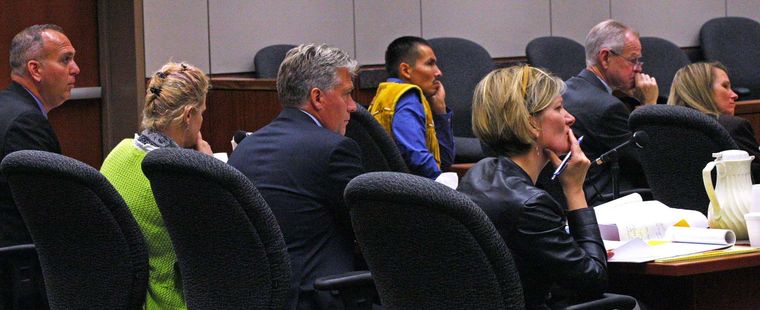
Inside the courtroom, Marvin Roberts was flanked by attorneys, his traditional beaded moosehide vest among the black suit jackets underscoring his singularity in the courtroom. His three – sat a few miles away at Fairbanks Correctional Center, where the State had been ordered to transport them. The court was, however, unable to force the State to transport them under guard the few remaining miles to the courthouse each day when the State refused. Equally alone, and every bit as tasked with the burden of representing those who could not be there in person, was Chris “Sean” Kelly, the elder brother of victim John Hartman.

Nearly eighteen years have passed since the last time this case was in court, and the years have altered many in the crowd. Accused man Marvin Roberts, the only one of the four to achieve parole, and Hartman’s brother Sean Kelly are middle-aged men now. Hazel Roberts, mother to Marvin, has gray streaking her hair now, and is on the doorstep of 60. The last time she sat behind her son proclaiming his innocence she was nearly the age he is today. Hartman’s mother is long deceased. Also present at court was George Frese’s daughter with her daughter on her lap. Today, she is twenty years old, and her daughter is three. In 1997 she was a three-year old on her mother’s lap and her father George was twenty. The years calculated in their alteration of the human beings involved are painfully visible. The rows of spectators listened carefully as the case began. Immediately prior to proceedings, journalist Brian O’Donoghue, whose investigative reporting first revealed the many issues with the original convictions to the public, was unceremoniously ejected from the courtroom. State prosecutor Adrienne Bachman deposed both O’Donoghue and blogger April Monroe, making them witnesses to the case, in what many suspect was an effort to execute control over coverage of the proceedings. The crowd shook their heads as O’Donoghue rose and walked from the courtroom, unable to cover the story for the first time since its inception.

During opening statements attorneys for the men and the State of Alaska outlined their respective cases. The Fairbanks Four, as George Frese, Kevin Pease, Eugene Vent, and Marvin Roberts have come to be known, are visibly well represented on this return trip to court. The eighteen years that have elapsed since their original conviction have virtually inverted the appearance of the courtroom – a reflection of the change in public sentiment about the case. The attorneys for the Fairbanks Four sat two tables deep, and opening statements were given in turn by the lead counsel for each of the men. The Fairbanks Four, their attorneys argued, are entirely innocent of the murder of John Hartman. In an opening bolstered by a series of video clips – William Holmes unemotionally confessing to the murder of Hartman in detail, his co-conspirator Jason Wallace implicated by both Holmes and his own statements cockily invoking his right against self-incrimination when asked about his role in the killing, and former star witness Arlo Olson recanting his original testimony – attorneys for the Fairbanks Four argued passionately that their clients were absolutely innocent, as they themselves have insisted since the first day of incarceration and maintained these many years.

Adrienne Bachman argued for the State of Alaska that jury trial is the “bedrock of the justice system,” that the judge had no business being a super-juror in the case, and went on to say she would call witnesses who bolstered the original case, including a cab driver who came forward in 2014 to claim she saw four “Asian-looking men” in the Barnette area the night of the murder, and “felt a catch in her heart.” She outlined a basic argument for countering the admissibility of anything she deemed hearsay, communicated her intention to stand by the boot print exhibit created by controversial figures Jeff O’Bryant and Aaron Ring, and exhibit repeatedly described as misleading and totally unscientific by experts, reiterated that alibi witnesses should not be called because if “they were not believable the first time, they are not believable now.” Bachman also revisited the testimony of Melanie Durham, a women’s shelter resident in 1997 whose testimony about hearing the Hartman beating has long been used as a reference for the time of the crime. Durham came forward when she realized the beating she heard had resulted in a death, claiming to have heard “dark” voices and a smaller voice plead for help. After the Fairbanks Four were arrested and she had a conversation with officer Aaron Ring, accused by supporters of significant misconduct in the case, Durham altered her story to be that although she was not close enough to hear audible words, and she saw nothing, that she was still able to identify the voices as Native due to an accent (as an aside – none of the Fairbanks Four have a “Native” accent, all are verified city boys). Durham’s  illogical but racially charged testimony was effective the first time, and Bachman argued that Durham did not hear a black man, despite Holmes’ having a classic “African-American speech pattern.” It was an interesting addition to the theory that witnesses can distinguish Natives in the dark distance by indistinguishable speech – the State expressed their stance that this is also true of African Americans.

In the end, both sides argued what is to be expected – the attorneys for the Fairbanks Four argued based on fact and witness testimony that their clients are actually innocent of the crime for which they have spent the last 18 years in prison, and Adrienne Bachman argued that she did not want to be there and did not think it was fair that her opponents were presenting this information in court. Oh, also that her witness has the superpower of identifying people by ethnicity without seeing them, and that she has a witness who may have seen four Asians in 1997, because that is close enough, right? In all reality, it is dismaying to say the least to hear bigotry presented as fact in 2015 as in 1997.

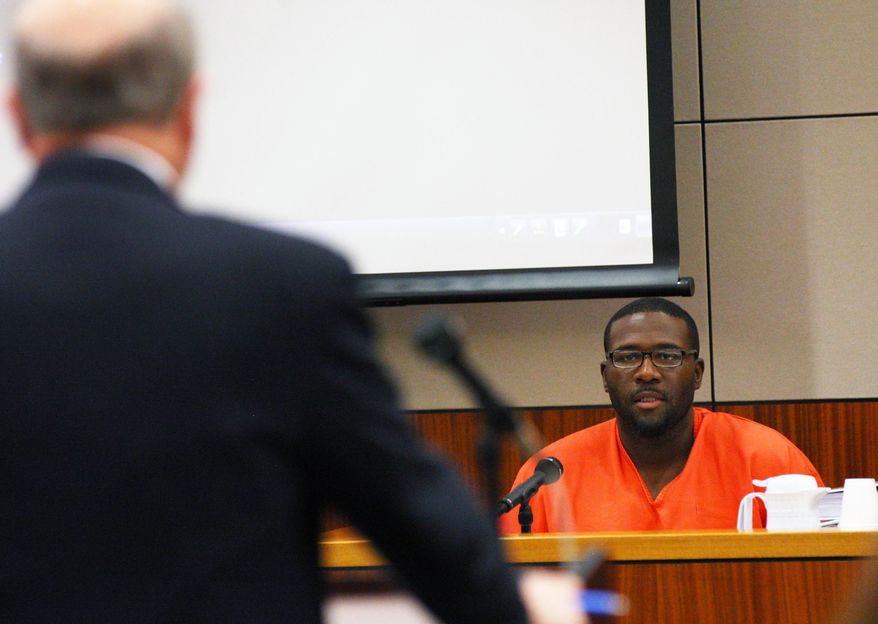
Opening arguments were followed immediately by the in-person testimony of one of the most critical and controversial witnesses in the current case – William “Bill” Holmes. The crowd sat in absolute silence as Holmes, in horn rim glasses, orange prison garb, and flanked by troopers, described with apparent ease his role in John Hartman’s death. He discussed attending a high school part at classmate Regent Epperson’s house, and leaving when it was “boring.” He described the plans to assault Natives, repeatedly referring to the Alaskan indigenous as “drunk Natives” as he relayed the series of attempted assaults that culminated in the fatal assault of Hartman. He described the other teenagers running back to the car, near hysteria because “little J was just trippin,’ stompin’ the old boy out.” He describes discovering a few days later that the assault proved fatal, that others had been arrested for the crime, Wallace showing off and laughing at Hartman’s blood still on his shoes, and how Holmes threatened the other teenagers present with murder should they ever come forward.

When describing his motivation, Holmes insisted that God had moved him, nothing more and nothing less.

William Holmes TestimonyHolmes proved a difficult witness to undermine for Bachman, who focused heavily on his ability to identify his route through arial photographs and his definition of “U-turn.” The line of questioning ultimately backfired as Holmes described by landmark with great accuracy the corner of 9th and Barnette. Bachman also sought to undermine Holmes’ claim of faith by grilling him about sexual conversations had via contraband cellphone with a woman. Bachman insisted Holmes could not be both coming forward for spiritual religions and ‘talking dirty’ to a woman. She ended her cross examination with a brief commentary about his testimony being hearsay, prodding Holmes with the claim that he didn’t see anything or commit a crime. Holmes responded that he thought driving the car for premeditated assaults, driving the getaway car for a murder, threatening witness/participants with death if they came forward, and destroying evidence was indeed a crime. In the end, Holmes had the better end of that argument.

Most memorable in the Holmes testimony, however, was simply the easy demeanor with which Holmes reflected on Wallace “stomping the ol’ boy out.” For the many people whose lives were turned upside down when Marvin, Eugene, Kevin, and George were imprisoned for the killing, hearing the details of the brutal death of young Hartman for the first time were overwhelming.

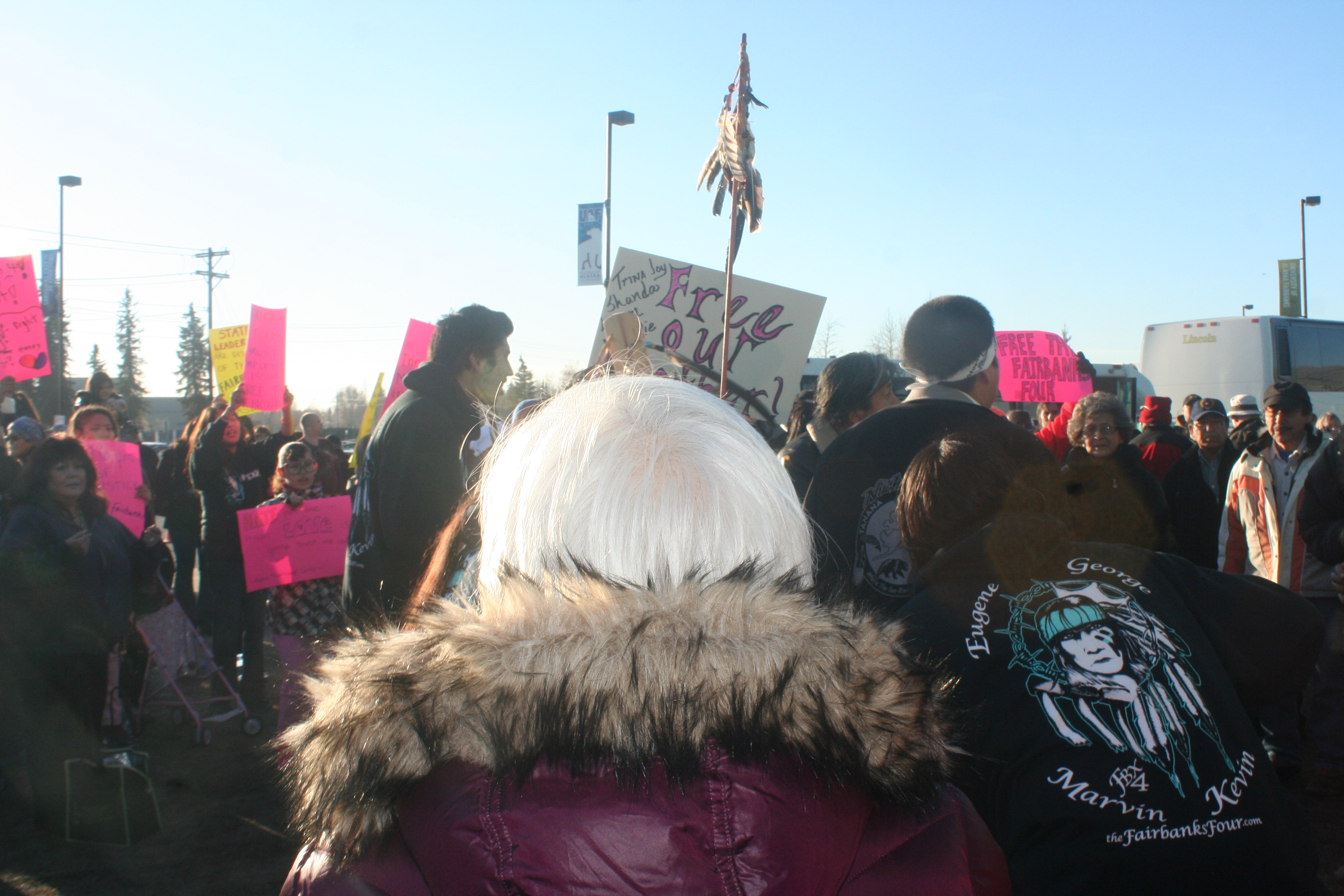
FairbanksFourrallySpectators exited the courtroom visibly shaken by the Holmes testimony, and as Marvin Roberts and TCC President Victor Joseph stepped into the large crowd gathered to protest outside the courtroom, the mood turned somber.

“We need to pray for John Hartman, for this little boy, and his brother who is here today. We need to lift him up,” Joseph began, and continued to urge the crowd to support the Four and continue their work.

Marvin thanked the crowd, tears catching in his throat as he listed his co-defendants still in jail by name.

The crowd of supporters, which included the UAF chancellor and bishop of the Alaska Episcopal church, played drum and sang traditional songs in a circle around the courthouse steps.

“Two years ago,” Father Scott Fisher said in closing prayers, “we gathered in this same place, with faith, and insisted, the light is coming. Today, it is sunrise.”
Below are some of the many articles and videos about the first day of the Fairbanks Four proceedings. We will update you as trial continues.

KTUU – Fairbanks Four Hearing Begins (article/video)

KTVF – First Day of Trial

Indian Country Today ‘Fairbanks Four’ Seek Truth, Freedom

NPR – Dan Bross – Bill Holmes Testimony

Washington Times – Fairbanks Four Want Convictions Overturned

Big Bad Wolf V – Adrienne Bachman

bachmanIn the 1990’s, when accusations of corruption and misconduct ran wild in the Fairbanks legal and law enforcement community, Adrienne Bachman had absolutely nothing to do with the Fairbanks Four case. But don’t get your hopes up that that is a good thing. She was busy engaging in misconduct on her own cases.

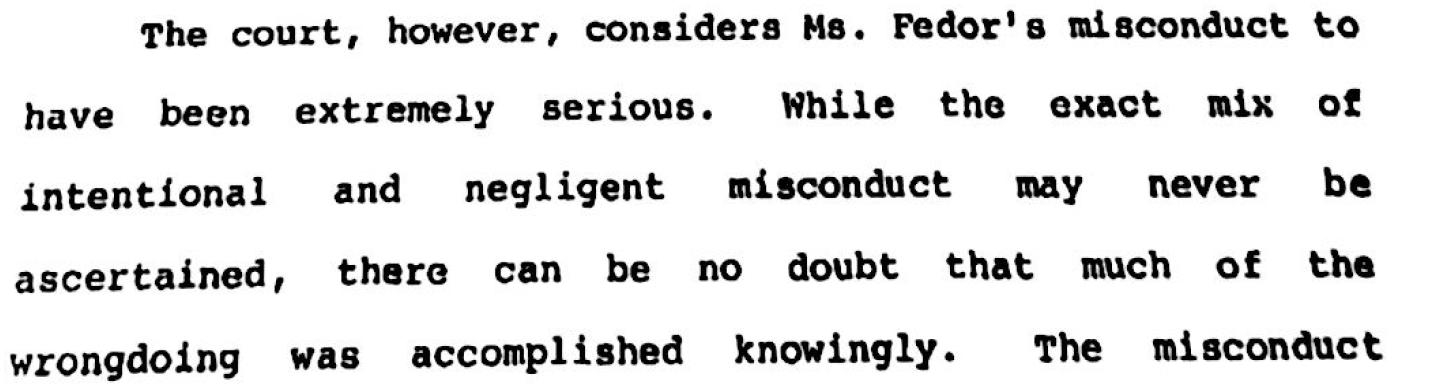
Ms. Bachman was a practicing prosecutor for the District Attorney in Anchorage. In the spring of 1990, Judge Joan Katz had the following to say about Ms. Bachman (The Ms. Fedor) and her work.

“While the exact mix of intentional negligence and negligent misconduct may never be ascertained, there can be no doubt that much of the wrongdoing was accomplished knowingly.”

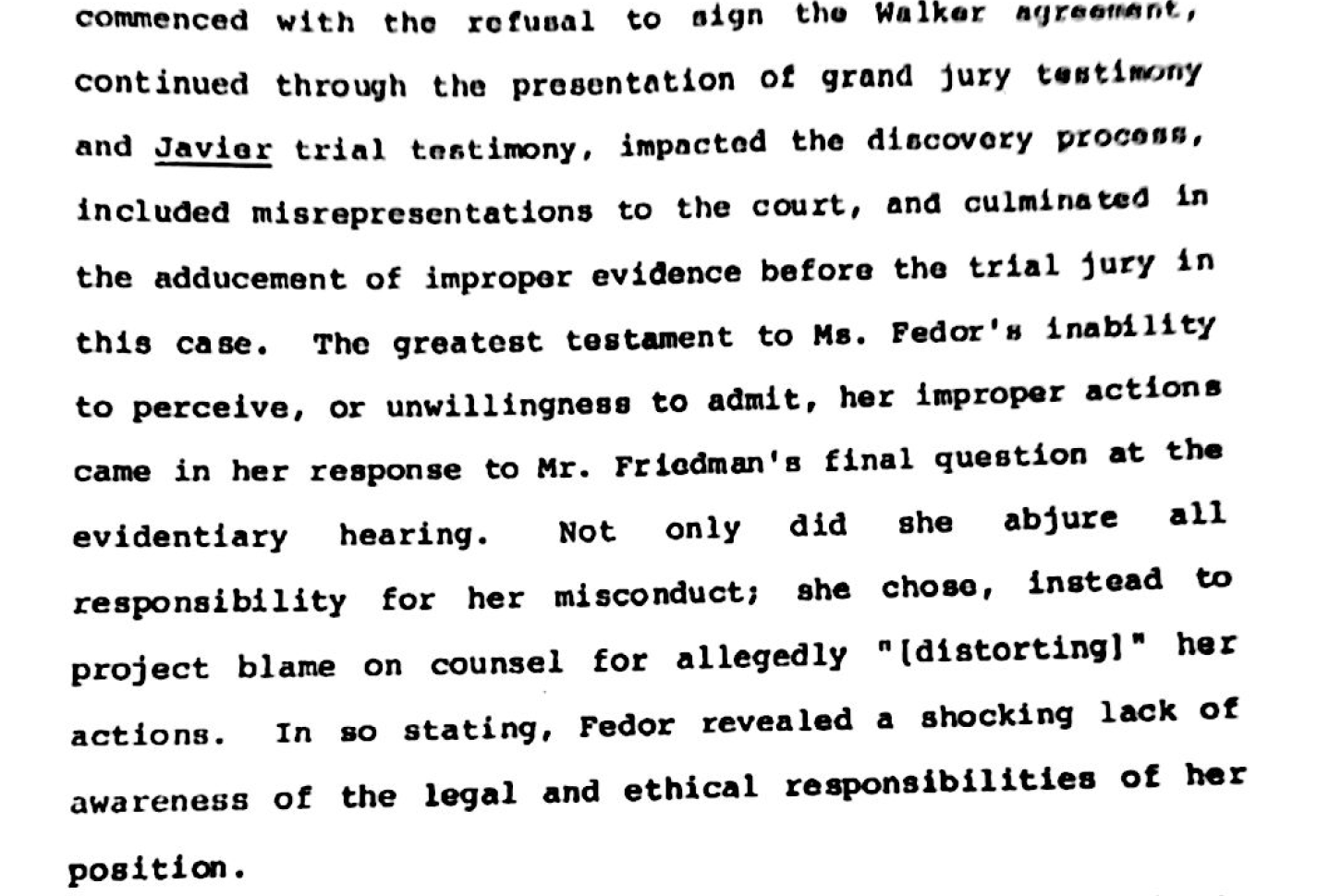
“She revealed a shocking lack of awareness of the legal and ethical responsibilities of her position.”

The judge’s commentary can be read in greater length below:

Bachman1

Bachman2

One can deduce from the document that Ms. Bachman knowingly engaged in misconduct which carried on through an entire legal process and resulted in false information being presented to a jury at trial. Then, when opposing counsel called her on it, she denied it, blamed it on them, and showed such a lack of awareness of her wrongdoing that the presiding judge called it “shocking.” Following this episode, Bachman was of course promoted and made her way steadily up the ladder within the District Attorney’s office in Alaska.

When the Alaska Innocence Project filed a petition for post conviction relief in September of 2013, the State of Alaska responded with this dismissive press release, at once promising the public an independent investigation and exposing the depth of their bias. The State then came under significant and immediate pressure from citizens, religious leaders, and politicians to act swiftly in the interest of justice. Senators Murkowski and Begich published open letters calling for a transparent and independent review of the revelations in the filing and pondering federal intervention. Letters to the editor flooded local publications across the state. The Alaska Federation of Natives, Tanana Chiefs Conference, scores of other Native organizations, and the Episcopal diocese all took public positions supporting the claim of innocence and demanding an actual investigation.

The State of Alaska ultimately responded to this outcry by assigning Adrienne Bachman to the case. Bachman is known as an aggressive criminal prosecutor – a conviction-at-all-costs attorney. There is no doubt she is both skilled and practiced at achieving and upholding criminal convictions. However, there is no indication that she is the right candidate for a thoughtful and unbiased examination of a civil petition for post conviction relief. The act of  choosing Bachman to head the State’s response on the Fairbanks Four case shows a shocking lack of awareness of the legal and ethical responsibilities the state has as an agent of justice. The apple, as they say, does not fall far from the tree.

To assign an aggressive prosecutor to a case where the convictions are in question and an independent review has been promised speaks volumes to the state’s intention with the case. To assign a prosecutor with a significant history of perjury and misconduct to an extremely public case so haunted by accusations of prosecutorial and police misconduct is…..confusing. Does the state not have access to a prosecutor who hasn’t engaged in misconduct? Is this the ultimate figurative middle finger to the petitioners, their attorneys, and every Alaskan whether a leader or citizen who asked for actual justice? They are attorneys, so they know to maybe be worried about getting sued later, right? Is this a joke? Like, a really inappropriate and poorly done joke? It defies explanation.

It would be wonderful to address the conduct of the special prosecutor as it relates to this case and assure readers that her “shocking” conduct is a thing of the past. However, this case began with Ms. Bachman’s request for a delay to accommodate, among other things, her vacation. That was followed by this fascinating interview with Indian country in which Ms. Bachman managed to tell enough lies that a post detailing them was longer than the interview. Then, there was this NPR interview where she boldly insisted that comparing Natives to unruly slaves lying ala Spartacus was not racist at all, following in the steps of original prosecutor Jeff O’Bryant (read about his controversial ‘Spartacus’ argument HERE),there was this insane attack on Scott Davison for having the gall to come forward without a bribe, the revelation that a murder confession was known and covered up in the case, and a virtually unending onslaught of offensive and dishonest statements, a fan favorite being when she made a filing attacking the credibility of William Holmes, AFTER she had administered and he had passed a lie detector test.

The counter-argument that some within the profession of law, particularly prosecutors, would supply to defend Ms. Bachman’s actions is that her actions fall within standard practice for prosecutors, or that she is ‘only doing her job.’ Although we can appreciate that people who do these kinds of things may need to tell themselves these bedtime stories to fall asleep at night, these excuses hardly make the choices acceptable.

Doing the wrong thing because other people do the wrong thing does not make it okay – it makes it a conspiracy. Doing the wrong thing for money is just gross. Do we really need to explain why receiving a paycheck for doing something wrong is probably even worse, but at best just as wrong, as doing it for free? The greatest travesties of humanity have been carried out by people who used the same excuses. Nazi soldiers did things like install new piping to gas chambers so as to more effectively murder thousands of innocent people, chatted over coffee while their victims clawed the  metal walls and begged for mercy, yanked screaming children from their mothers, and went home at night and told themselves, ‘everyone is doing this.” When the war was over and they were taken to trial in Nuremberg to explain how they perpetrated such atrocities, they all used the same defense so consistently that it has come to be known as the “Nuremberg defense.” The premise of this defense is “Befehl ist Befehl,” or “I was only following orders.”

It is hard to say whether the State of Alaska selected Bachman because they felt she was the woman for the job (the job, of course, being holding faith in these convicitons into delusional territory and without regard for actual justice), or if they just chose to throw her under the bus by handing her someone else’s impossible mess to clean up while those with meaningful power hid from the ramifications of this failing case. Either way, their selection of Ms. Bachman and her ensuing conduct since have made it entirely clear that the State is not interested in justice, honesty, or transparency. Some day, when this verdict is clear and this case takes its rightful place as an important moment in the civil rights movement of Alaska, this story will be told in its entirety for posterity. History will remember, and it will all be made clear. Until then, we can only hope the best for all, and that everyone involved will make choices they can be proud of later, because someday these choices will be examined by history and aired in a court higher than the one of man.

.

Appeals Court Reveals Second Murder Confession in Hartman Murder

In a ruling made public today, the Alaska Appellate Court has shot down the efforts of inmate Jason Wallace to keep his confession to the murder of John Hartman out of court.

Although the exact statements of Jason Wallace related to his participation in the 1997 murder for which the Fairbanks Four were convicted and remain incarcerated have yet to be revealed to the public, the ruling confirms that Jason Wallace made statements to “an investigator working for his attorney which, if true, would tend to exculpate four defendants who were previously convicted of the same crime that J.W. described.” Wallace, currently incarcerated for another murder and represented by Fairbanks attorney Jason Gazewood who was most recently in the news after being held in contempt of court, has fought the release of his confession since the Alaska Innocence Project entered them under seal as part of a Post Conviction Relief filing based on actual innocence on behalf of the Fairbanks Four. Marvin Roberts, Eugene Vent, Kevin Pease, and George Frese were arrested and convicted of the Hartman murder in October of 1997. the four young men were convicted despite a wealth of alibi evidence and with no physical evidence of any kind linking them to the victim or each other.

Jason Wallace has been fingered as an alternate suspect in the Hartman killing since at least 2004, but a substantial statement related to his involvement proved elusive. Finally, in a sworn affidavit to the Alaska Innocence Project dated in 2008, high school acquaintance of Wallace Scott Davison detailed the statements about the killing Wallace had made to him just days after the murder. Davison was absolutely bullied and berated by the State of Alaska for coming forward.

According to oral arguments made during a recent misconduct hearing on the case, in 2011 William Holmes, a Fairbanks man serving a double life sentence in a California prison for unrelated murders, developed a relationship with correctional officer and chaplain Joseph Torquato. Holmes told Torquato about his life in Alaska and his troubled past. On December 5th, 2011 Holmes detailed to Torquato his role in the stomping murder of a young boy for which four innocent men were imprisoned. Torquato was so compelled by the statements of William Holmes that he went home the same night and used the internet to research similar murders in Alaska. He came upon the Hartman case, and the next day when he saw Holmes he asked him, “Does the name Hartman mean anything to you?” to which Holmes replied, “Do you mean John Hartman?” The inmate confirmed that the murder he had confessed to the previous day was indeed the Hartman murder. Torquato implored Holmes to come forward to Fairbanks authorities, but he refused.

The correctional officer then took the information to his supervisor and together the two composed what is now referred to in proceedings as the “Torquato Memo.” Torquato sent the written account of the confession by Holmes to the Fairbanks Police department. They forwarded it to the District Attorney’s office. Ultimately, neither party took action.

The State’s failure to disclose the confession of Holmes when first received was the subject of the July 30th hearing in Fairbanks Superior Court, where the state argued that the wording of the Code of Ethics as written in 2011 should have allowed the prosecutor to withhold the confession, although they conceded that such conduct would not be acceptable in 2014. They further argued that because the Fairbanks Four had been convicted by 2011 that they did not have any remaining constitutional due process rights.

Counsel for the Fairbanks Four argued that there were indeed state and federal constitutional rights violated through the withholding of the Holmes confession, and that the ethical obligation to disclose the confession was so clear that it was “offensive to justice” to have withheld it. Attorneys for the Fairbanks Four discussed the harm that had come to the four men’s case as a result of the State’s decision to hide the Holmes confession. Among other things, they cited the 2014 deaths of two witnesses who had heard confessions from Marquez Pennington. Had the State revealed the confession as obligated, the argued, the witnesses may have been alive to testify that Marquez Pennington made admissions in the case as well. This small comment was the first reference to yet a third confession – the confession of Marquez Pennington. 

A decision as to whether the actions of the District Attorney violated the rights of the men known as the Fairbanks Four is forthcoming from Judge Paul Lyle.

Despite the State decision to withhold the confession, it eventually came out. Holmes confessed directly to the Alaska Innocence Project. In 2012, Holmes mailed a detailed and handwritten confession to his role in the killing of John Hartman in which he named Jason Holmes, Marquez Pennington, Shelmar Johnson, and Rashan Brown. The five teenagers, according to Holmes, went out that night hoping to assault “drunk Natives” for fun, and after being unable to find the ideal victim happened upon John Hartman. According to Holmes Jason Wallace was the ringleader of the vicious assault, but all four of the other men he named attacked and killed Hartman, while Holmes served as driver. (Read the Holmes confession HERE). IMG_7092

The Holmes confession provided answers long-sought by the Fairbanks Four and their families and friends who for nearly two decades have insisted on their innocence. It also corroborated the affidavit of Scott Davison, and became the centerpiece of the 2013 Alaska Innocence Project filing for Post Conviction Relief on behalf of the men. Also contained in the filing were statements made by Jason Wallace said to “corroborate the confession of William Holmes.”

The statements by Wallace, potentially subject to attorney-client privilege, were filed under seal and it was never known if they would be made public. Jason Wallace can, and likely will, appeal the decision to release his confession to the Alaska Supreme Court, although it seems unlikely that they would opt to hear the case. The decision by the Court of Appeals only applies to the narrow issue of whether or not the judge CAN consider it for admission. It is still possible that Judge Lyle will not declare it admissible. It is possible that he may admit it and keep it confidential.

This wins a battle, but the war is long.

story1Whatever the legal meanderings of this case through the maze of a truly sick justice system, we have as much faith today as we did when we wrote our first post. The first time anyone ever used the term “Fairbanks Four” we used it with this promise beside it  –  “This is story of injustice, a plea for help, for understanding, and above all a story of faith in the power of stories, of the truth. Writing this blog is an act of faith, a testimony to the power of the truth, spoken, read. We may not be experts in journalism, in law, or many other things. But the contributors here come from Alaska, from a culture that has a long tradition of storytelling, and a belief that the truth holds incredible power. This is a long story, and we will have to tell it the old way, the slow way, in pieces as they come.”

This story is unfolding as we knew it would and know it will because we have known the ending since the beginning. This blog is still a story, told in pieces as they come. Today, this is a new piece of a long story. This movement is still a plea for help. We need you to share this story and do what you can to right a wrong.

Above all, it is still an act of faith and we have absolute faith in the good of people like you and the power of the truth.

Deranged State of Alaska Insists that Innocent Men Should Remain in Prison

queenofheartsThe State of Alaska filed their response to the Innocence Project filing that rejected their claims. You can and should read about that HERE. Because, honestly, the state’s response is so stupid that it isn’t even fun to write about and probably no picnic to read about either. And it has left me thinking about the crazy, mean Queen of Hearts from Alice in Wonderland. Remember her? I am feeling pretty convinced that if we put her in charge of the justice system in the State of Alaska we would be making a fair trade in terms of ethics and competence. But at least we would have painted roses and maybe a catchy theme song.

The State of Alaska started this response period of with….wait for it….yet another request for an extension! When they requested an extension I had high hopes that they may have something at least new to say. Alas, it appears they needed more time to simply regurgitate their last filing, with the spelling errors mostly cleaned up, and the rather embarrassing, tasteless, dishonest attack on a witness removed.

But the basics are the same. The State of Alaska is willing to have an evidentiary hearing on the Fairbanks Four case. They just don’t want any of the evidence to be allowed in. They surmise that in this evidence hearing they do not want any evidence that will bring Alaskans “closure” on this issue. Apparently, they honestly believe their citizens are so unaware or stupid that we will accept an evidence hearing without the evidence as closure and go on with our lives, pretending that they didn’t lock up innocent children. Pretending that they didn’t leave serial killers on our streets. Pretending that they didn’t lie, hide, cheat, and bribe. We cannot have justice, so they offer “closure” through a review of evidence with no evidence allowed.

I can see why – it is evidence likely to set innocent men free. It is evidence likely to make it crystal clear that the Fairbanks Police Department chief hid a murder confession. That the DA hid a murder confession. That the courts are still hiding what appears to be a separate murder confession. That witnesses were harassed. That witnesses were bribed. And, most horrifyingly, that if the people sworn to seek and uphold justice in 1997 had tried even a little bit to do that, not only would four innocent men be free, but at least five other lives could have been saved, perhaps more. It’s the brutal and unflinching truth, and the truth is the rattling skeleton in the State of Alaska’s gleaming mansion of lies.

The State argues that the confession of William Holmes should be thrown out and considered hearsay. We discussed that at length HERE the last time they made the argument.

The State argues that the scientific evidence should not be allowed in because progression in the forensic sciences is not relevant to post conviction relief filings. I mean, who needs science, right? The progression in the sciences has more than doubled our life expectancy and led to such revelations as the world not being flat, the existence of space, and the cure to the diseases that used to kill nearly all of us. But, scientific progress isn’t for the State of Alaska.

In a nutshell, the state believes a confession of murder from the murderer is “hearsay” and that modern science has no place in a courtroom. Even though the filing is full of words and legal references (as a matter of fact, in one jewel of a statement they attempt to discuss precedent by citing an unpublished opinion that they then acknowledge does not set precedent), all I can picture is that crazy queen. Our system indeed seems that absurd, deranged, and sick with power. It would be easy to make fun of that for 5,000 words. Yet, the state opinion is so ridiculous it is essentially a parody of itself. And, they are spending your tax dollars to do this absurd work, much more slowly than necessary!

In the end, there is nothing funny about it. This isn’t a movie and it isn’t a joke. Lives are at stake, and our justice system is sick, sick, sick. It remains sad, it remains shocking, it remains heartbreakingly painful that the State of Alaska is so invested in protecting themselves from embarrassment that there is no limit to the lives they will ruin, deaths they will turn a blind eye to, and lows they will stoop to. But, it has been made clear that they have no plan to change their tactic.

It’s an election year. Alaskans, you might want to ask your politicians about this issue. Surely, we can do better than this.


Scott Davison Is Not Only Credible, He is ADMIRABLE

truthIn late 1997 Lathrop student Scott Davison skipped school to smoke pot with friend Matt Ellsworth and fellow student Jason Wallace. While the three young men got high and talked, Wallace made a statement that would prove life-altering for Davison.

According to Davison, Jason Wallace told them that he and his friends had beaten and killed John Hartman. He detailed a night of driving around looking for victims that culminated in the fatal beating for which four other young men had just been charged. Wallace ended the story with a threat. If Davison or Ellsworth ever repeated what he had just told them, he would kill them as well.

At the time, Davison was only seventeen years old. He was a child. And he was now a child burdened with a terrible and violent secret and the very real possibility that unburdening himself of the secret would result in his death. To keep a secret is to carry a weight. It drags you down and it permeates the deepest recesses of the mind. It hardens the heart. What an awful curse to be placed on the shoulders of a child.

Davison, understandably, said nothing to anyone. Years passed. If there was ever any doubt in his mind that Wallace was capable of making good on his threat, that doubt would have been entirely destroyed when just five years after Davison heard Wallace confess his first murder, Wallace killed again. On Christmas Eve of 2002 Jason Wallace beat a young woman to death with a hammer, crossed town to stab another man repeatedly with a screwdriver, and then returned to the woman’s apartment to set her lifeless body on fire. Clearly, Wallace was not only capable of killing, he was capable of inflicting unthinkably depraved torture and killing in cold blood. He was capable of killing an unarmed woman on Christmas Eve. He carried within him a darkness beyond imagination. So, understandably, Scott Davison continued to hold his secret.

Yet, a secret of that magnitude is a heavy burden. It is difficult to imagine the internal tug-of-war that any human being holding that information would endure. On one hand, innocent men are in prison. On the other hand, the system in place put them there and could not be trusted to allow the information to free them. On one hand, Wallace was locked up and couldn’t just show up at the door. On the other hand, Davison himself was in and out of jail at that time. On one hand, his life could be destroyed or taken if he revealed his truth. On the other hand, four other men’s lives had been destroyed. Hartman’s life had been taken.

Davison must have weighed these things over, and over, and over. Like a stone tumbled for years until finally the rough edges are worn away and the stone is smooth. And after years of that internal dialogue, Davison made a choice.

He had nothing to gain. Absolutely nothing to gain. Nothing, that is, besides becoming a man who was given a choice and made the right one. With his life and dignity and reputation at risk, Davison walked into the Innocence Project office and revealed the secret he had been so unfairly lain in his life’s path on a snowy October afternoon in 1997.

There is a reason for everything. Davison was not the victim of happenstance. To be the bearer of a truth so heavy was a task he was fated for, because Davison did something with it that few are capable of. He risked his life, he signed up for humiliation, risked retaliation, reputation – he laid all he had to offer down in service of a higher truth.

Much of the State of Alaska’s filing made in response to the Alaska Innocence Project’s aimed at demonstrating the innocence of the Fairbanks Four is focused on the task of discrediting, humiliating, and slandering Scott Davison.

Although prosecutor Adrienne Bachman waxes disjointedly and frequently about hearsay throughout the twenty-three page document, claiming that the Holmes confession and Davison’s statements are both hearsay and therefore have no place in a court of law, the remainder of the filing appears to consist nearly entirely of actual hearsay generated by Bachman herself. She makes one claim after another about the character of Scott Davison, yet the filing contains no documentation to support that her claims are factual.

Bachman berates and belittles Davison in every imaginable way. She calls him an informant in one breath, and with the next says he did not follow through with a request to be an informant. She speculates about the relationships Davison had, claiming he was “charged often and convicted occasionally” of domestic violence. Which, of course, means what it says – despite frequently being accused of domestic violence inside a relationship, he was seldom found to be guilty of the charges. Not that the nature of his relationship drama has a thing at all to do with his credibility.

Bachman asserts in her filing that because Scott Davison has nothing to gain by coming forward, and that in the past when he had legal problems he could have attempted to leverage this information to ask for leniency in his own sentencing and did not, that he should not be believed. Read that one twice. She says there is nothing in this for Scott Davison personally, and somehow that makes him less credible. Umm…okay, Adrienne. In all reality, the fact that he has nothing to gain and so much to lose bolsters the credibility of his statement.

She further attacks his credibility because he did not come forward in 1997 when Wallace first confessed to him. Yet, Davison was a teenage boy when he heard the confession of Wallace. Wallace had literally just gotten away with murder, and threatened to kill Davison should he come forward. It is unreasonable for anyone to think that a child sworn to secrecy under threat of death would call the police to tell them the secret. A secret he had heard while skipping school to get high. It is reasonable to expect an adult to make that judgment – to come forward despite the risks. And when Davison became an adult he used the judgment of one and came forward. But in 1997 he responded the way any thoughtful person would expect a child to respond. With fear. He was scared, as anyone would be.

As a young man Scott Davison clearly took a troubled path. It was that troubled path that crossed with Wallace’s. If not for the poor life choices Davison was making in the late 90’s, he would have never encountered Wallace. Although Bachman attacks his credibility based on his past criminal activities, it is only logical that anyone who had credible information on Wallace would be an associate. And most of Wallace’s associates would have had criminal tendencies. Brids of a feather, as they say.

Davison was a drug user and committed a series of crimes, primarily domestic violence and violations of the original conditions of release which all stemmed from an incident in 1998 when Davison apparently robbed someone and injured them in the course of the robbery. She describes this in such a way as to lead a reader to believe that Scott Davison ran up to an old woman, slashed her face, and ran off with her purse. Although her characterization of the events is dramatic, it is unsupported and irrelevant.

Scott Davison has clearly made mistakes in his life. He has made choices I cannot and will not defend, and he has made choices which are not admirable. Most human beings have made choices that are not defensible, and that we are ashamed of. Most of us would be devastated to read our regrets, shame, and sins on the front page of the paper. Scott Davison may have made some bad choices, but he made one decision that I find heroic. With nothing to gain and everything to lose, he opted to tell the truth and do the right thing for four strangers. For fellow human beings that he did not know. He laid his life on the line for men he never knew. And that, my friends, is one of the most courageous things I have seen a person do during my time on Earth.

When the investigators for the state contacted Davison he stuck with his story. They attack his credibility on minor details – in one version of events he claimed they smoked pot inside a car, in another version outside, etc. But on this point he did not waiver: Jason Wallace had confessed in detail to murdering John Hartman in 1997. When the state was unable to attack the factual merit of Davison’s story, they attempted to attack his will. They attempted to humiliate and discredit him as a human being when they realized that he could not be discredited as a witness.

Scott Davison, wherever you are, thank you. From the bottom of our hearts. Matt Ellsworth, wherever you are, please, DO THE RIGHT THING. That secret was bestowed upon two men. Two men have turned this over and over in their minds and made very different decisions. Davison’s is to speak, Ellsworth’s is to remain silent. We have said before and will say again the enemy of the truth is not a lie, it is silence. It is time to speak up. Four innocent men are in prison. Many murder victims followed Hartman and their lives could have been saved. Ask yourself, are you the kind of man who in the face of oppression with lives on the line speaks or remains silent? What would you wish from your fellow man if you were the the victim of injustice? It is understandable to be afraid then, and now. But how does a secret keep you safe when murderers know you are keeping it? The time for secrets is over. Scott Davison should not have to stand alone. You should be standing behind him. And if you do, we will stand with you.

Imagine hearing a confession of murder as a kid. Imagine carrying that secret for years. Imagine mustering the courage to speak out. And imagine, for a moment, what it must feel like to be so personally and obscenely attacked as retaliation for doing the right thing.

Whatever his past misdeeds, Scott Davison did what the State of Alaska will not and more: he accepted the risk of humiliation and even death to protect the concept of justice. Scott, thank you. We are so very sorry for the way you are being treated, and admire your decision to come forward. No matter what contents of your past the state chooses to parade around, your courage in this case has revealed the content of your heart to be good. Keep on keeping on!


State of Alaska Responds to Fairbanks Four Claim of Innocence

clockTick, tock. Tick, tock.

Life is about time. Time is all we have, really. And time is what the State of Alaska has stolen from so many, and what they are always wanting more of.

In the last hours of the last day remaining of the six month extension the State of Alaska was granted to review the Alaska Innocence Project’s motion for post conviction relief based on actual innocence for the Fairbanks Four, the State of Alaska has finally responded.

In September the Alaska Innocence Project and attorney Colleen Libby filed motions claiming that George Frese, Eugene Vent, Marvin Roberts, and Kevin Pease were innocent of the crime for which they were convicted. The state responded to that claim (which spanned some 131 pages) with a 23 page response which focuses largely on legal technicalities and little on the inherent accuracy of the claim that the Fairbanks Four are innocent, and that five other men are actually responsible for the violent beating death of John Hartman.

In general the response by the state reads like a typical attack by a prosecutor made on the arguments of opposing counsel. The response appears to be hastily written, with typos and a very conversational tone. It is not an thorough nor is it an independent review of the case and the claims of innocence by the Fairbanks Four, which is what the State of Alaska assured the Alaskan public is what they would receive at the end of the long extension (HERE).

In fact, the complexity of the case and the need to be thorough were cited as primary reasons for the long extension request. Senators Begich and Murkowski both wrote open letters to the governor (HERE and HERE) stating the importance of a thorough and independent review. Murkowski demanded that “no stone be left unturned.” In response, the State of Alaska overturned no stones. In fact, they only attempted to bury the stones. Begich asserted that “there can be no excuse for not having acted quickly in pursuit of justice and fairness for all involved.” In response, the State of Alaska acted slowly in pursuit of vague and poorly crafted arguments that this case should be kept out of court, with no indication that these arguments were in the interest of justice nor fairness.

We will highlight some of the most important and striking statements made by Alaska Prosecutor Adrienne Bachman on behalf of the State, and respond to them here. In this post we will focus on a few of her most important and central arguments. In the days to come we will continue to provide specific responses to the many statement made by the State. For tonight we will highlight the principle attacks on the Holmes confession. Quotes from the filing are in bold.

“As reported at the court’s last status hearing, investigation into the allegations made in the petitions is not complete.”

Let us begin by clarifying the roles of the State and Innocence Project. The Innocence Project is a legal non-profit. They function as a neutral third party who conducts independent reviews and investigations of cases that are referred to them and pass the initial screening process, during which it is determined that there exists a credible indication that the case may be one of wrongful conviction. They then complete a review and investigation and produce findings. In the case of the Fairbanks Four there has only ever been one independent investigation. That investigation was done by the Innocence Project, and the findings of that investigation were made public through the filing of a post conviction relief motion.

The State of Alaska was tasked only with reviewing and verifying the information in the PCR filing made by Alaska Innocence Project. The Innocence Project is staffed by one attorney, run by a volunteer board, and funded through donations and grants alone. They investigated a case that originated in 1997, reviewed all original materials, investigated the assault of Hartman, procured at least one direct confession, and filed their findings in less than eighteen months. By contrast, the State of Alaska has scores of attorneys at their disposal, access to the use of Alaska State Troopers, police, Alaska Bureau of Investigation, and millions of dollars in their budget for this fiscal year alone. Yet, they were unable to thoroughly review the work of one attorney in an eight month period. This is cause for concern. Furthermore, they failed to even scratch the surface of the task given them, which was to complete a review of the Alaska Innocence Project findings and investigate the evidence contained within. Instead of investigating the information to verify its accuracy they simply crafted an argument to keep the information out of court.

Let us also clarify what exactly the Fairbanks Four are asking for. They have filed a motion for post conviction relief that asks the state to vacate their convictions. It does not ask for immediate exoneration and release. It asks for convictions that were obtained with incomplete information, fictional information, fabricated testimony, coached and bribed testimony, and junk science to be vacated. The state could comply with that request and proceed into a trial. If the State of Alaska could convict them today with all available information admitted into trial, they could vacate these convictions and return to court to have an honest and fair trial, kinda like the one promised to all Americans in the constitution. It is not the release of the Fairbanks Four the State of Alaska is arguing against, it is their right to have a jury of their peers determine their guilt or innocence in a court of law. For eight months the State of Alaska has, with its virtually limitless resources, produced a document that not only fails to fulfill its expressed purpose, but is by their own admission “not complete.”


Bachman makes numerous and vigorous assertions that the testimony of William Holmes (HERE) is not in fact a confession, but hearsay.

“What the petitioners present amounts only to hearsay allegations that a third person, Jason Wallace, made incriminating statements about assaulting John Hartman…and hearsay is not admissible evidence.”

Webster Dictionary defines the two words in question here as:

Hearsay. noun. information received from other people that one cannot adequately substantiate; rumor.

Confession. noun. a written or spoken statement in which you say that you have done something wrong or committed a crime.

The confession by William Holmes is a firsthand account of his actions, motivations, intentions, movements, and observations the night John Hartman was killed. He confesses to driving into downtown Fairbanks that night with a group of friends for the express purpose of assaulting someone. He expresses that he intended to harm someone, and to drive the car necessary for all parties to flee the scene of these assaults. He further states that after learning John Hartman had died from the assault that he told his accomplices to not talk about the assault.

William Holmes confesses his crime. He confesses his sins. In fact, Holmes first attempted to provide this confession to the Fairbanks Police and through them, the District Attorney and state. They then hid the information and did nothing with it. Read about that HERE.

When the State of Alaska interviewed William Holmes about his involvement with the Hartman murder he maintained his guilt and the guilt of the other parties named. Without the ability to disprove his claim it appears that Adrienne Bachman chose the only method left to her in attempting to uphold the Fairbanks Four conviction, which was not to address whether or not the confession was true, but simply to craft an argument that it was technically not a confession.

The legal definition of hearsay is more complex, but in essence the same in spirit and application. Bachman’s assertion that the Holmes statement is purely hearsay is absurd. If her version of hearsay were to be applied that would mean that essentially a person could agree to drive their friend to go stab someone. They could wait outside until the friend came back out, bloody with a knife in hand, and said “I just finished stabbing so-and-so, let’s get out of here,” and that person’s testimony would not be allowable in court. I am not attorney, but I don’t need a legal degree to tell you, that is stupid. And if it is the best that the combined brainpower, money, resources, and attorneys at the department of law can produce in eight months, we should all be very concerned.

Bachman goes on to poke holes in the credibility of Holmes and Davison’s statements by explaining that they should not be believed because they did not come forward to get any leniency for themselves. As in, they had nothing to gain by coming forward, so we should not believe them.

Um…….okay, I officially have a headache.

In reality, the fact that neither Holmes nor Davison had anything to gain in coming forward lends credibility to their statements. If they had been offered some kind of leniency or reward or personal gain their statements would be less credible. But apparently at the department of law doing the right thing simply because it is the right thing to do is unheard of. Somehow, I am not surprised. They themselves seem much more interested in taking action for personal gain or to avoid responsibility for their actions than in doing the right thing. Which is disturbing. Because that means that the State of Alaska is apparently less ethical than a petty criminal and a triple murderer.

Perhaps the most interesting element of this filing is not what is in it, but what is NOT in it.

Bachman makes many personal attacks on Davison. Apparently when she was unable to dismantle the factual nature of his statements she opted to take a stab at intimidating and humiliating him to weaken his will. Remember, this young man had nothing to gain and everything to lose. She attacks him over and over as a person, yet does not bother to attach evidence that her claims are factual.

Bachman makes many comments about interviews and evidence that she does not introduce or include.

Bachman insinuates that she has ‘many’ witnesses, yet does not name even one.

What this filing fundamentally contains is a lot of grasping at straws, and very few facts. It is heavy on attempts to attack the truth through technicalities and light on any actual truth of its own.

Funny thing about the truth – it outlasts us all. Time reveals it. Funny thing about darkness – light banishes it.

The State of Alaska had an opportunity to seek justice instead of ego. Fundamentally, it is disappointing that they did not take that opportunity. No matter how hard they try to make this case go away, it will remain. No matter how hard they try to bury the truth, it will emerge. It is not disappointing because their approach will destroy the truth – it won’t. This battle will be long, but truth will prevail. It is disappointing because life gives human beings opportunities to choose between what is status quo and what is right. Those opportunities are gifts, and they failed to receive it. And at the end of the day, that is sad, because there is nothing so rewarding in life as to listen to your better angels and take a stand for good.

justiceAdrienne Bachman is only a person. In all reality she is just a person with a job, following rules, and taking orders from department heads and bosses. Orders from above.

We are taking orders from above, too. Perhaps it is time that she seeks a power higher than the one whose orders she followed today.


State Prosecutor Bachman’s Astounding Interview With Indian Country Today

truthWe have been pleased to see the story of the Fairbanks Four debut onto various national media outlets, but have been perhaps most gratified to see the case appear on Indian Country Today. This story has universal meaning and all Native rights issues are, at their core, human rights issues. That said, history indicates that progress is rarely made on Native issues unless and until the indigenous people of America join forces. So, we have been especially pleased to know that the story of the Fairbanks Four is reaching across tribes. This story is new to most Native people only in its specifics. Mistreatment and dismissal at the hands of the American government is, of course, a very old and familiar story to people of all tribes.

Indian Country Today’s latest article on the Fairbanks Four case is an interview with state prosecutor Adrienne Bachman, who is responsible for heading the state’s review of and response to the recent Alaska Innocence Project filing. Nothing would please us more than to tell you that the window this interview provides into the state’s perspective gave us a hope that the state intends to lead a fair and balanced investigation in the interest of justice. However, in this interview Adrienne Bachman reminds us a great deal of her predecessors – the interview contains a few politically correct general statements and an awful lot of detailed statements which indicate that Adrienne Bachman stands firmly where Jeff O’Bryant stood before her – determined to uphold a prosecution through any means necessary. And the devil, as they say, is indeed in the details.

Read the interview for yourself HERE. Below, we would like to highlight some of the more fascinating lies it contains.

“All of the arguments currently made in the petition were made during the original trial, except the Holmes affidavit. Only the Holmes allegations are new.”

This particular statement is one of the most bold, baffling, and patently false of them all. The Alaska Innocence Project filing contained over 130 pages. Less than ten were dedicated to the Holmes confession. Some other highlights? The eyewitness expert who determined that the testimony of Arlo Olson was scientifically impossible. The causative instrument forensic specialist who debunked the state claim that George Frese’s footwear matched the victim’s injuries. The affidavits by half a dozen others, including one that outlines a detailed confession made by another of the five perpetrators Jason Wallace, and language which strongly infers that the contents of the sealed brief contain yet another confession. The statement that the only new allegations contained in the filing are contained in less than 10% is outrageous. We will hope for the best here and assume that perhaps the prosecutor was only able to read the first few pages on her month-long vacation. Read the entire AKIP filing for yourself HERE. Read about SOME of the additional new evidence HERE, HERE, HERE, HERE, HERE or even, HERE.

“The petition characterizes the original evidence, but a review of the actual trial testimony shows that there were many additional pieces of evidence that are never mentioned by either the petition or the newspaper articles that seem to form the basis for much of the public opinion that lingers about this case. Examples include the various admissions or confessions made by three of the four.”

Well, this is not so much a mischaracterization as it is an absolute lie. Bachman states here that an example of evidence that has never made it into the newspaper or the AKIP filing includes “various admissions or confessions made by three of the four.” The interrogations and police interviews can be read HERE, HERE, HERE, and HERE and just in case you want to be sure you can find them in the press, take a look HERE and HERE.

Eugene Vent, after 11 hours of interrogation in total, made incriminating statements. Read about his take on that HERE. The method used to obtain the statements HERE. George Frese also made incriminating statements in the case, after hours of interrogation, and sandwiched between insistence on his innocence, a request to go home, and statements that he didn’t”actually remember any of that shit.” George’s statements were not allowed into trial after the court determined they were ILLEGALLY OBTAINED.

For readers who struggle as much as the prosecutor with counting in the single digits, that makes for TWO people who made highly questionable statements but certainly statements it would be reasonable to classify as “admissions or confessions.” Her assertion that she is in possession of three admissions is patently false.

“The state is committed to conducting a prompt, thorough and thoughtful investigation of the Holmes allegations. It is a top priority.”

Sigh. Here is a statement we WISH was true. In reality, the state waited almost a month into their 45 day response time to even begin work on this case, and in an initial interview with the Daily News Miner Bachman made it clear that her first priority in regards to the Fairbanks Four case was for the state to review the original case. You know, THEIR case, which is apparently quite unfamiliar to them. In her response to the AKIP filing Bachman made it clear that her actual first priority during the beginning of her review was her “long-standing” vacation plans. Don’t take our word for it, read all about that HERE.

No one on the jury thought there was a reasonable doubt about their guilt based on all of the evidence presented at trial.

The first jury to hear a case against George Frese ended in a hung jury.One juror, convinced the accusations were the result of a conspiracy, locked themselves in the bathroom and refused to come out. It has always seemed, to us, that juror had doubts.


The interviews of both men were fair and above board. The police did not supply the details of the beating, Mr. Vent did. He named his co-defendants as involved in the beating, not the police. As a further example, Eugene Vent told the police that he’d given [John Hartman] some gum. Since the police had not mentioned chewing gum, but did find a small pack at the scene, Mr. Vent’s own words told the world that he had been there – no matter how much he now attempts to back away from those statements.

Okay, she does know we can read, right? I am going to skip quoting anything related to gum from Eugene’s interrogation, and use a quote I find more suitable from Eugene while being interrogated: “I can’t believe what you’re saying right now.”

Like, really. I can’t believe what you’re saying right now. Sadly, that is not true. In 1997 being tricked and lied to by people meant to protect you and uphold justice seemed unbelievable. Today, it seems routine. Live and learn.

We would like to encourage all of you to read the interview with Bachman for yourself, and any and all of the case materials she refers to. We would further encourage you all to let your elected leaders know whether or not you think this case was handled properly in 1997, and whether or not much has changed since then. Although it would be possible to pick this interview apart line by line, we will leave off here with a quote from us, and a quote from someone far wiser.

At the end of the day, only one of two things can be true: either Bachman lacks the ability to read and understand the material that she is responsible for reviewing, or else she has a full grasp on the information and is choosing to lie. Neither is acceptable. We have said for the last sixteen years without abating that the State of Alaska has demonstrated a lack of ability and propensity toward dishonesty in this case that indicated it should be removed from their jurisdiction, handled by a federal agency, and that each indication of corruption, perjury, bribery, racism, and civil rights violation should be investigated thoroughly by a federal body as well. We think we have done a good job laying out our extensive reasons for taking that position; we would like to thank prosecutor Bachman for taking the time to do several press interviews that demonstrate state bias more effectively than we could ever hope to do on our own. – Fairbanks Four Blog, today, right now.
Woe to those who make unjust laws, to those who issue oppressive decrees, to deprive the poor of their rights and withhold justice from the oppressed of my people, making widows their prey and robbing the fatherless. – Isaiah 10: 1-2