Day 6 – State Cold Case Troopers Turn on Prosecution

October 12, 2015

troopersThe first witness in the court proceedings supporters and attorneys believe will free the Fairbanks Four was William Holmes, who calmly took the stand and confessed to the crime for which the four men have served the last eighteen years. He was followed by a litany of powerful witnesses who bolstered his claim. It was difficult to imagine a witness that may prove more damaging to the state’s case than Holmes. But perhaps the most powerful testimony, and the testimony most damning to the state’s insistence that the Fairbanks Four are guilty may have come today from two cold case detectives who set out to investigate the case on behalf of the state.

Troopers Gallen and McPherron worked directly under prosecutor Adrienne Bachman from late 2013 until their premature dismissal in January 2015. Both took the stand today and provided absolutely damning testimony. They disclosed that their investigation turned up serious defects in the original investigation, significant evidence to support the claim that it was William Holmes, Jason Wallace, Rashan Brown, Shelmar Johnson, and Marquez Pennington who killed a young John Hartman in 1997 – the very crime for which the Fairbanks Four were convicted and have maintained innocence for and fought 18 long years to bring back to court. Frese attorney Jahna Lindemuth asked Trooper McPherron if their investigation produced any evidence that the Fairbanks Four were present when Hartman was assaulted, McPherron simply answered, “No.”

But the two investigators testimony about the deficits in their own investigation cast harsh light onto the current approach and practices of the State of Alaska and the prosecutors who are defending the faulty convictions. Gallen and McPherron revealed that Special Prosecutor Adrienne Bachman instructed them not to collect a specific and exonerating statement from a witness who had heard a confession from Marquez Pennington, a man named as one of the fellow Hartman killers by Holmes. They also testified that prosecutors and police hid the Torquato memo and the fact that they had received and failed to respond to a confession from Holmes in 2011. Bachman, they claimed, refused to hand over emails between herself and Officer Jim Geier, a man heavily involved in the original investigation as well as alleged efforts to downplay or hide significant exonerating evidence that emerged from the time of the initial investigation through 2015.

A particularly cringe-worthy exchange between Bachman and one of her former investigators occurred when the trooper described how he, Bachman, and McPherron had tested the Olson testimony by attempting to identify each other from the distance Olson described in his testimony. Gallen stated that they had been unable to distinguish even the most basic identifying details of appearance at that distance. Bachman remarked that the troopers failed to indicate in their report that she had been able to make an ID from that distance.

“You did not indicate that to me,” Gallen replied.

Bachman only scoffed in response, and Gallen continued, “all you said was ‘O my God, oh my God, and I didn’t know what you meant by that.”

Gallen and McPherron also testified that they were removed from the case before their investigation was complete. Their demeanor toward Bachman was palpably hostile, and accusations of inappropriate conduct on behalf of the special prosecutor were peppered amongst the testimony condemning the convictions of the Fairbanks Four.

liar2Bachman had indicated during opening statements that the state’s investigation confirmed the original convictions. Testimony from her own investigators today not only failed to confirm that, but undermined absolutely every facet of the case, from the integrity of the original convictions, the police work that led to them, the prosecution of the original cases, bolstered the alternate suspect theory, and cast significant doubt as to the intention and honesty of the State effort led by Bachman to defend the convictions. These should have been the state’s star witnesses, and instead they proved catastrophic to the state’s case. The local reputation of Alaska State Troopers is indeed one of independence, and in general they are locally perceived as more trustworthy than other branches of the Alaska justice system. Today’s testimony certainly affirmed that the troopers reached their own conclusions without inappropriate consideration to the politics of the case, a welcome first for supporters of the Fairbanks Four.

There remains absolutely no indication that the State of Alaska has changed their strategy, and it appears that they will move forward with attacking the post conviction relief proceedings based on technicalities and hopes to declare much of the exonerating evidence inadmissible. Alaska State Governor Bill Walker has remained conspicuously silent as the State spends untold millions on a conviction even their own investigators believe is wrongful. Meanwhile, two known child killers are free on the streets of Fairbanks, presuming they have not fled, which may be Alaskan’s best hope for safety from the men, and there is no indication whatsoever that the State plans to pursue them despite the growing mountain of evidence that they committed one of the most heinous crimes in the history of the “Golden Heart City.”

Read this story in our local news!

Troopers Refute Prosecution Claims

Day 5 – A Star Witness Recants

October 9, 2015

The last day of the first week of proceedings in the Fairbanks Four case featured critical witness Arlo Olson recanting the testimony he gave at all three of the trails that led to the convictions now in question.

The importance of Arlo Olson’s testimony in the original convictions of the Fairbanks Four is best described by the prosecutor who relied so heavily upon it:

Simply put,” Jeff O’Bryant told jurors, “if Arlo didn’t see what he saw, and you throw out some of the state’s evidence, the state doesn’t have a case. No doubt about it.”

Olson himself confirmed that he did not see what jurors believed he saw, and that in fact he would not have been able to identify anyone.

“No, it was far. It was dark,” he said, “I was drunk.”

Marvin Roberts from 300 feet away, a photograph taken 10/12/13 at McKenzie Point Correc

Marvin Roberts from 300 feet. Olson identified him from 550 feet away, but now claims that testimony was fabricated.

Jurors from the original trials have described in press interviews how heavily they relied upon Olson’s testimony to reach a verdict. Yet, the testimony on which four men were convicted of a brutal murder has come under significant scrutiny for many years. In the original trials, Olson claimed to have seen all four men together that night, and witnessed them commit an assault against Franklin Dayton. Olson claimed to have seen this from 550 feet away, drunk, in the dark, even though the crowd of people he stood among saw nothing of the sort. The testimony itself was predicated on the idea that one lone person in a crowd had been able to see for a distance and in conditions that greatly surpass the known limitations of the human eye, and the details of the testimony were equally suspect. Olson testified from prison on a videotaped deposition that his original testimony had been fabricated, and coached by Officer Aaron Ring and prosecutor Jeff O’Bryant.

Olson described being interviewed by Officer Ring, and testified that the officer slowly shaped a story to fit the case, supplied him with details, took him to the police garage to see Marvin Robert’s car, and only recorded an interview once the story had “shaped up.” Investigative notes created by Officer Aaron Ring confirm some aspects of Olson’s account, including the trip to the garage and the only partially recorded contact. Olson claimed to have been both afraid and persuaded by the officer’s assurance that the men were guilty. Olson went on to describe how he would sit in the D.A.’s office to practice and memorize the testimony.

“I kept memorizing it and memorizing it and after a while, you start believing it,” he said.

Despite the State of Alaska’s original position that the Olson testimony was critical, there is no indication that it has impacted their strategy of rigorous defense of the original convictions. Under cross-examination Olson largely held his head down and answered “okay” or “I don’t know.” During the deposition he confirmed that he is on medications and struggles with mental illness.

We have long maintained that Olson’s testimony was false, inappropriately influenced, and came from a troubled young man. His testimony, unsurprisingly, confirms all of that.

Arlo Olson was followed by testimony of public defender investigator Thomas Bole and former public defender investigator Richard Norgard. Bole recounted how in 2004 Wallace’s public defender sent him to see Jason Wallace, incarcerated at FCC in connection with the beating death of a young woman, the brutal stabbing of another man, arson, and a conspiracy to take over a drug ring with partner William Holmes that culminated in the Christmas Eve murders of two other victims. When Bole interviewed Wallace, the inmate confessed to the killing of John Hartman. Bole described Wallace as extremely emotional and related how the inmate broke down in tears repeatedly.

Thomas Bole, 2015

Thomas Bole, 2015

The investigator heard and believed the claims, and according to his testimony was burdened by the information but also unable to come forward, constrained by rules of confidentiality. Bole ultimately discussed the Wallace confession with fellow investigator Richard Norgard, a public defender’s investigator who would eventually go on to found the Alaska Innocence Project. It was Norgard who passed the Bole account to the Alaska Innocence Project, sparking a series of sealed and secret filings, hearings, and a long legal debate over who broke the confidentiality owed to Wallace, whether it mattered, and most importantly, whether or not the information would ever be admitted to a court of law, or if it would remain forever sealed and secret. The statements of Wallace were ultimately revealed through an accidental leak by Jason Wallace’s attorney Jason Gazewood, published by the Fairbanks Daily Newsminer, and republished here. The publication of the statements, according to Judge Lyle, for all practical purposes broke the court seal, and allowed the testimony of Bole and Norgard to be open in light of the breach.

Attorneys for the State attempted to dispute the testimony of Bole based, in part, on the psychology theory of confirmation bias. The idea of confirmation bias is that human beings have a tendency to inadvertently seek confirmation of their preexisting notions and ignore contradictory information. Confirmation bias is likely to have impacted many involved in the original case, but did not make logical sense when applied to Bole. The theory is not applicable in Bole’s situation, as there is no indication that Bole had any preexisting notion to confirm when he walked blindly into an investigative interview with Wallace in 2004. The line of questioning baffled Bole, who reiterated that he hadn’t “known Jason Wallace from Adam” when he went in to interview him. “There is the possibility, sir, is there not, that when you spoke with Wallace you heard what you wanted to hear?”

Bole appeared momentarily speechless, shook his head and laughed in apparent disbelief, and said, “No.”

“Not possible?” Bachman repeated.

“No,” said a stunned Bole. “Not possible at all.”

“Jason Wallace told me what he told me, and I am never going to forget that,” Bole stated.

Under continued cross-examination Adrienne Bachman for he State of Alaska asked Bole whether he feared for his career in light of the fact that the now disclosed statements made by Wallace were subject to confidentiality. He immediately confirmed that he did fear for his career, but said that he was ultimately glad that the information had come out, as it weighed on him.

Amid many procedural losses and victories, depositions and examinations, there was the weight of a terrible secret lifting from many shoulders this week inside the Fairbanks Superior Court. we applaud all who have courageously told the truth in this case, especially those who did so in fear for their safety, their careers, of humiliation and more. Courage is not the absence of fear, but bravery in the face of that fear, and it took real courage to do the right thing in this instance.

Some News Links:

Arlo Olson Says His Account Was Fabricated

Fairbanks Four Trial week in Summary

Day Four – Scott Davison vs. Adrienne Bachman

October 8, 2015

Scott Davison, Newsminer Photo

Scott Davison, Newsminer Photo

The fourth day of proceedings in the Fairbanks Four case focused largely on the testimony of Scott Davison, who testified that Jason Wallace confessed his role in the Hartman killing just days after the murder to Davison and another student.

According to Davison’s testimony, he and a friend were sitting in a car in the Lathrop High School Parking lot just days after Hartman was murdered when Wallace jumped in and the three ditched school to smoke weed. When they were parked near the bowling alley a few blocks away, Wallace produced the local newspaper and told Davison and driver Matt Ellsworth that he and his friends were the ones truly responsible for killing Hartman.

Davison talked about his struggle to come forward, and that he believed Wallace’s threat to kill him if he did, then and now. In previous videotaped deposition, Mr. Davison said he felt blessed that the Innocence Project had tracked him down and allowed him to unburden himself of a secret that had tormented him for years. Davison  also outlined other attempts to come forward, most notably when he disclosed the Wallace confession to Officer Avery Thompson, who failed to record only that portion of the interview and did not pursue the information. Thompson blowing the information off, Davison said, was discouraging.

Officer Thompson took the stand briefly and denied much memory of the Davison statements, but came up stammering when the Fairbanks Four counsel produced a string of emails between he and his supervisor (as well as original investigator) Jim Geier to counter his claim that the one-time conversation was never expanded upon. He defended the failure to record the interview its entirety.

Davison’s former girlfriend and mother of his children took the stand as well to confirm that Davison had told her about the Wallace confession during their relationship, which spanned the late 1990’s and early 2000’s.

During cross-examination, State prosecutor belabored Davison’s inability to remember small details of his day or life in 1997 – how many credits he was taking that semester, for example, or small inconsistencies in his story – in one interview he described a man he confided the confession to as a friend, in another he described the man as an acquaintance. Davison defended his inability to remember such distant minutia, stating simply that perception is like that – that he had forgotten small details of the day but that Wallace’s confession was “tattooed into my mind.”

Bachman has previously attacked Davison from all angles, including rather dishonestly in the initial state response to the post conviction filing, and during questioning Davison was frank at his distaste for her tactics. “How is that relevant?” he asked when questioned about his children. He was consistently vocal about her questioning, and at one point when referring to a previous meeting with Bachman he stated that he hadn’t recognized her because she “had her nice face on” then. Judge Paul Lyle had to quell laughter from the public at the remark. In the end, Davison acknowledged his inability to remember some details, but was adamant about his testimony regarding the Wallace confession.

“I am not lying. He confessed to me.” Davison reiterated.

Judge Paul Lyle is taking the approach of hearing everything and considering admissibility when proceedings finish. This leaves his decision solidly unpredictable, as it is possible that any of the witnesses will have testimony excluded from the decision. However, for the time being it allows for the testimony to be heard and as such become public, and Davison proved a powerful addition to the discourse.

A few links for news coverage:

Newsminer

Day Three – Assaulted Man Comes Forward, Wallace Pleads the 5th

October 7, 2015 –

SHpostergrayOn the third day of the legal proceedings which the Fairbanks four believe will lead to their exoneration, the court heard from witnesses who corroborated the Holmes account that he met up with Rashan Brown, Shelmar Johnson, Jason Wallace, and Marquez Pennington, and that the five went on from there to fatally assault John Hartman, from the elderly Robert John who was assaulted by Holmes, Wallace, Brown, Pennington, and Johnson the night in question, and viewed the Wallace deposition, where the convicted killer invoked his right against self-incrimination on nearly every question.

The first witnesses all discussed the events of the high school party where Holmes and the others met up. Regent Epperson testified that she had thrown the party in her mother’s apartment. The party was typical high school fare – with a parent away on a business trip, high school students flooded in and out of the small south side apartment. Epperson denied that Holmes would have been at her party, as she distinctly remembers disliking him for dating two girls at once (although he did not begin dating either of the girls named until some months later) but acknowledged that he could have been in the other room our outside. Two of Regent’s part guests confirm having seen Holmes at the party.

Jennifer Nutt placed both Holmes and Brown at the party, additional witness Phil Duty placed Holmes, Wallace, Brown, and Johnson there. One small detail that is confirmed across witnesses are the undergarments of Rashan Brown, which apparently attracted a great deal of attention. According to Epperson, Holmes, and Duty, Rashan Brown was extremely intoxicated and while he was on the floor his leopard print underwear were visible to other party goers. This was a source of great amusement for the teenager, and is a detail some eighteen years later that remains consistent and fresh.

The Fairbanks Four counsel elicited significant information about the departure of the maroon ford tempo Holmes was driving and claims in his confession was the car used in the assault of Hartman. Philip Duty testified that he wanted to catch a ride with Holmes, but wasn’t able because the car was full. They were, according to the Duty testimony, “riding five deep.” He was able to identify Holmes as the driver, and the passengers as African-American men. The witness testimony confirmed the presence of Holmes and the others he named on the night in question, and placed Holmes leaving with a full car. Bachman, special prosecutor for the State of Alaska focused on the lack of time-specific information. It is absolutely the case that most of the witnesses can testify to the order of events, confirm the events and the date, but eighteen years later are not clear on time.

The party-goers were followed by a feeble and ailing Robert John, an elderly man who persisted through clear physical discomfort to relay the assault he suffered on the same 1997 night that Hartman was killed.

Before we knew that Holmes would confess, had heard his name, knew who really had killed Hartman, or any of the details which have now become central to the case, we knew that there had been a significant number of similar crimes committed that evening. One of the assault victims was Robert John, who was attacked outside Past Time Card Room in Fairbanks. John’s assault was witnessed by a man named Raymond Stickman, who did not know who John was, but reported the attack to Fairbanks Police. In his police statement, Stickman described an “older” Native man attacked near the card room by four African-American youth. He described their car as a four-door full size car, perhaps a Ford.

Robert John testified that three African-American youth attacked him, hitting and kicking him, but ultimately retreated when he fled for the card room. In Holmes’ confession he described an identical assault, and described how as they drove away the group saw “twenty drunk Natives” down an alleyway, and joked that had they chased the man into the alley they would have “got their asses whooped.” Past Time Cards was next to a long alley, and it was into that alley and Past Time cards that John escaped.

Jason Wallace, 2004

Jason Wallace, 2004

Jason Wallace, implicated by his own 2003 confession and the 2011 and 2013 confessions of associate Bill Holmes, made his debut as a witness in the case as well. A videotaped deposition of Wallace showed the man blithely answering various versions invoking his fifth amendment right against self-incrimination. He did answer questions unrelated to the Hartman crime, including confirming that he is in prison now after bludgeoning a woman to death with a hammer, driving across town to stab a friend with a screwdriver many times, then returning to the first crime scene to light to woman’s body and fully occupied apartment complex ablaze. The only thing that was made clear by Wallace’s answers to the questions in deposition was that Wallace cannot answer any questions about the murder of John Hartman without incriminating himself, which bolsters the argument that he is criminally responsible for the killing.

liar2The day’s proceedings ended with multiple requests from the State of Alaska to suppress testimony regarding Wallace’s 2003 confession to his public defender and the public defender’s investigator. Judge Lyle struck down the effort, citing the leaked information as an obvious breach of sealed proceedings, and reiterating his desire to consider admissibility only after hearing information in the case. Judge Lyle also declined to keep testimony of the public defender and the public defender’s investigator closed, citing the same reasons.

“I couldn’t stop the press from publishing what 18,000 people had already seen. This information is out in the public, and if the only place it cannot be public is in this courtroom, in this case, where it’s relevant, then there has to be something wrong with that law,” Lyle said.

Adrienne Bachman, on behalf of the state, cautioned the judge that he should warn the witnesses about their potential criminal liability should they choose to testify. Judge Lyle challenged Bachman to validate the threat with either law or through the constitution, and she was unable to do either. So, to clarify, Bachman made a thinly veiled threat of prosecution toward these witnesses once they were admitted against her wishes, despite clarity on their testimony not being illegal. If that doesn’t sound familiar, revisit any of the original witnesses who gave testimony against the state’s interest and were threatened with criminal prosecution. It is a trick, but not a new one.

The prosecution’s theory is that the Holmes confession is entirely fabricated. For this theory to hold water, that would mean a lot of people secured a time machine and went back to 1997 to fabricate corroborating details and police reports to match the Holmes account. The petitioner’s attorneys continue to argue steadily and convincingly that George Frese, Eugene Vent, Marvin Roberts, and Kevin Pease are, as they have claimed to be since their arrests, innocent of the murder of John Hartman, and that William Holmes, Rashan Brown, Shelmar Johnson, Marquez Pennington, and Jason Wallace are responsible for the crime. The proceedings to present the evidence for each theory will continue until the end of October, and the ultimate outcome will rest in the hands of Superior Court Judge Paul Lyle.

Day Two – A Prison Guard Bolsters an Inmate’s Confession, State Denies Courtroom Access

October 6, 2015 –

During the second day of the Fairbanks Four hearing, two witnesses and one argument over the right of the petitioners to attend proceedings dominated the day.

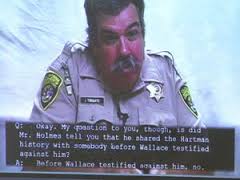
torquatoCalifornia Prison employee Officer Torquato and his supervisor’s video taped depositions were played in the courtroom. Torquato is the correctional officer, working as chaplain and educational officer in 2011, who first alerted authorities to Holmes’ involvement in the Hartman murder. Holmes confessed to Torquato, but vowed he would never name names or come forward with the story. Torquoato described in his testimony attempting to persuade Holmes to come forward to no avail, then seeking the guidance of his supervisor. Both correctional officers remember writing out the Holmes account and sending it to Fairbanks Police Department, after first making contact with officer Nolan there. The FPD ultimately did nothing with the confession. Torquato further described how he encouraged Holmes to come clean over a period of months, and how eventually Holmes wrote out his confession and sent it to the Alaska Innocence Project.

The two men, uniformed in khaki, spoke matter-of-factly about the Holmes confession and the events that followed, although at one point Officer Torquoato became more emotional in explaining his motivations for taking action, and that he could not live with the idea that four innocent men were in prison. The officers were a stark contrast to the law enforcement community in Alaska, who have roundly denied even the potential existence of wrongful conviction, and their testimony was believable. Adrienne Bachman objected to admissibility premised on hearsay, but Judge Lyle overruled her objection, reiterating that he would take in testimony and determine later which portions he was able to rely upon in his decision.

The correctional officer’s depositions served to bolster the testimony of Holmes, who took the stand the previous day to testify to his role in the 1997 murder for which the Fairbanks Four have been imprisoned for nearly 18 years.

The Fairbanks Four attorneys also focused on refuting the State’s claims that Holmes came forward to enact revenge on Jason Wallace. Holmes and Wallace committed not only the Hartman murder together, but also four other killings, and ultimately Wallace took the stand against Holmes to receive leniency in his own charges during their respective trials. Judge Lyle appeared to agree with the Fairbanks Four’s counsel that Holmes did not appear to have anything to gain, and had he been interested in revenge would have taken the opportunity during their murder trials.

A procedural issue which has ignited outrage amongst supporters of the four men was also prominent in proceedings. Superior Court Judge Lyle had previously ordered the State of Alaska to transport George Frese, Kevin Pease, and Eugene Vent from their prisons hundreds of miles away to the local jail for the evidentiary hearing. The state did so but refused to absorb the cost of transporting the men the few miles from the jail to the courthouse during proceedings and keep them there under guard. After being pressed for a dollar figure associated with the men attending their own exoneration proceedings, the State supplied the figure of $500 per man per day, for a total of $1500.00 per day. The community of Fairbanks, outraged at the idea that individuals were being prevented from attending the proceedings which would determine their future, raised nearly $10,000.00 in a matter of days to help the men appear in person.

John SkidmoreWhen attorneys for the men revealed that the money for them to attend had been raised, John Skidmore with the Alaska Department of Law initially stammered over the phone from his Anchorage office, then asked for time to determine a response. Shortly thereafter he announced that in light of the defendants “having funding” the total cost had been raised to $4,800.00 per day, that the men would be guarded by two troopers a piece, remain handcuffed, and that the troopers would be flown in from Anchorage each day and flown back, despite there being nine designated Judicial Services troopers in Fairbanks. In addition to the outrageous and more-than-tripled dollar figure, the State went on the say that to meet their own demands would be to taxing and that they did not want to do it all. John Skidmore is a favorite lackey of the state, and is pictured above in a Alaska Daily News photo explaining a 2014 missing-drugs-scandal where he neither confirmed nor denied anything with remarkable adeptness at saying a lot of nothing and taking no accountability, a party trick he repeated for the October 6th proceedings.

In his ruling, Judge Lyle acknowledged the importance of the request and explained that it was outside the power of the court to order the state to bring the men to court. He was apologetic as he denied the motion for the men to attend.

Although supporters of the Fairbanks Four are outraged by the transparent and absurd effort to keep the accused out of court, and it is indeed outrageous, we have resolved to be grateful. The Alaska Innocence Project was not awarded a Department of Justice grant that they have depended on as their major source of operating funds. The State of Alaska’s rather disgusting attempts to dodge facing the innocent in court should be a motivation to us all to be sure they face the innocent in court over and over. The $10,000 raised to send the men to court will now be donated to the Alaska Innocence Project, and we hope to triple that figure by the end of the month. The answer to darkness must always be light. So, thank you Ms. Bachman and Mr. Skidmore, together you have inspired us to make sure you continue to face the innocent. Next time, we will be prepared to assure that involves looking them in the eye.

To donate to the fund to support the Innocence Project CLICK HERE! If everyone who saw this post gave just $1 we would have $30,000 in a matter of a few days.

Below are a few links to coverage of day two:

Newsminer – Judge Denies Motion for Attendance

KTUU Day Two – VIDEO

Back in court – Opening Arguments and Witnesses in Fairbanks Four Hearings

MArvininCourtOctober 5, 2015 marked the first day of proceedings in the evidentiary hearing the Fairbanks Four, their attorneys, and supporters hope will ultimately lead to their exoneration.

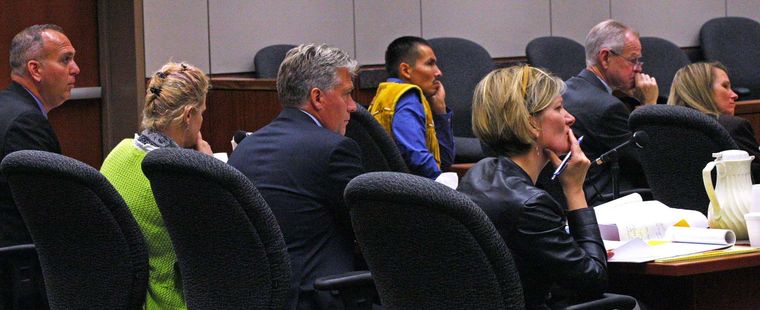
Inside the courtroom, Marvin Roberts was flanked by attorneys, his traditional beaded moosehide vest among the black suit jackets underscoring his singularity in the courtroom. His three – sat a few miles away at Fairbanks Correctional Center, where the State had been ordered to transport them. The court was, however, unable to force the State to transport them under guard the few remaining miles to the courthouse each day when the State refused. Equally alone, and every bit as tasked with the burden of representing those who could not be there in person, was Chris “Sean” Kelly, the elder brother of victim John Hartman.

Nearly eighteen years have passed since the last time this case was in court, and the years have altered many in the crowd. Accused man Marvin Roberts, the only one of the four to achieve parole, and Hartman’s brother Sean Kelly are middle-aged men now. Hazel Roberts, mother to Marvin, has gray streaking her hair now, and is on the doorstep of 60. The last time she sat behind her son proclaiming his innocence she was nearly the age he is today. Hartman’s mother is long deceased. Also present at court was George Frese’s daughter with her daughter on her lap. Today, she is twenty years old, and her daughter is three. In 1997 she was a three-year old on her mother’s lap and her father George was twenty. The years calculated in their alteration of the human beings involved are painfully visible. The rows of spectators listened carefully as the case began. Immediately prior to proceedings, journalist Brian O’Donoghue, whose investigative reporting first revealed the many issues with the original convictions to the public, was unceremoniously ejected from the courtroom. State prosecutor Adrienne Bachman deposed both O’Donoghue and blogger April Monroe, making them witnesses to the case, in what many suspect was an effort to execute control over coverage of the proceedings. The crowd shook their heads as O’Donoghue rose and walked from the courtroom, unable to cover the story for the first time since its inception.

During opening statements attorneys for the men and the State of Alaska outlined their respective cases. The Fairbanks Four, as George Frese, Kevin Pease, Eugene Vent, and Marvin Roberts have come to be known, are visibly well represented on this return trip to court. The eighteen years that have elapsed since their original conviction have virtually inverted the appearance of the courtroom – a reflection of the change in public sentiment about the case. The attorneys for the Fairbanks Four sat two tables deep, and opening statements were given in turn by the lead counsel for each of the men. The Fairbanks Four, their attorneys argued, are entirely innocent of the murder of John Hartman. In an opening bolstered by a series of video clips – William Holmes unemotionally confessing to the murder of Hartman in detail, his co-conspirator Jason Wallace implicated by both Holmes and his own statements cockily invoking his right against self-incrimination when asked about his role in the killing, and former star witness Arlo Olson recanting his original testimony – attorneys for the Fairbanks Four argued passionately that their clients were absolutely innocent, as they themselves have insisted since the first day of incarceration and maintained these many years.

Adrienne Bachman argued for the State of Alaska that jury trial is the “bedrock of the justice system,” that the judge had no business being a super-juror in the case, and went on to say she would call witnesses who bolstered the original case, including a cab driver who came forward in 2014 to claim she saw four “Asian-looking men” in the Barnette area the night of the murder, and “felt a catch in her heart.” She outlined a basic argument for countering the admissibility of anything she deemed hearsay, communicated her intention to stand by the boot print exhibit created by controversial figures Jeff O’Bryant and Aaron Ring, and exhibit repeatedly described as misleading and totally unscientific by experts, reiterated that alibi witnesses should not be called because if “they were not believable the first time, they are not believable now.” Bachman also revisited the testimony of Melanie Durham, a women’s shelter resident in 1997 whose testimony about hearing the Hartman beating has long been used as a reference for the time of the crime. Durham came forward when she realized the beating she heard had resulted in a death, claiming to have heard “dark” voices and a smaller voice plead for help. After the Fairbanks Four were arrested and she had a conversation with officer Aaron Ring, accused by supporters of significant misconduct in the case, Durham altered her story to be that although she was not close enough to hear audible words, and she saw nothing, that she was still able to identify the voices as Native due to an accent (as an aside – none of the Fairbanks Four have a “Native” accent, all are verified city boys). Durham’s  illogical but racially charged testimony was effective the first time, and Bachman argued that Durham did not hear a black man, despite Holmes’ having a classic “African-American speech pattern.” It was an interesting addition to the theory that witnesses can distinguish Natives in the dark distance by indistinguishable speech – the State expressed their stance that this is also true of African Americans.

In the end, both sides argued what is to be expected – the attorneys for the Fairbanks Four argued based on fact and witness testimony that their clients are actually innocent of the crime for which they have spent the last 18 years in prison, and Adrienne Bachman argued that she did not want to be there and did not think it was fair that her opponents were presenting this information in court. Oh, also that her witness has the superpower of identifying people by ethnicity without seeing them, and that she has a witness who may have seen four Asians in 1997, because that is close enough, right? In all reality, it is dismaying to say the least to hear bigotry presented as fact in 2015 as in 1997.

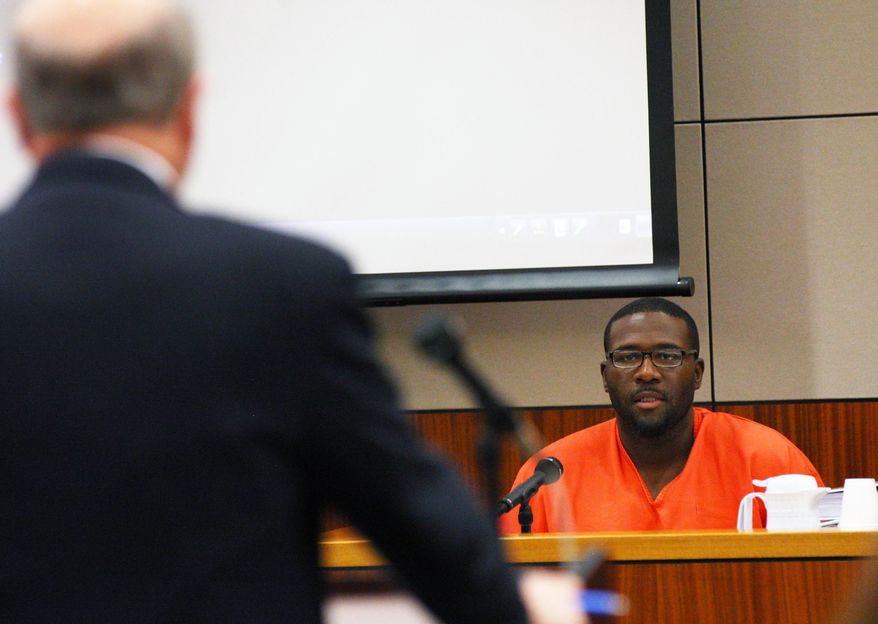
Opening arguments were followed immediately by the in-person testimony of one of the most critical and controversial witnesses in the current case – William “Bill” Holmes. The crowd sat in absolute silence as Holmes, in horn rim glasses, orange prison garb, and flanked by troopers, described with apparent ease his role in John Hartman’s death. He discussed attending a high school part at classmate Regent Epperson’s house, and leaving when it was “boring.” He described the plans to assault Natives, repeatedly referring to the Alaskan indigenous as “drunk Natives” as he relayed the series of attempted assaults that culminated in the fatal assault of Hartman. He described the other teenagers running back to the car, near hysteria because “little J was just trippin,’ stompin’ the old boy out.” He describes discovering a few days later that the assault proved fatal, that others had been arrested for the crime, Wallace showing off and laughing at Hartman’s blood still on his shoes, and how Holmes threatened the other teenagers present with murder should they ever come forward.

When describing his motivation, Holmes insisted that God had moved him, nothing more and nothing less.

William Holmes TestimonyHolmes proved a difficult witness to undermine for Bachman, who focused heavily on his ability to identify his route through arial photographs and his definition of “U-turn.” The line of questioning ultimately backfired as Holmes described by landmark with great accuracy the corner of 9th and Barnette. Bachman also sought to undermine Holmes’ claim of faith by grilling him about sexual conversations had via contraband cellphone with a woman. Bachman insisted Holmes could not be both coming forward for spiritual religions and ‘talking dirty’ to a woman. She ended her cross examination with a brief commentary about his testimony being hearsay, prodding Holmes with the claim that he didn’t see anything or commit a crime. Holmes responded that he thought driving the car for premeditated assaults, driving the getaway car for a murder, threatening witness/participants with death if they came forward, and destroying evidence was indeed a crime. In the end, Holmes had the better end of that argument.

Most memorable in the Holmes testimony, however, was simply the easy demeanor with which Holmes reflected on Wallace “stomping the ol’ boy out.” For the many people whose lives were turned upside down when Marvin, Eugene, Kevin, and George were imprisoned for the killing, hearing the details of the brutal death of young Hartman for the first time were overwhelming.

FairbanksFourrallySpectators exited the courtroom visibly shaken by the Holmes testimony, and as Marvin Roberts and TCC President Victor Joseph stepped into the large crowd gathered to protest outside the courtroom, the mood turned somber.

“We need to pray for John Hartman, for this little boy, and his brother who is here today. We need to lift him up,” Joseph began, and continued to urge the crowd to support the Four and continue their work.

Marvin thanked the crowd, tears catching in his throat as he listed his co-defendants still in jail by name.

The crowd of supporters, which included the UAF chancellor and bishop of the Alaska Episcopal church, played drum and sang traditional songs in a circle around the courthouse steps.

“Two years ago,” Father Scott Fisher said in closing prayers, “we gathered in this same place, with faith, and insisted, the light is coming. Today, it is sunrise.”
Below are some of the many articles and videos about the first day of the Fairbanks Four proceedings. We will update you as trial continues.

KTUU – Fairbanks Four Hearing Begins (article/video)

KTVF – First Day of Trial

Indian Country Today ‘Fairbanks Four’ Seek Truth, Freedom

NPR – Dan Bross – Bill Holmes Testimony

Washington Times – Fairbanks Four Want Convictions Overturned

Big Bad Wolf VII – Rashan Brown and the Murder of John Hartman

Rashan Brown, 1997 Lathrop High Yearbook

Rashan Brown, 1997 Lathrop High Yearbook

In 1997, Rashan Brown was, by all outward appearances, a typical high school student. He was a senior at Lathrop High School, where he at one point served on the school paper. Brown once published an interview with classmate William Holmes. Holmes would include Brown in his own nonficiton account some fifteen years later. In his written confession, Holmes named Rashan Brown as a fellow participant in the brutal kicking death of Jonathan Hartman. According to Holmes, he and Rashan Brown along with fellow Lathrop students Marquez Pennington, Shelmar Johnson, and Jason Wallace, left a house party on in the early morning hours of October 11, 1997, and drove to downtown Fairbanks and killed John Hartman for fun. Hartman was discovered draped across a curb, fatally wounded and comatose. He died the following day. Four other young men were swiftly arrested for and convicted of Hartman’ killing and remained imprisoned despite their unbroken insistence that they are innocent, no physical evidence linking them to the crime, and significant evidence to include Holmes’ own confession, that link the alternate suspects to the crime.

Rashan Brown was the son of a local community leader and city councilwoman and has no public criminal record in Alaska. What is known of Brown is that some months after the Hartman murder he is rumored to have had a mental breakdown of sorts. He was sent to live with his father in Oregon, where it seems things did not improve.

Rashan Brown was arrested on August 5, 2004 in Umat County, Oregon. Brown was charged on 10 total counts, including "MURDER AGGRAVATED", "", "MURDER AGGRAVATED", "", "MURDER AGGRAVATED", "", "MURDER AGGRAVATED", "", and ""

Brown was charged on 10 total counts

On December 13, 1999, Rashan Brown met up with Julie Ann Wilde and Victor Torres, aged 18 and 19, with the victims believing that the meeting was for the purposes of Brown purchasing drugs. Evidence indicates that Brown had planned a murder of this type for some time, and intended to kill Torres and Wilde to steal any drugs and money they had. Brown indeed shot both victims at close range and left their bodies where they fell. He threw away the bicycle he had been spotted on driving to and from the crime scene and reported it stolen. He went to the home of an acquaintence and offered him $20 to tell police he had been there all night. Brown became a suspect in the killing. His bicycle was found in a dumpster, a handful of witnesses came forward to implicate Brown in the crime, the murder weapon was recovered, and blood from the victims was found on his underwear.

Brown was tried for aggravated murder as well as conspiracy. During trial he was extremely disruptive. He engaged in many yelling and screaming courtroom outbursts, hunger strikes, was repeatedly removed from the courtroom, and his state of mind was debated back and forth by defense and prosecution. Although the defense asserted that Brown was mentally ill and not fit for trial, the prosecution believed he was, and not only that Brown was fit, but that his outbursts and behaviors were a farce.

Brown was ultimately convicted of his crimes and sentenced to life without the possibility of parole. He filed many appeals, all predicated on accusations of procedural missteps, but received no decisions favorable to his position and has exhausted his appeal process.

The blood spilled in the injustice that began with the killing of John Hartman and was followed by this wrongful conviction is incredible. Brown demonstrates well the ultimate price of leaving the guilty on the streets. Had the right men been arrested in 1997, many people who are dead would be alive. This includes the victims of Brown – Julie Ann Wilde and Victor Torres – whose families must live with incredible loss and grief, and may not even know how their personal injustice is interwoven with an injustice many miles north.

As to Brown, it is impossible to say who is was in 1997, and further impossible to know the contents of his mind and heart before the night John Hartman was killed. It is clear that his life took a dark turn. It is, again, sad to consider who Rashan brown may have been had justice found him in 1997. In the Holmes account of the Hartman killing, five high school aged boys left a house party with a plan to assault “drunk Natives” for fun. When they could not fund a suitable victim, they happened upon Hartman and said, “we got one!” Holmes pulled the car up to the child, and the other four young men jumped out and attacked him. They knocked him to the ground and kicked him. And, then, Jason Wallace kept kicking. And stomping. And kicking. The boy shuddered his last while Jason Wallace kicked and Marquez Pennington rifled through his pockets. And, once back to the car, Wallace sat silent while the other boys screamed.

What if? Those may be the two saddest words in the English language, used to number losses unknown. What if they had been pulled over just moments after they pulled away? What if John Hartman had gotten medical treatment in minutes, not hours? What if they had told the truth that night, and not lived under the burden of a terrible secret? What if Jason Wallace had been sentenced to life for the unimaginably brutal kicking death of a child? What if the others, with less involvement and still minors, had received sentences that reflected the gravity of the events, but included rehabilitation? Who might they have been? And who may still be alive?

We will never know if Brown may have grown up to be okay had he been caught that night. We may never know whether he became ill under the weight and trauma of a terrible secret and the fear of killers, or if he was destined to break. But we do know that had he been incarcerated in December of 199, as he absolutely should have been for his role in the killing for John Hartman, that Julie Ann Wilde and Victor Torres would be alive today. Our hearts are with those families. In a few short days the Fairbanks Four will have another chance in court. Someday, they will come home. There is no such relief for the families of the other victims, and the permanency of their loss is a tragic reminder of our blessings. May they heal, hope, and see a greater justice someday.

Big Bad Wolf VI – Marquez Pennington and John Hartman’s Murder

Marquez2

Marquez Pennington

When William Holmes confessed to his role in the brutal murder of John Hartman, he named four accomplices: Jason Wallace, Rashan Brown, Shelmar Johnson, and Marquez Pennington. The press, as a rule, has excluded mention of the two named by Holmes who are not in prison. Holmes, Wallace, and Brown are all serving time for murders they committed as individuals. Pennington and Johnson are free and residing at least part-time in Alaska. We do not see any reason to shelter them and have never excluded them from reference.

Mr. Pennington appears to have used the eighteen years that have elapsed since his alleged participation in the beating death of John Hartman to pursue other criminal activity. His criminal record is extensive. Marquez Pennington has been arrested more than 30 times between 1998 and 2012, or 2.14 times per year. His record can be viewed HERE. These arrests have often contained multiple charges, and his record exposes a long history of drug sales, use, and violence. Despite many significant charges being brought against him, including multiple drug related felonies, Mr. Pennington has apparently avoided harsh prosecution. He did serve some time in prison alongside the men currently incarcerated for the murder of John Hartman, and was apparently unmoved by the process of looking innocent men serving time for his sins in they eye.

Marquez

Marquez “QB” Pennington

In addition to his relatively brazen work as a drug dealer apparently conducted without significant law enforcement interference, Mr. Pennington has enjoyed a long if unremarkable career as an amateur hip-hop artist. When rapping, Marquez Pennington goes by the stage name “Q.B.” and “Q.B. of Choldhustle.” His work appears on Myspace, and a compilation album titled “Interior’s Most Wanted,” produced by Redd Dott studios, or Alaska Redd, the studio of Josh “Red” Silva, a Fairbanks rapper who has collaborated with Marquez Pennington as well as Bill Holmes and Shelmar Johnson. On this particular album, distressingly dedicated to both William Holmes and his slain ex-girlfriend Mahogany Davis, Marquez Pennington is featured as Coldhustle. Other self-imposed monikers associated with the middle-aged Pennington include Cube, Q, Quadruple, and so on.

Holmes is not the only source who links Pennington to the murder of John Hartman.

A source who spoke on the condition of anonymity relayed the following story about  Mr. Pennington:

“In 1998, early 1998 I think, I was in FYF (Fairbanks Youth facility – the local juvenile detention center) with Marquez. Everyone knew he killed Hartman. He told people, he bragged about it, that they curb stomped this kid. And here, we were doing time for little stuff. Curfew, weed, drinking. Nothing big. And he was getting out ahead of us, before all of us. We were there and he was leaving, and that’s when I remember hearing about it. Because that was what caused people to really talk, their frustration that a murderer is just walking out the door. Guys being like, man that’s messed up, killers getting out of here and we are stuck here. No one thought it was okay what he did, but we were just young and scared. Still scared. When a person will do that to a little for nothing what would they do to you?”

A recent filing on behalf of the Fairbanks Four revealed another source linking Marquez Pennington to Hartman’s murder. According to the filing, Fairbanks man Takory Stern contacted investigators in March 2014 and requested a meeting. Once there, he gave statements indicating that Marquez Pennington had confessed to his role in the murder directly to him in 1997. At the time Stern would have been 14 years old. The officer who conducted the interview recorded only small portions of the interview. In this article about the statement, Officer Avery Thompson alleges that it is normal practice to only record portions of interviews. It seems contrary to basic investigative skill to record a statement only partially, but it is safe to say that for this case at least, it is routine for interviews to be truncated, partially recorded, or missing altogether.

Takory Stern is reported to have killed himself during a police chase several months after giving his statement. Whatever his troubles, we are grateful that he chose to do the right thing and come forward with his information, and glad he was able to relieve himself of this burden before his time on Earth was finished. It was clear from his obituary that he was very loved and is missed.

holmesMarquez Pennington is a man with a long criminal record who has been named as the killer of John Hartman by one of his accomplices and other witnesses. He is a resident of Fairbanks and North Pole, Alaska, and remains entirely free in the community he has been harming since at least 1997. In the Holmes account of the Hartman killing, Marquez Pennington was rifling through John Hartman’s pockets when the young boy shook and went limp. In that story, a child’s soul fled his body during an act of unspeakable violence, and Pennington was there hoping to steal a few dollars. Someday, he will answer for that, and it would do him well to get right with his maker before that day comes.

Pennington was allegedly distressed at the events, screaming in the back seat as they sped away from the crime scene. It is sad, really, to consider he may have been a misguided but scared teenager in way over his head in 1997. It is sad to think about the man he may have been had he received the intervention as a boy he so clearly needed at the time, and the harm to others that it may have prevented. No one did Marquez Pennington any favors when they arrested the wrong men for the crime. As it stands, he has made no public comment about the murder of John Hartman. If the accounts of Stern and Holmes, who passed a lie detector when his claims were tested, are correct, then Marquez Pennington is also guilty of the murder of John Hartman, a 14-year-old young boy who was mercilessly kicked and stomped to death for no reason in October of 1997. If so, he has lived the last 18 years without a shred of decency or honor, failed to take responsibility for his actions, and sad idly by while innocent men do his time. It is way past time for Marquez Pennington to stand up like a man to whatever events took place in 1997, and it is our hope that he does. It is extremely unlikely that he or anyone will ever face charges for the killing of John Hartman – the State is unlikely to prosecute after 18 years of publicly taking the position that someone else did it. But Pennington and the others could still come forward like men and own their decisions, give peace to the family, and assist in justice for four innocent men.Time grows short. Please keep Marquez Pennington in your hopes, thoughts, prayers, dreams, or whatever you do. He still has time to come clean before the Fairbanks Four trial begins October 5, and if life is providing him a chance at redemption, let’s hope he takes it, steps into the light, and can live the remainder of his days out with some peace.

Marquez, if you read this, please look into your heart and ask yourself what the right thing to do is. Do that. Think about how 18 years would feel locked up for anything, let alone something you didn’t do. Think about George’s baby girl, 3 when he went away. George is a grandpa now, and he missed almost all of it. Trust that good does come from choosing the right thing. It is never too late to find forgiveness, and there is always more shame in hiding a truth than owning it. We are rooting for you, hoping for you, praying for you, believing in you. Please do what you believe in your heart to be right.

If you or anyone you know has information about Marquez Pennington and his role in the 1997 murder of John Hartman, please call Alaska Innocence Project at 907-279-0454, or Fairbanks Police at 456-2583. Please do ask that they record your entire interview.

Big Bad Wolf V – Adrienne Bachman

bachmanIn the 1990’s, when accusations of corruption and misconduct ran wild in the Fairbanks legal and law enforcement community, Adrienne Bachman had absolutely nothing to do with the Fairbanks Four case. But don’t get your hopes up that that is a good thing. She was busy engaging in misconduct on her own cases.

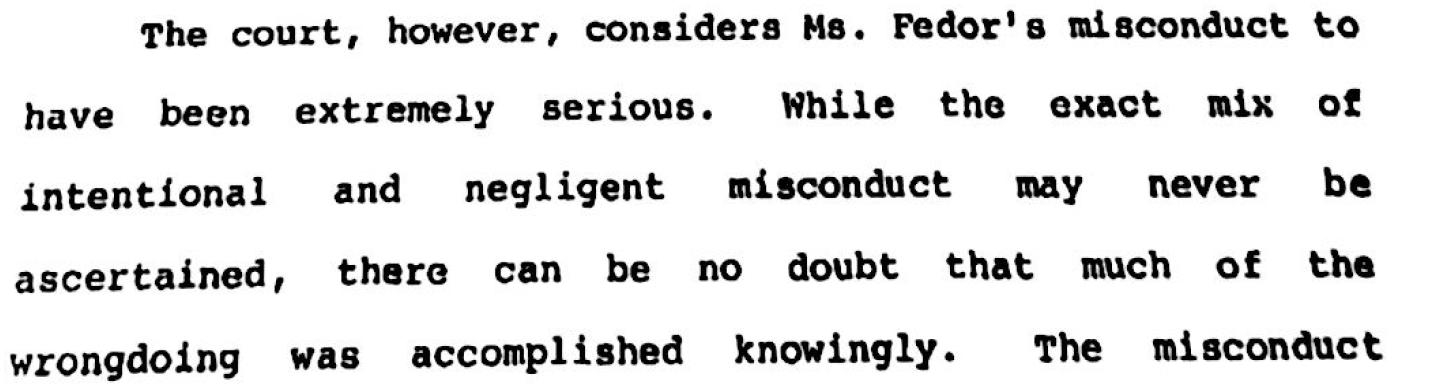
Ms. Bachman was a practicing prosecutor for the District Attorney in Anchorage. In the spring of 1990, Judge Joan Katz had the following to say about Ms. Bachman (The Ms. Fedor) and her work.

“While the exact mix of intentional negligence and negligent misconduct may never be ascertained, there can be no doubt that much of the wrongdoing was accomplished knowingly.”

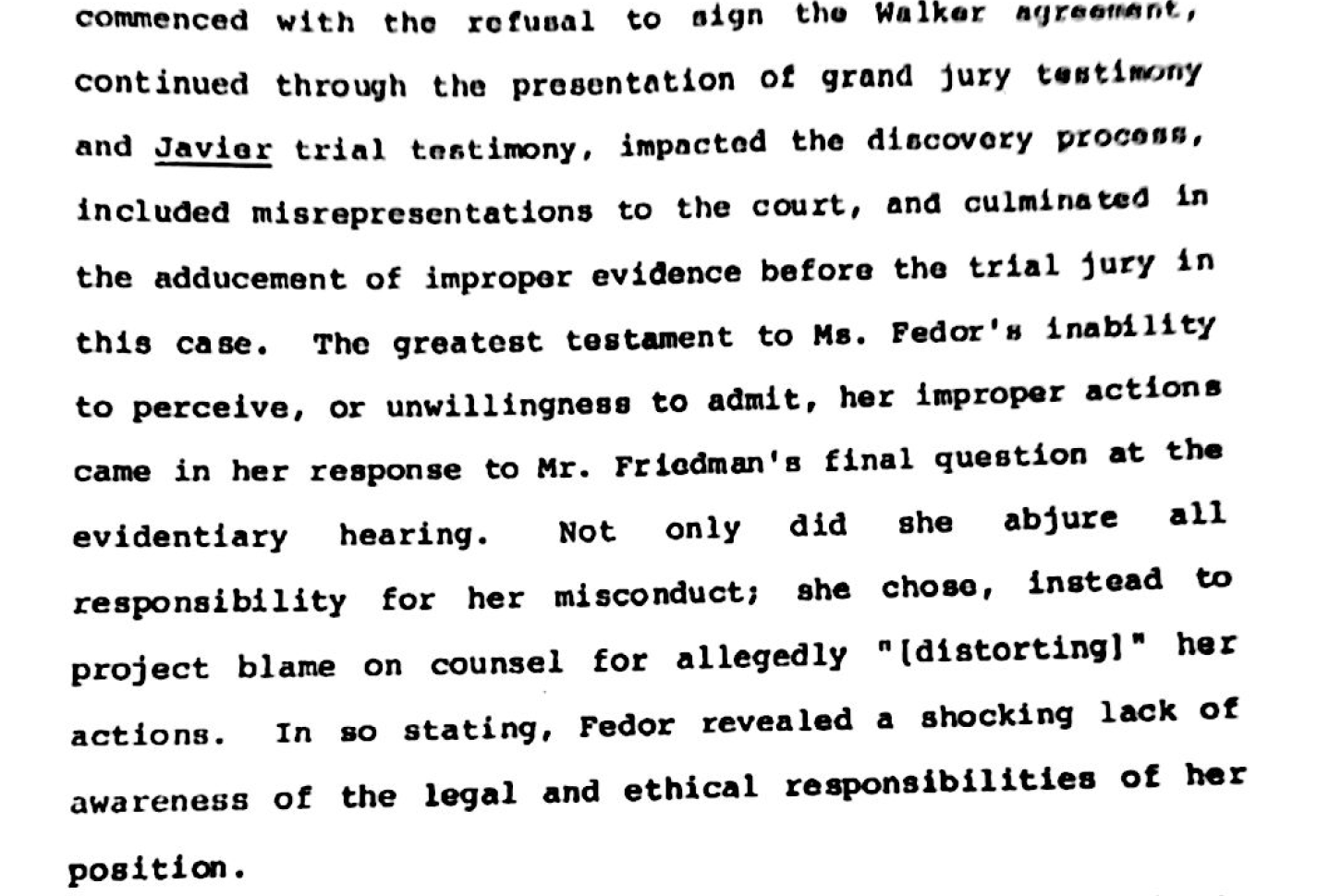
“She revealed a shocking lack of awareness of the legal and ethical responsibilities of her position.”

The judge’s commentary can be read in greater length below:

Bachman1

Bachman2

One can deduce from the document that Ms. Bachman knowingly engaged in misconduct which carried on through an entire legal process and resulted in false information being presented to a jury at trial. Then, when opposing counsel called her on it, she denied it, blamed it on them, and showed such a lack of awareness of her wrongdoing that the presiding judge called it “shocking.” Following this episode, Bachman was of course promoted and made her way steadily up the ladder within the District Attorney’s office in Alaska.

When the Alaska Innocence Project filed a petition for post conviction relief in September of 2013, the State of Alaska responded with this dismissive press release, at once promising the public an independent investigation and exposing the depth of their bias. The State then came under significant and immediate pressure from citizens, religious leaders, and politicians to act swiftly in the interest of justice. Senators Murkowski and Begich published open letters calling for a transparent and independent review of the revelations in the filing and pondering federal intervention. Letters to the editor flooded local publications across the state. The Alaska Federation of Natives, Tanana Chiefs Conference, scores of other Native organizations, and the Episcopal diocese all took public positions supporting the claim of innocence and demanding an actual investigation.

The State of Alaska ultimately responded to this outcry by assigning Adrienne Bachman to the case. Bachman is known as an aggressive criminal prosecutor – a conviction-at-all-costs attorney. There is no doubt she is both skilled and practiced at achieving and upholding criminal convictions. However, there is no indication that she is the right candidate for a thoughtful and unbiased examination of a civil petition for post conviction relief. The act of  choosing Bachman to head the State’s response on the Fairbanks Four case shows a shocking lack of awareness of the legal and ethical responsibilities the state has as an agent of justice. The apple, as they say, does not fall far from the tree.

To assign an aggressive prosecutor to a case where the convictions are in question and an independent review has been promised speaks volumes to the state’s intention with the case. To assign a prosecutor with a significant history of perjury and misconduct to an extremely public case so haunted by accusations of prosecutorial and police misconduct is…..confusing. Does the state not have access to a prosecutor who hasn’t engaged in misconduct? Is this the ultimate figurative middle finger to the petitioners, their attorneys, and every Alaskan whether a leader or citizen who asked for actual justice? They are attorneys, so they know to maybe be worried about getting sued later, right? Is this a joke? Like, a really inappropriate and poorly done joke? It defies explanation.

It would be wonderful to address the conduct of the special prosecutor as it relates to this case and assure readers that her “shocking” conduct is a thing of the past. However, this case began with Ms. Bachman’s request for a delay to accommodate, among other things, her vacation. That was followed by this fascinating interview with Indian country in which Ms. Bachman managed to tell enough lies that a post detailing them was longer than the interview. Then, there was this NPR interview where she boldly insisted that comparing Natives to unruly slaves lying ala Spartacus was not racist at all, following in the steps of original prosecutor Jeff O’Bryant (read about his controversial ‘Spartacus’ argument HERE),there was this insane attack on Scott Davison for having the gall to come forward without a bribe, the revelation that a murder confession was known and covered up in the case, and a virtually unending onslaught of offensive and dishonest statements, a fan favorite being when she made a filing attacking the credibility of William Holmes, AFTER she had administered and he had passed a lie detector test.

The counter-argument that some within the profession of law, particularly prosecutors, would supply to defend Ms. Bachman’s actions is that her actions fall within standard practice for prosecutors, or that she is ‘only doing her job.’ Although we can appreciate that people who do these kinds of things may need to tell themselves these bedtime stories to fall asleep at night, these excuses hardly make the choices acceptable.

Doing the wrong thing because other people do the wrong thing does not make it okay – it makes it a conspiracy. Doing the wrong thing for money is just gross. Do we really need to explain why receiving a paycheck for doing something wrong is probably even worse, but at best just as wrong, as doing it for free? The greatest travesties of humanity have been carried out by people who used the same excuses. Nazi soldiers did things like install new piping to gas chambers so as to more effectively murder thousands of innocent people, chatted over coffee while their victims clawed the  metal walls and begged for mercy, yanked screaming children from their mothers, and went home at night and told themselves, ‘everyone is doing this.” When the war was over and they were taken to trial in Nuremberg to explain how they perpetrated such atrocities, they all used the same defense so consistently that it has come to be known as the “Nuremberg defense.” The premise of this defense is “Befehl ist Befehl,” or “I was only following orders.”

It is hard to say whether the State of Alaska selected Bachman because they felt she was the woman for the job (the job, of course, being holding faith in these convicitons into delusional territory and without regard for actual justice), or if they just chose to throw her under the bus by handing her someone else’s impossible mess to clean up while those with meaningful power hid from the ramifications of this failing case. Either way, their selection of Ms. Bachman and her ensuing conduct since have made it entirely clear that the State is not interested in justice, honesty, or transparency. Some day, when this verdict is clear and this case takes its rightful place as an important moment in the civil rights movement of Alaska, this story will be told in its entirety for posterity. History will remember, and it will all be made clear. Until then, we can only hope the best for all, and that everyone involved will make choices they can be proud of later, because someday these choices will be examined by history and aired in a court higher than the one of man.

.

What IS Kevin Pease? Ethnicity vs. Culture in the Fairbanks Four Case

KevinMompicSince the beginning of this case there has been a tremendous emphasis on race as it pertained to the crime itself and its potential impact on motive. We have caught plenty of heat for not shying away from discussing that, but is worth mentioning that we didn’t bring that emphasis here we simply exposed the opposing vantage point on it. The first articles in this case and nearly every one written since identifies the races of those accused very specifically.

Kevin is fair-haired and blue-eyed. His family has Crow in its ancestry, but it is not his dominant ethnicity, and at the end of the day Kevin would easily and always be identified by appearance and ethnicity as white. Reporters have expressed ongoing confusion as to Kevin’s ethnicity, and one reporter recently asked, “What is Kevin? Some articles call him white, some American Indian, but all of my interviews with the supporters would lead you to believe his is Athabascan.”

It is an interesting element of the case and one to which Eugene and some supporters have spoken directly. Ethnicity and culture impacted this case from many angles. Although this is not the most pressing or urgent issue in this case, it is thought-provoking and deserves to be addressed. This post contains their well articulated thoughts on the topic.

“I don’t like this idea that  outsiders get to define who we are for us. That’s up to us. It’s like Kevin isn’t Native enough for the newspapers, but he’s Native enough for the Natives, and he’s enough of an Indian to be stuck in here with us, right? Blood quantum and all, I think that’s just a way to control people. Tell them who they are. Our words in almost any tribe for ourselves in our languages mean, the people. It doesn’t mean, the people who BIA says are of the people. It means, the people who are of, basically, each other. Us. Kevin was raised with us, around us, he’s one of us, he just is. He’s as Athabascan as anyone can be right that word just means “us”, and I don’t like reading different in the paper. Like why do they want to always make that a big point. And I don’t care they call him white there’s nothing wrong with it not like its offensive  I just care they always want to make it like, he’s different. They don’t get it. But it’s always kinda like bugged me.” – Eugene

“The idea of adoption, in Athabascan culture, is an old concept. A lot of people were adopted in. The historical and cultural fact is that Athabascans never defined themselves in the way of birth order or pedigree. That is the white man’s way of thinking. It was never ours. Our generation isn’t seeing this some new way, we are seeing it the old way.” – Ricko DeWilde

“There is a critical and misunderstood difference between ethnicity and culture. Kevin’s ethnicity and his cultural identity may be different. His perception of his place in a community or culture versus the perception of the community’s view of him may differ as well. As in, Kevin may not see himself as culturally Athabascan while the Koyukon Athabascan community may see him as a member. To Kevin specifically he grew up with Athabascans through a series of events which he did not control as a young person which is not much different than a birthright. We are born into cultural identity in the sense that we are born into a specific culture. For many and most people this may align with their ethnic makeup and for some it does not. Through experience and sustained contact he was raised culturally Athabascan. Kevin does not look at a Native person and see a ‘Native.’ Kevin sees a person and often a person he knows through a relational concept of identity (again a concept which he was exposed to culturally). This is a tricky concept to articulate but I hope at least some blog readers can and will follow.

Fundamentally, Kevin is a cultural Alaska Native. At least, that is my perception of Kevin and I know it is widely shared in the Interior Native culture of Fairbanks in particular. Kevin for example is far more culturally Athabascan than an ethnic Athabascan who was raised by Swiss Italian American parents in New Jersey and never exposed to our way of life. That person is ethnically Alaska Native and culturally not. Those adopted in are more culturally a part of a society than those adopted out.

I want to find a way to make the frustration when it comes up over and over in newspapers that identify him as white or outside Indian understandable to any random reader. When, while that may be true from a genetic or ethnic perspective, it is dismissive to us as a culture to instruct who we can consider part of our people, and further dismissive of our individual value as just human beings. The emphasis on race in these publications does not have the goal of identification although that may be the stated goal or the only motivation consciously known to the author, the categorization on this level has to do with othering the subjects. The ‘othering’ of Kevin in the beginning of this case was important. The media and community were hung up on this notion of the players. They couldn’t make a sound case for the guilt of innocent men in a crime so they had to attack their essence as a way to attack their credibility based on the social psychological perception of the situation. They placed them into roles that met the social normative and were therefore more readily accepted. They made these human individuals into archetypes – Eugene the stupid savage, Marvin the savage nature, underscoring the notion that even cloaked in apparent assimilation (valedictorian, etc) there is a savage nature; a difference which is past skin deep, George as the wild savage, and Kevin was the disturbed race traitor who associated with them.  Then there did not have to be actual motivation the public would accept the motivation was simply their nature, so different from the reader. In reality these identities were a construct which had almost nothing in common with who these people were as individuals and was only an articulation of  racial archetypes.

An attack on the identity of a cultural group weakens the position of the group. It is psychological genocide, it’s a way of eliminating a culture to take away the group’s own right to define themselves. Kevin likely views himself from many angles and in many ways, and probably has a cultural identity that is dynamic and made up of all of these roles and experiences. But from my perspective, and I know from the perspective of many within the Athabascan culture, Kevin is a member of our community and culture. He understands the traditions, the nuances of the language, the social strata, the modern history, the interconnection, he just is one of us as a people, as a specific group of people in the world. And being allowed to define yourselves does not in any way take from a person or group’s right to discuss discrimination. Quite the opposite because in fact these parameters put on a group from without are their own form of discrimination, and a under-discussed racial microaggression.” – Misty Nickoli