It’s amazing how much can be changed by a cage of concrete and barbed wire. This video covers some basic information about the Fairbanks Four – pass it along, it’s an easy way to tell this story to others!

It’s amazing how much can be changed by a cage of concrete and barbed wire. This video covers some basic information about the Fairbanks Four – pass it along, it’s an easy way to tell this story to others!
 This short video covers the most basic information about this case. This is a great thing to pass along, link to, post on Facebook, tweet, text, and spread far and wide. Many people who do not have the time to read the case files have three minutes to watch a video.
The soundtrack is I Shall Be Released as sung by Walter Trout and the Free Radicals
They say everything can be replaced
But every distance is not near
So I remember every face
Of every man who put me here
They say ev’ry man needs protection
They say ev’ry man must fall
Yet I swear I see my reflection
Some place so high above this wall
I see my light come shining
From the west unto the east
Any day now, any day now
I shall be released
Standing next to me in this lonely crowd
Is a man who swears he’s not to blame
All day long I hear him shout so loud
Crying out that he was framed
I see my light come shining
From the west unto the east
Any day now, any day now
I shall be released
 em mad, and the officer gives Conan a little speech about owning the streets:
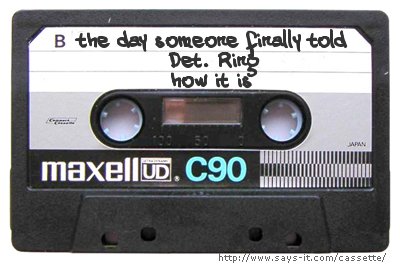
For the purposes of this transcription “G” will be Conan Goebel, and “O” will be officer. (transcript does not confirm that one of the officers is Aaron Ring. We are operating on a hunch when we assume that it was him)
Goebel: All right. So, I gotta go over this all over with you?
Officer: Yes, just where you were Friday.
G: 11:30, around 11:30, I got dropped off at, um – Over by the 21st Avenue at my cousin’s house (inaudible). And, uh…
O: Well, who dropped YOU off? I think that’s one of the questions.
G: Chrsty Moses and – I answered this.
O: I understand. That’s why I’m taking notes this time.
G: And Kevin Pease and um…
O: Okay.
G: Dropped me off
O: Was Eugene I the car at that time?
G: No.
O: Okay, 11:30?
G: Yeah, it was probably around 11 – 11:30.
O: 11 – 11:30, okay. What’s your cousin’s name again?
G: Samantha.
O: Samantha, okay. And how long did you stay there?
G: Till about 2:30, 2, I think.
O: Two? 2:30, okay.
G: Could have been (inaudible). ‘Cause I know I went to town for a while. It might have been earlier when they dropped me off the first time, or when they dropped me off the second time (inaudible).
O: What do you mean, first and second time?
G: Well, they dropped me off the first time and I stayed there for a while, and then they took off. Then it’s just those people right there, and then they came back, and, uh, I got – I went – I come to the van with them and we went and picked up Eugene and Nathan. They were at Eugene’s house. And then we drove back over there and then they dropped me off right there, but I told them when they were looking for a place to go I (inaudible) take the car back. So, I was like, well, you can drop me off at Sam’s house.
O: Well, see, okay. That’s – That is why he’s confused and why I’m a little confused. you got dropped off there the first time by who?
G: By just them people I said.
O: Okay, what time was that?
G: About 10:30.
O: It was those people that dropped you off
G: It was those – what time was that? The van (inaudible)
O: Tanya’s van? Okay.
Another Officer: And who was in this van with you?
G: Tanya, Christy Moses, Allen Sisto.
O: Okay, and they dropped you off at Sam’s and they went – you don’t – do you know where they went?
G: They went up to Kevin’s – Kevin Bradley’s.
O: Kevin Bradley.
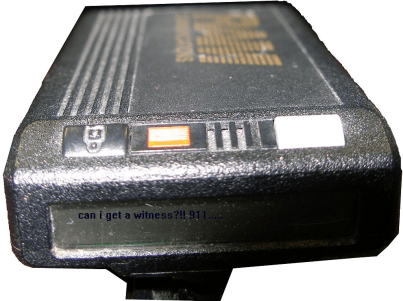
G: There, yes. And then, they paged me, probably between 12:00 and 2:00 (inaudible) and they were (inaudible) it up there for a while, and I talked to them on the phone a few times and told them (inaudible) but I never (inaudible) so I called the next time around – I don’t know – 2, around 2:30
O: Well, what’s this 11:30 time that you gave me when you were dropped off there?
G: That’s when I got dropped off the second time.
O: Okay, tell me about that – when you got dropped off the second time at 11:30.
G: Well, after we picked up Nathan and Eugene, we went over – back over there, and I was like, they were going to find a place. Get me on the pager, and I’ll call (inaudible).
O: YOU didn’t go up to Kevin’s?
G: huh-uh
O: Okay.
G: And I, um, (inaudible) down there and they paged me and I talked to them on the phone. (inaudible) I think it was like probably around, uh, 2:30 is when I called again. I called at, um, it was probably like, (inaudible) left. And I was like, all right. And I asked, where did they go. and they went down to Eagles Hall to meet you. And I was (inaudible) so I hung up the…
O: You didn’t know they were going to go down to Eagles to meet you?
G: Nah-huh.
O: Okay.
G: Um, I think Eugene paged me before they leave. I don’t know who – he told Dana – he said we’re going to go meet Conan down at Eagles Hall, but I don’t – I didn’t call him back. (Inaudible)
O: Oh, I see
G: And, uh, he paged me 479-____.
O: (Inaudible)
G: And then, uh, walked down to Eagles Hall and, uh, it was about 3:00. (Inaudible) and um,
O: Who was there?
G: I ran into, uh, Eugene, Dana, um, George, Marvin, Harley, uh, all those – all those guys. And I was talking to them. And nothing seemed – uh, I mean I was talking to him right there and, uh, he even talked to me and George (inaudible) hadn’t seen him in a while, and there was NOTHING WRONG WITH HIM AT THE TIME (inaudible) and he was in a pretty good mood. And then, uh, so we was talking for a while, and um, and then, um, then everybody’s taking off – we were pretty faded at that time (inaudible). And I was like, well, um, (inaudible) I called for a taxi for Dana. And I, (inaudible) the taxi, (inaudible), Eagles, but they took too long because it was 3:30 when we finally got out of there, and, uh, Eagles – a red taxi rolled up and I went out there and I put here in that one and I sent her
home. And after that, me, Eugene and Edgar, we proceeded on foot downtown. And we walked downtown. And (inaudible) across the street from – over at Elbow Room, and kind of walked in there, and then we turned around and…
O: Who was in that bar?
G: Um…
O: Nobody YOU knew? Okay.
G: And, um, I walked (inaudible), and, then, uh, (inaudible) he didn’t last too long. He was pretty (inaudible). So then I – we walked over to Alaska Motor Inn. And chilled there for a while. And, uh, then, somebody said, (inaudible)
O: Did YOU see that?
G: I didn’t see (inaudible). Eugene (inaudible). But then I found out Eugene (inaudible) I talked to Harley
O: When did you hear about that? Because I don’t think you told me about that before.
G: Well, see, I walked back over to – walked back over to Shannon’s – Shannon Charlie’s – (Inaudible) and, uh, I just took off over there after (inaudible) and I walked – walked over – back over to 21st. That was at my cousin’s for a while.
O: What time did YOU get back over to 21st?
G: Probably around, uh, (inaudible). Then, uh, I was – I don’t know – it could have been the next morning or that night that I talked to Harley about mace down there and it was like Eugene – Eugene and George got in a fight at Alaska Motor Inn. That’s what I thought happened. George got in a fight at Alaska Motor Inn. And I was like, where’s he at? And they’re like, he got arrested. And then, after that, the next morning I heard about some kid getting beat up pretty bad and in a coma.
O: Where’d you hear about that, Conan?
G: Um, I think that was Louis. ‘Cause the cops (inaudible). And I was like – I was like, really. and they’re like (inaudible). We got in a fight with some other guy. And that’s what I thought happened.
O: That’s pretty weird because…
G: I don’t know how – I mean Eugene took off and he didn’t say nothing – there was nothing wrong with him – no blood.
O: Well, let me ask you about this. You know the Tritts – Cordell and Courtney and their sister – what’s their sister’s name? I’ve got their names written down. Any way, Cordell and Courtney and their sister. And you know… ?: (Inaudible)
O: Antonio Sisto. And you remember riding in the car with these guys?
G: On Friday?
O: Um, Saturday.
G: Mm
O: YOU remember talking to Antonio and Courtney?
G: (Inaudible)
O: And telling them about this guy that these guys beat down?
G: No, I didn’t tell them about (inaudible) I asked and they said (inaudible) fight or some…
O: Well, let me tell you. I talked to all these people and they had information about you talking about this guy that got beat down. And you know what they thought, by the way you were talking about it and all the details you had and everything – and this is Saturday where all the details came out. They thought you were there.
G: That I was there?
O: When this happened.
G: I read it in the paper. It was all in the paper. I told them – I told that Eugene, Marvin, Kevin, and George are accused of murder.
O: That wasn’t in the paper Saturday.
G: Well, it was in the paper or on the new then, because even, uh, Sammie Smith told me heard about it on the news – somebody got coma – in a coma.
O: What time was that you were (inaudible)?
G: Then it was probably close to – it was like 12:00 at night. And, I says to them (inaudible) ’cause I was calling and talking to (inaudible) and telling me they had all those guys in jail, and I was like – I don’t know – I don’t know (inaudible) he died or heard – at first I heard he was in a coma and then I heard he died. And I was telling (inaudible) that. And after that I got a ride with Courtney. And I was – I got in there and I was talking to Antonio, and he was asking me about (inaudible), and I was like, I don’t
know, man. I heard that they’re being accused for murder or something like that.
O: Well, I think Antonio knew all about it because I think we’d talked to him by then. And, uh, and – me and the Tritts are under the impression that you were there and saw this.
G: Well, I wasn’t even anywhere around them.
O: Or, they were under the impression maybe even a little more so that you were there and participated in this.
G: You say that’s what they say?
O: That’s the impression they got from you.
G: I don’t think so. I didn’t tell them anything like that.
O: But if you were there and saw what happened, that’s another thing.
G: I didn’t…
O: Now, you mentioned Jeremy. And I’ll talk about Jeremy for a minute. Because Jeremy asked youvabout it, okay? And you told him, geeze, I don’t know what was up – I was in a blackout.
G: I was in a blackout? I wasn’t blacked out.
O: I know, but that’s what you told Jeremy. ‘Cause he asked you why were in the fight with these guys and this thing, and you told him you were in a blackout. Well, you know I’m not lying to you ’cause you told Jeremy that. You know I’m not lying to you.
G: I don’t know nothing about that.
O: And Jeremy told us.
G: I seen – I recall…
O: ‘Cause he’s concerned about you and wanting to know if maybe you were just a witness to this happening or you were a participant.
G: I wasn’t a participant or a witness. I didn’t – I didn’t even get down there until…
O: Why’d YOU tell Jeremy you were in a blackout then?
G: I never told him I was in a blackout.
O: Well, I don’t think he made it up. He doesn’t have anything against you.
G: Well, I know he don’t have anything against me. There’s no reason, ’cause I never told him I was in a blackout.
O: You see how this all looks? The Tritts thinking – or thinking you’re talking like you were there and you participated. Jeremy’s asking you a couple of times about the fight you were in and you…
G: I wasn’t even in a fight. I didn’t tell him. I said, I don’t know what happened. They’re getting accused for beating somebody up.
O: You told him you didn’t know because you were in a blackout, okay?
G: I didn’t know because…
O: See, Conan, you’re not – we’re not arresting you here.
G: But I ain’t got nothing – I wasn’t even around then. I didn’t even hear what happened until like the next day about this kid being comatose…
O: We’re – we’re kind of concerned as to whether you want to be a witness or not, or whether you want to…
G: Hey, if I seen it, man, I would tell you guys what happened.
O: Well, let’s talk about that for a minute.
G: But the thing is, I wasn’t even in the neighborhood that it happened in. And that’s what I…
O: Were you in Marvin’s car at all?
G: Naw-huh. I never even noticed Marvin’s car that night. I never even rode in the car at all from Eagles
Hall.
O: Well, is there any reason why YOUR fingerprints would be in Marvin’s car?
G: Marvin’s car?
O: HIS blue car?
G: There’s no reason my fingerprints would be in there. (Inaudible) I mean, I’ve rode in there before, but I didn’t ride in there Friday night. I don’t even think they could be in there ’cause I haven’t rode in there for a while.
O: Okay, well, no reason – in the back seat area – you weren’t in the backseat area of that car?
G: (Inaudible)
O: Did YOU go to the Eagles Hall at all?
G: Yes.
O: How?
G: Walked.
O: What time did YOU leave?
G: Around 3:30.
O: 3:30? What time did you go to (inaudible)?
G: Around 3:00. I ran into Dana (inaudible).
O: Where were you? Dana had been looking for you.
G: I was at my cousin’s house (inaudible).
O: You were there that whole time? You didn’t leave there then?
G: No
O: All right.
G: (Inaudible) Went in. I talked to him on the phone a bunch of times.
O: Why didn’t you go to the Eagles Hall with (inaudible)
G: Because I didn’t know there was nothing going on down there.
O: (Inaudible)
G: (Inaudible) because I talked to them on the phone, and it was like come on, it’s like, we’re going to Eagles Hall, and then I found out (inaudible)
O: Were they – were they at Eagles Hall when you talked to Joey?
G: No, Joey was up at Kevin’s and he said they just left.
O: Oh, okay. Well, let me – let me clue YOU in there. Joey drove them to Eagles Hall.
G: Oh, really?
O: Oh really. Oh really. So, see, we’re having a problem here. ‘Cause Joey drove them. He borrowed Kevin’s car. Kevin didn’t want to go and Joey drove ’em.
G: Well, (inaudible) ’cause he went to Eagles Hall (inaudible) that’s why he called. ‘Cause I was like how long ago. He was like, not too long ago. They left when (inaudible)
O: And what time was that?
G: Uh, (inaudible) about (inaudible).
O: Uh-huh, but you’re telling me Joey was telling you this. And I’m telling you Joey drove.
G: I don’t know who drove. I just talked to Joey – I don’t remember what time it was. It was around 2:00, 2:30, somewhere around…
O: Well, maybe Joey had driven and come back?
G: (Inaudible) that’s what I (inaudible)
O: So maybe it was around 1:30 or earlier than that that HE drove them in, huh?
G: Huh
O: Maybe it was around 1:30 or earlier than that that he drove them in?
G: Could be, I don’t know. I didn’t talk to him ’till late.
O: Well, you told me that…
G: I don’t know. I don’t recall. I could check my pager was.
O: You got it?
G: No
O: You haven’t?
G: No, that was Friday. All those pages are erased. I don’t know (inaudible)
O: Well, see what I’m saying? I’m a little bit confused about what you’re telling me. Either Joey had already come and come back, which means it was quite – quite a while ago that you’d taken to the Eagles, because they got – he was –
G: I don’t remember the time, though, man, I mean…
O: Well, you might be right – you might be right. ‘Cause I think your sister saw him (inaudible) time, so you might be right. You might have talked to Joey and he’d already gone and come back.
G: I don’t, I don’t, don’t know. I talked to Joey Shank. I don’t know what time it was. It could a been around 2:30. But, then I remember I walked down there and…
O: Between 1:15 and 2:15, you were where?
G: I was over at Sam’s (inaudible).
O: And you were there from 11:30 until –
G: Probably about 11:30, 12:00. I remember Darrel Calling from the car and (inaudible). But I was sitting there ’till like probably 2:30 or later. I don’t know.
O: (Inaudible) around
G: Because I said I was at the Eagles Hall – I don’t even know what time I was there. I said I was there when everybody was leaving. I was like one of the last people at Eagles Hall.
O: Well, there’s no one (inaudible). When did YOU leave there?
G: Probably like 2:30.
O: What did you do there?
G: I just sat there talking to my cous (inaudible).
O: Okay, well I’ll give them a call and we’ll figure it out. In fact, I can give them a call here in just a minute.
G: And then I sat there for a while, and then I talked to Joey on the phone. I don’t remember what time it was. He says, I (inaudible) – when I talked to him last time, I got to – I got to Eagles Hall and everybody was leaving. But I don’t know what time it was. (Inaudible) it was around 3:30 when everybody was taking off (inaudible).
O: Well, that’s what your sister and them’s saying. But I don’t know if their times are right.
Other O: They locked the doors between 3:00 and 3:30.
O: Yeah, THEY had the doors closed.
G: Because we were the last people there.
O: Because the thing was over at 3:00.
G: Yeah, it was probably around then.
O: You left, um…
G: But it took a while for everybody to get out, because everybody’s drunk.
O: Yeah, everybody was out by 3:20.
G: There were a lot of people.
O: So, you went from 21st Avenue over to the Eagles Hall?
G: Yeah.
O: And you got there, people were leaving?
G: Uh-huh. People were leaving.
O: You see, the problem I’m having here is it’s sounding to me like people are trying to back step and figure out things to match up with other people’s stories and it’s starting to sound like a big mess.
G: I don’t – I don’t know. I…
O: And the way you talked to in front of the Tritts and Antonio, they were thinking you were there when this happened.
G: I wasn’t even there. How can they say that? I told them that…
O: Well, good point. Because of the detail you had. And I would like to know if one of these guys talked to you and told you what happened, or if you were there?
G: No. Somebody’s (inaudible)
O: Which one of these guys talked to you?
G: Harley told me…
O: No. Which one of these guys that were in the fight told you about it?
G: Nobody told me anything.
O: (Inaudible) You’re not in trouble here. We’re not here trying to hassle…
G: Look! I’m basing it all on the times you said. Eagles Hall – we left – a lot of people left Eagles Hall.
O: Look, here’s the problem. You call and you talk to Joey. Well, Joey thought you dropped these people off, right? And did some things in town and come back up to the hill. Right. (Inaudible) Well, that doesn’t match up with your sister’s (inaudible), who’s called by Kevin and told to adjust her time a little bit.
O: Well,
G: I don’t think that (inaudible) happened was Eugene and George got in a fight. It’s nothing that Eugene and George got in a fight was a whole different fight.
O: NO! He did! Now, I can play a part of the tape for your sister with Eugene saying how many times he kicked the guy. I just asked him how many times you kick him…
G: (Inaudible). How could Kevin do it, when it happened over there? Kevin was at my house and he had to go to his house.
O: No, he wasn’t at his house.
G: He was at my house and then he went to his house and got in a fight with his mom.
O: He got in a fight with his mom later.
G: All right.
O: Okay, and the way it happened, is ’cause all these guys have lied about (inaudible) and what time it was and all that, okay.
G: I don’t even know where they were. Because I didn’t see these people until 3:00 – when I first got down to Eagles Hall and I talked with them. And if they would have got in a fight, they would have told me (inaudible) because –
O: Right. Because that’s what we figured. We figured they told you about it –
G: (Inaudible)
O: And that’s why we knew so much information to talk with Antonio…
G: No, somebody’s telling you…
O: (Inaudible)
G: Um, like, I think it’s Harley, or one of them, told me that he got (inaudible) so bad that they had to cut open (inaudible). So, well…
O: How would he know that?
G: I don’t know, man. Lewis or somebody told me – I don’t know. But I was like, well, I was like, how could these guys – these guys wouldn’t (inaudible)…
O: Well, they certainly did. They certainly did.
G: Well, I think Eugene got in a fight at Alaska Motor Inn. That’s what happened.
O: And what, a space man killed this boy?
G: Huh?
O: A guy from outer space killed this boy downtown?
G: I don’t know, man, there’s a lot of people downtown that night. You gotta’ understand there were other people downtown on Friday night.
O: But you see, none of them are admitting to doing it. And Eugene and George are, okay. That’s the problem we have, okay.
G: Well, how could – how could Kevin do it when he was sitting here and –
O: He wasn’t here.
G: He was here. He got dropped off at my house.
O: Well…
G: He got dropped off at my house.
O: And then he left. He didn’t even come in inside. Then he came back on his three-wheeler to your house.
G: He left his house. How could he –
O: ‘Cause he actually went downtown. He didn’t –
G: His house is that way, unless he got beat up that way. Then (inaudible) he would walk that way.
O: Well, I’M not going to argue with you. ‘Cause I know where Kevin was and I know what time he had a fight with his mom.
G: Well, yeah, it’s like. Not too (inaudible). ‘Cause after he got in a fight with his mom he came back over here on the three-wheeler and then passed out on the floor.
O: Except for (inaudible) – he stopped by the Alaska Motor Inn (inaudible).
G: He wasn’t even over there. I went over there. I never seen him over there the whole time. I stopped –
O: So, you really don’t know what time he was doing anything, do you?
G: I stopped –
O: Except what time he got here last.
G: I don’t know. It was probably about – I don’t know
O: Right.
G: I just heard –
O: Absolutely. So, you don’t know where any of these guys were when this boy was killed.
G: (Inaudible) I seen Eugene at 3:00 down at –
O: That’s not when the boy was killed. You don’t know when these guys were killed – or where they were when this boy was killed?
G: Uh-huh. Well, I don’t know where –
O: So don’t try to figure it out, okay. We just need to know –
G: I – I don’t see how they could do this, man.
O: WE just need to know what you know.
G: ‘Cause if they did, they would have told me about it. They would have told me they got into a fight. That’s the thing. And, George – I seen George and his foot – was nothing wrong with his foot.There’s nothing wrong –
O: If it was your brother or sister laying face down and had this done to ’em, you wouldn’t be talking like that, okay.
G: Yeah, but it wasn’t. That’s the thing.
O: That’s right. It wasn’t.
G: But it ain’t.
O: This was a 15 year old boy…
G: I don’t pretend things that never happened –
O: This was a 15 year old boy. This is a 15 year old boy –
G: I know it’s a 15 year old boy.
O: That got his head beat in.
G: Well, I can’t say it’s them.
O: His pants pulled down. Raped, and left in the gutter, okay. Now, if that was your friend, okay –
G: (Inaudible) problem, but it wouldn’t…
O: It would be –
G: I still wouldn’t blame these kids for something that I don’t know. See, there’s – I can’t tell…
O: That’s why you’re not the police and you’re not investigating this –
G: Thank God, ’cause I wouldn’t want to be working your job.
O: Okay, that’s why…
G: (Inaudible) but I –
Other O: I don’t understand your point. That’s exactly why what?
G: I don’t know. You said that’s the law. Whatever, man. I don’t need this. You all coming in here and harassing me in my own home. I wasn’t even with them; I was –
O: We’re not harassing you. What we’re doing is we’re just (inaudible) this right here in your home.
G: Well this is my home.
O: So you can disrespect whoever you want?
G: In my home, yes. This is my home. This is my house, man. I don’t need peole coming up in my house giving me shit (inaudible) –
O: Well, let me tell you something here. These are our streets, okay.
G: Right, man. They’re my streets too.
O: Just remember that, okay.
G: I don’t remember nothing. (Inaudible) on the streets. I live on the streets more than you do.
O: Remember that.
G: And, the thing is that I think if they did it, they would have told me about it. That’s all I’m saying
O: Maybe they’re not good friends with you. Maybe they –
G: Nah, man, these are my best friends. Ask the school – go to (Inaudible) Roberts. Ask them how close they are to me. Ask them how close these guys are. I mean, these are all my boys. Really close friends. And that’s the thing –
O: No, I have no idea. I don’t think so. I don’t think so.
(TAPE OFF)
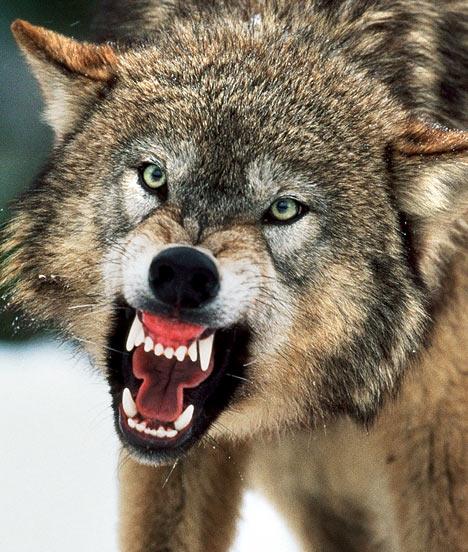 A better question might be who’s afraid of the big bad wolf pack?
The corruption in this case runs very deep. So deep that there is no point in denying that there is a large range of potential risks in writing about some of it publicly. Every stone that is turned over in researching this case reveals more and more indications of corruption, some on the part of common criminals, some on the part of those that we should be most able to trust – police officers, attorneys, and judges. And the idea of making any of them too angry is, well, scary.
But the truth in this case is that fear was used like a tool to repress many people. A lack of courage on the part of many was required for justice to be so far miscarried. In this climate, the courage of some is all the more astounding. The earliest truth-tellers in this situation are people to be admired. It seems simple enough to just tell the truth, but as Orwell said, “In times of universal deceit telling the truth becomes of revolutionary act.” It was scary to stand up then, and many didn’t.
There is a quote so often repeated that it is hard to find its original source – “All that is required for evil to prevail is for good men to do nothing.” It is a powerful idea, and one that applies here. Many, many, many people did not come forward as alibis, or as informants to the actual perpetrators while this case was active because they were afraid. It is understandable, it was a terrifying time, but to move forward we must let go of that fear. Many good people did nothing when this case occurred. That is the past, and we must learn from it, but we must also let it remain the past and walk bravely into a new future.
So, here is a new quote to for a new era:
“Power is of two kinds. One is obtained by the fear of punishment and the other by acts of love. Power based on love is a thousand times more effective and permanent then the one derived from fear of punishment.” – Gandhi
We possess a power greater than those that oppose us because we act from love. On that note, here are some of the highlights of corruption in this case. Sadly, this is the tip of the iceberg:
When the labwork came back and there was NO physical evidence against the Fairbanks Four, the investigators did not pursue other leads. They went “shopping” for jailhouse snitches. One was a woman who claims that she overheard an incriminating statement while she was in jail at FCC the same time as the four. Even though male and female inmates are separated even in general population. Even though the four were being held in isolation, where they made comments of any nature to absolutely no one. The star witness was a man who received leniency in his own crimes (and whose criminal record would make you sick) who agreed to testify that he had seen the four together. From 550 feet away. In the dark. Drunk. High on drugs. Standing with a group of people, some who were sober, who saw nothing. (To be fair, perhaps he got into radioactive goo or something as a child and has super powers).
In the absence of any physical evidence to take to trial, Detective Aaron Ring and Prosecutor Jeffery O’Bryant got together in their hotel room and made some. Don’t bother reading that sentence twice, you did indeed read it right the first time. With young men’s entire FUTURES at stake men sworn to uphold justice, to serve and protect us all, made exhibits for court during a hasty craft hour held in their hotel room. They took a lab-made ink print of George’s boot that was printed on clear overhead type paper. They selected a few slides that did not show all of the tread. They then layed it over a photo of John Hartman’s face. The photo had no scale. It was scientific garbage, but the lab logo would lead the average person to see it as legitimate. With no scale, a picture can be adjusted until its size roughly corresponds with any shoe. The exhibit was not made by a forensic lab, but by a police officer and prosecutor in their hotel room.
In an affidavit filed by John Cayton, the forensic expert the defense employed at the trial, filed post-trial, Mr. Cayton calls the exhibit “extremely misleading,” “troubling,” a “misrepresentation,” and states that, after repeatedly asking the defense attorney for a chance to review the evidence (remember, the defense attorney should have WANTED his expert informed), he was eventually told to get it directly from Aaron Ring, who sent poor quality copies and copies without any scale.
George’s first attorney, Bob Downes, made some other remarkable choices during trial. In addition to not supplying the expert the information he would have needed to testify properly, he did not call any of George’s alibis as witnesses. He also DID NOT OBJECT to the homemade bogus boot exhibit.
Bob Downes had worked with the prosecutor, Jeffery O’Bryant in the past, and knew him personally. After the trial was lost Bob Downes became a judge. He used Jeffery O’Bryant as a reference, and got the job. You can read his application/resume HERE.
No other suspects were investigated. Even though John Hartman’s brother had received a phone call warning him that his brother might be in danger the same night that he was killed. Even though Chris Stone, the person last seen alive with the victim, had astounding inaccuracies in his statement. Even though the victim was found wearing his pants. Even though he had suffered a similar beating a few weeks earlier and had refused to name his assailants. Even though there was never ever any evidence that any of the accused knew the victim or would have had any reason to harm him. Even though Chris Stone left a disturbing message for a friend that night, even though that friend asked police to get a copy, even though she went to the police station that day to make a statement that she thought Chris Stone was not being honest. EVEN THOUGH THERE WAS NO PHYSICAL EVIDENCE.
All interrogations in Alaska are required by law to be taped. George insists, and Crystal Sisto also insists, that his interrogation began long before a tape recorder came on. Read transcripts of the interrogation HERE and decide if that seems to be the case. You can also read the post about his interrogation HERE.
Eugene Vent was a minor and had the right to have a parent present. They told him that, but read about his interrogation HERE and ask yourself if they really believed he had understood all of his rights.
There is no recorded Blood Alcohol Level for George Frese on record anywhere. Interesting, considering that he had drank beer and liquor all night, hard liquor all morning and into the afternoon. Unusual, since it seems that an intoxicated underage patient would typically have a blood alcohol test. It makes you wonder…..is there a blood alcohol content at which a person must receive medical treatment and cannot be interrogated? Is there a blood alcohol content at which a person is considered legally incompetent and their statements could be voided? If there was one taken, how did it disappear?
The key players in this case received serious promotions following the “successful” outcome. These boys made the list of his notable accomplishments when Jeffery O’Bryant’s promotion to Fairbanks District Attorney was announced. Check that out HERE
Add to that the MANY PAGES of details that we will need time to write down. Add to that controversies that we are still afraid to write down. Add to that corruption we have not unearthed. And add this final quote to your mind for times when you want to blend into the flock because you are afraid:
“Make yourself sheep and the wolves will eat you.” Benjamin Franklin
There are many people in our community who know who committed this crime and have remained quiet out of fear. To you we say, muster your courage. Put your faith in the idea that to act from love gives you great power. Remember that fear does not make you safe, it makes you sheep. And the wolves are out there.
 Below is a detailed timeline of Eugene’s motions on the evening of October 10th and early morning hours of October 11th. John Hartman was assaulted at 1:30am. Through a series of bizarre events, Eugene becomes a suspect at about 4:30am. You can read a timeline of John Hartman’s night HERE.
Eugene Spent the evening getting drunk with friends of his from school at a house party. He made his way from the house party to the last bit of a wedding reception at the Eagle’s Hall, and eventually continued partying into the early morning hours at the Alaska Motor Inn.
10:00 pm – Eugene gets a ride with Christy Moses, who drives Eugene, Kevin Pease, and several others to Kevin Bradley’s house off of Chena Small Tracts. Since the van was full, he left his friend Daniel behind at his house. A very small decision, but one Eugene says still haunts him. Of course at he has no idea as he heads to the party that this night will change his life. Kevin Bradley’s parents are out of town, and he is throwing a house party. The drive from downtown to the Chena Small Tracts home takes them 20 minutes or so.
10:30 pm – The group arrives at the house party. There are a dozen or so people drinking and partying at Kevin Bradley’s house, including Joey Shank. They listen to music, drink, drink, and drink for the next several hours.
1:30 am – Joey Shank, who was the only person not drinking at the house party and was the designated driver, says he left Kevin Bradley’s house at about this time with Eugene Vent, Kevin Pease, and a group of other friends (Shawna, Allen, Dana, and Nathan). He is driving a blue Nissan owned by Kevin Bradley’s parents. He takes the Johansen to the College Road Exit, then takes the Wendell Street Bridge toward the Eagles’s Hall.
1:50 am – Joey Shank arrives at the Eagles Hall. Joey Shank says he remembers the timeframes because he was nervous, sober, and conscious of the time. He was driving a car packed like sardines full of drunk teenagers, and the car belonged to Kevin Bradley’s mother, who was out of town. Once there they only stay for a few minutes – long enough to figure out that Conan, who they had hoped to meet there, was not at the reception.
1:55 am – After Dana determines that Conan isn’t at the reception, the group all jumps back in the car. Eugene hopped in the front seat even though Kevin had called shotgun, so Kevin got Eugene to move and Kevin rode in the front, Eugene squeezed in with the rest in the back. They left to drive to Conan Goebel’s house.
2:05 am – The group arrives at the Goebel Residence, but Conan isn’t home. Shawna Goebel, Kevin Pease, Eddie, and Nathan get out at the Goebel house. Joey Shank drives the rest of his passengers (Eugene Vent, Shara, and Allen) back to the Eagle’s Hall.
2:15 am (approx) – Eugene attends the reception. The band at the wedding reception was supposed to stop playing at 2 but the audience takes a collection and pays the band to keep going. Eugene spends some time dancing and mingling with the crowd at the reception.
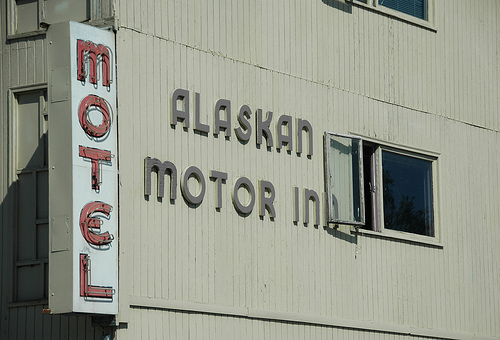 2:50-3:00 am (approximately) Eugene and others leave the wedding reception sometime near 3 am and head to the Alaska Motor Inn to continue partying in room 107. There is a small group of core people there, and others are trickling in and out. The party is making a lot of noise, and the frustrated hotel clerk Mike Baca tries unsuccessfully to break it up. He calls the police to report the loud underage drinkers, but they do not respond. They are, of course, very busy with a rash of crimes, including the recently discovered assault victim John Hartman.
4:19 am – Alaska Motor Inn Clerk Mike Baca calls 911 and reports that he has had a confrontation with the young partiers, who refused to quiet down or leave. Eventually, he says that he maced a few of them after one pulled a gun on him. In reality, he did mace at least one of the kids, but no one had a gun. He made that up, hoping the police would respond immediately and break up the loud party. The police do respond within minutes, and the kids from the party scatter, running off to avoid getting in trouble for underage consumption of alcohol. Among those running are Conan Goebel, Gilbert Frank, Harley Semekan, and others.
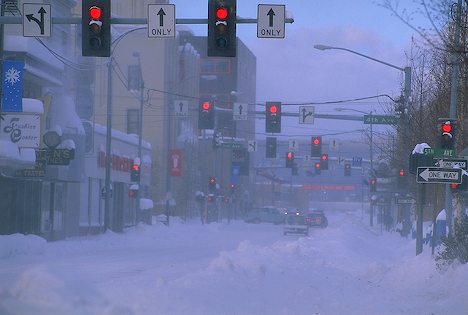 4:30 am – Police catch one of the kids that fled the Alaska Motor Inn Party – Eugene Vent. They find him at the intersection of 5th Avenue and Barnette. They tackle him violently and arrest him for minor consuming. Although he is unarmed and shows no signs of having been maced, they think he may be the gunman from the hotel clerk’s report.
4:40 am – (approximately) The police drive Eugene to the Alaska Motor Inn and have clerk Mike Baca look into the back of the squad car at Eugene Vent, and ask him if Eugene is the gunman. Baca identifies Eugene as the gunman (although it was soon learned that there was no gunman). While they are there, they show Mike Baca a picture of John Hartman’s clothing and ask the clerk if John Hartman had also been at the party in room 107. Mike Baca says he is “sure” that there was a kid there in those clothes (it is determined within a day that John Hartman was not there, and that Mike Baca once again was falsely reporting).
5:00 am – Eugene’s questioning begins as soon as he was arrested, but begins in earnest sometime around 5:00 am. He is processed at Fairbanks Youth Facility, where he registers a blood alcohol level of .168, a level known to indicate extreme intoxication and blackouts, confusion, disorientation, difficulty walking, slurred speech, and a myriad of other symptoms. He is interrogated into the late afternoon.
Eugene’s interrogation lasts, with a few breaks, approximately eleven hours. You can read about the interrogation and read transcripts of the interrogation HERE
Human beings can feel honesty. Which is why this post is so important. There is much information about this case available. Transcripts, trials, interrogations, articles, and the like. And in those, you have to search for the truth. But in Eugene’s own words you can feel the truth. Not because he is the next great American novelist, not because he reaveals shocking new information, but simply because he is telling his story and you can sense that it is honest.
This case is complex and the details can be overwhelming. Because Eugene’s letter is specific to his night, here is some background for reference:
Eugene Vent left a a party at the Alaska Motor Inn on foot when the police were called by the hotel clerk. The hotel clerk had called repeatedly to ask police to break up a loud party in one of the rooms. They were slow to respond. So slow, in fact, that the clerk was eventually so frustrated that he called and falsely reported that one of the party goers had pulled a gun on him. The police responded immediately, and the kids at the party took off on foot. They caught one of them several blocks away – Eugene Vent. They then drove Eugene to the hotel clerk and asked him if he could identify Eugene as the gunman. He did. They also showed him a photograph of the clothes that John Hartman, now fading in ICU, had been found wearing a earlier in the night and asked the clerk if he recognized the clothes. He said that he did, and that the kid wearing them had been one of the partiers at the hotel.
Ultimately, all of those things were false. John Hartman had not been at the Alaska Motor Inn that night (Read about his last night HERE). No one pulled a gun on the clerk, that story was a lie. The clerk did recant his statements about the gun reasonably quickly, but it was too late. His identification of Eugene as a gunman created suspicion in the police that Eugene may have been involved with the assault on John Hartman, and over the course of eleven hours police aggressively interrogated Eugene until he eventually made incriminating statements about himself and the three others. (Read Eugene’s Interrogation HERE).
There is a lot of information about this case out there. Transcripts, articles, news stories, interrogations, interviews, timelines, blogs, websites, and the like. But sadly absent from all of that information is the voice of the four young men to whom the cost of this case has been so real. Anyone can take many things from you against your will, including your freedom. But they cannot take your voice and they cannot take the away the truth. No one can take your story. Below is Eugene’s story, written this October from the Hudson Correctional Facility:

“Time is what I took for granted early on in my life. I made decisions based on the fact that I would have plenty of time. On the October 10, 1997 I left my family to go drink alcohol with my friends from school. I drank beer, drank hard liquor, and even smoked marijuana. I attended a house party, a wedding reception, and last but not least… an Alaska Motor Inn party.
At this party there was a lot of noise and the clerk did his job by telling us to leave. We refused, and this clerk called the police before an altercation eventually developed in which this clerk sprayed my friend with mace.Immediately following this the police showed up; I chose to run…as did everybody else. My thoughts were I cannot get caught drinking again and that I could make it home without getting caught. Boy, was I wrong.
I got apprehended a few blocks away. But then things took a turn for the worst. The clerk accused me of pulling a gun on him and I was charged with assault in the third degree. I never had a gun on me and I didn’t pull a gun on this man. Of course this man was caught on tape telling a coworker that he lied about the whole story to the police, resulting in a not-guilty verdict. Needless to say, the damage was done and it changed the course of not only my life but of countless others…
I was seventeen at the time. I registered a .168 blood alcohol level and I was taken to the youth facility. Police had a busy night with assaults, robberies, and a kid was in the hospital on life support. The police had a hunch that maybe I was involved in some of these crimes so they came to question me, especially since the clerk said I had a gun on me and he also identified the clothes of the kid on life support as having been at the hotel party with us. Of course, I made things worse for myself by being defiant and even lying to the detective. The Detective exercised tactics of interrogation on me including lies, lies, and more lies. After a few hours I was confused, not sure of myself and even afraid of these accusations.
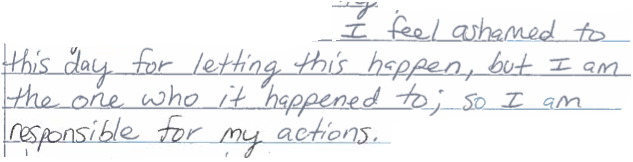
 I ultimately (falsely) admitted to participating in the assault of the kid, who I later learned was named John Hartman. I also implicated my three co-defendents Kevin, Marvin, and George during these interviews. I feel ashamed to this day for letting this happen, but I am the one it happened to so I am responsible for my actions.

The next few days were a nightmare, but I knew that in no possible way was I responsible for these terrible crimes……No possible way!!!! I pled not guilty to all charges and even the judge dismissed the charges only to see them reinstated by the Alaska Court of Appeals.
I refused a deal offered by the State Involuntary Manslaughter and robbery in which the State wanted me to lie against the other boys. I had no hesitation in saying “No” and I went to trial July 1999.
The trial lasted almost a month, witness after witness, no DNA evidence, alibi witnesses…my expert in false confessions was not allowed to testify… I believe that ruling changed the whole Trial.
I was convicted of Murder, RobberyX2, and Sexual Assault…all this with no physical evidence. My admission hurt, and eyewitness testimony from 550 feet away sealed my fate. I was sentenced to 38 years, and at my recent parole board hearing I maintained my innocence in front of a Board that had the power to release me. I received a continuance until 2014.
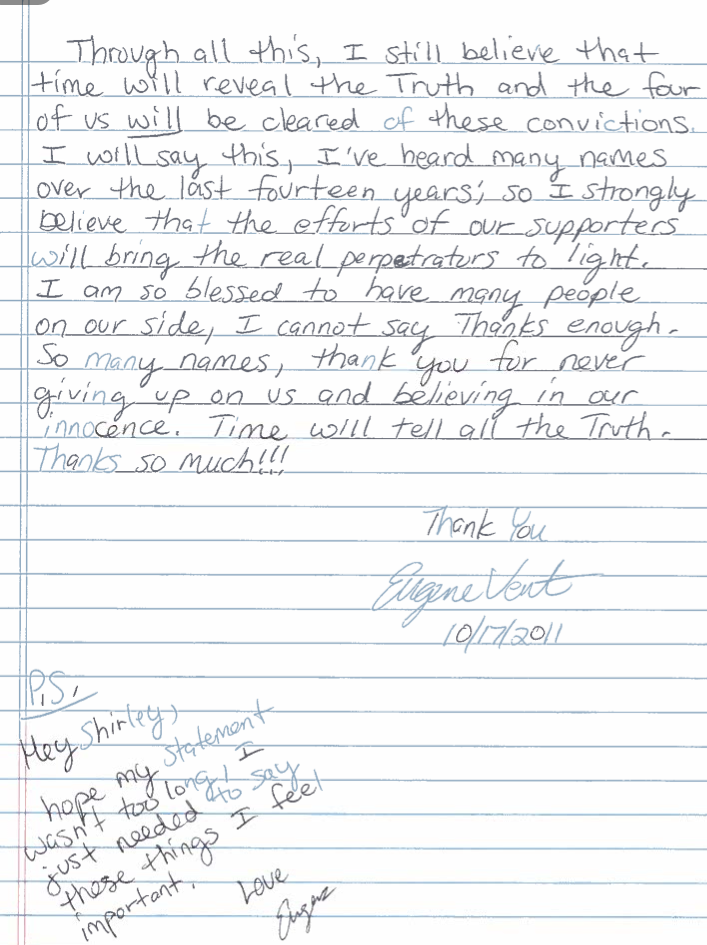 Through all this, I still believe that time will reveal the Truth and that the four of us will be cleared of these convictions. I will say this, I’ve heard many names over the last fourteen years; so I strongly believe that the efforts of our supporters will bring the real perpetrators to light. I am so blessed to have so many people on our side, I cannot say Thanks enough. So many names, thank you for never giving up on us and believing in our innocence. Time will tell all the Truth. Thanks so much!!!
Thank You,
Eugene Vent
10/17/2011″
 The true definition of con·fes·sion is: Noun. A formal statement admitting that one is guilty of a crime.
The truth is Eugene did not confess. But he did make incriminating statements after many hours of interrogation.
The truth us that the police, media, and prosecuters led all of Alaska to believe in those first days that he had confessed.
The truth is that the issue of false confessions is one of the hardest elements of this case for most people to understand, but we are not going to avoid it. We are going to address it right away.
The truth is, the average Native kid from Interior Alaska, especially before this case, had no idea that the police can lie to you. We were raised to believe that police should be honest.
The truth is, the police can tell some pretty compelling lies. They can, for example, tell a drunk seventeen year old who was blacked-out drunk for half the night that there is blood on his shoes. That his friends say he kicked someone. Lies that are hard to imagine. The truth is that they can use lies like weapons, to take someone’s mind apart.
The truth is, they did that to Eugene. It took over eleven hours.
The truth is, eventually, he fell for it.
The truth is, the interrogation technique the FPD used on Eugene is not used anymore, because it turns out it is a good way to trick someone, but not a good way to find out the truth.
 The truth is, false confessions may be the single leading cause of wrongful convictions in homicide cases.
The truth is that more than two-thirds of the DNA-cleared homicide cases documented by the National Innocence Project were caused by false confessions.
The truth is that 93% of false confessors are men. 65% are under 25 years of age.
The truth is, multiple false confessions to the same crime were obtained in 30% of the cases, wherein one false confession was used to prompt others.
The truth is, the majority of people polled believe that a person would “never” or “almost never” confess to a crime they had not committed.
The truth is, most of us are blessed enough to have never had our psyche tested to that point. We are lucky that we do not know firsthand what it feels like to be interrogated for murder, and in reality we do not know how we would respond.
THE TRUTH IS OUT THERE, JUST LOOK FOR IT.
READ EUGENE’S INTERROGATION HERE. For most of the interview, Eugene thinks they are trying to bust him for hooking a friend with weed, and doesn’t actually know what they are questioning him about. Remember that the “evidence” the police are citing is fictional, that Eugene is extremely intoxicated, and scared. Do your best to put yourself in HIS shoes.
READ WHAT EXPERTS HAVE TO SAY ABOUT FALSE CONFESSIONS HERE, HERE, and HERE, in their sites dedicated to the topic. Also, read HERE in Scientific American, HERE in the Economist, or HERE in the Huffington Post.
If that is not enough, Google it. Look it up on Wikipedia. Look anywhere – what you will find is the suprising truth about lies. Stay tuned to hear what Eugene himself has to say about the experience.
Many prominent exonerations have come after Innocence Projects re-tested DNA evidence collected from a crime. Unfortunately, that is not an option in this case. The summary of physical evidence connecting George Frese, Eugene Vent, Kevin Pease, and Marvin Roberts to the murder for which they were arrested and convicted is contained below:
 That’s right – nothing. No physical evidence. Zero, Nada, Nothing. There are many points of this case on which people disagree and can present a compelling argument. The point of physical evidence is not one of them.
Perhaps, if we assume the best of the investigators, they may have believed during the earliest points of the investigation that they had the right men. Kevin Pease, for example, had blood visible on his shirt when he was questioned. He claimed that the blood was his from a nosebleed. Labs would confirm that was the case.
Police collected the shoes and clothes that George, Marvin, Eugene, and Kevin were wearing the night of October 12, 1997 and sent them to a forensic lab, most likely hoping or assuming that some physical evidence would link them to the victim. Nothing did. No blood, no DNA, nothing.
Police dismantled Marvin’s car looking for evidence that would at least place the four young men together in the vehicle. Nothing.
Despite the accusation that these four men had spent the evening together on an unprovoked spree of violence, culminating in the kicking/stomping murder of John Hartman, no physical evidence of any kind has ever linked them to the victim, the crime scene, or each other.
According to the national Innocence Project, eye-witness misidentification, snitch testimony, and false confessions are often the key ingredients to wrongful conviction. All of these elements would be used to build a case against the four. Missing from this case is physical evidence of any kind, the most reliable form of evidence, and in a crime of this nature, the most obvious type of evidence to look for in the search for the responsible parties.
It seems logical to assume that there was indeed physical evidence on the people who committed this crime. Unfortunately, such evidence was never collected. No other suspects were ever pursued in this case. The physical evidence of this crime probably existed in those crucial hours following the murder, on the shoes, vehicle, and clothing of the actual perpetrators. And it was probably washed away a decade and a half ago.
These four will have to proceed toward exoneration without physical evidence, a notoriously difficult and complex fight.
 On the same evening that John Hartman lived his last night on Earth, four other young men also spent a normal day with their friends and families, with no idea as evening fell that October 10, 1997 would be the last normal day. No premonition that the night and early morning hours of October 11, 1997 would contain the moments that changed their lives forever; the line that now divides their lives into two parts – before and after.
None could have possibly predicted that each movement they made would be scrutinized for a decade and more. Not one of the looked into the faces of those around them knowing that these friends, family members, acquaintances, and strangers were about to become alibis. That some of them would be threatened, that some of them would be courageous, that some would be afraid, that some would become activists, that some would sink into their sorrow. No. It was an ordinary night.
The four boys knew each other. They were not close friends, but had all played on the same basketball team for Howard Luke, a predominantly Native high school. They did not spend the evening together, but each saw the others at least for a moment at some point that evening. The times their paths crossed that evening they would not have known that soon they were to be each others only friends – the only familiar faces in a foreign place, and an all encompassing nightmare.
The Four Were:

Marvin Roberts. Marvin was 19, had been valedictorian of his class that spring, a basketball enthusiast, a doting older brother to his toddler brother, and best friends with his sister. A gentle person. He was not a drinker, and unlike most of his classmates and friends, had a car.
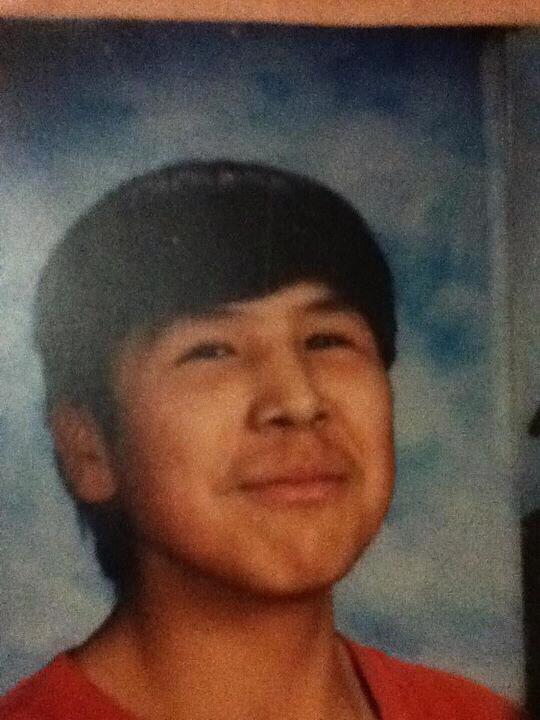
Eugene Vent. Eugene was 17 that fall and a basketball enthusiast. He was funny guy, always smiling, and kind. He was young, and like many young men he drank too much and too often. He had, just days prior, revived a ticket for drinking underage. Like so many other teenage boys Eugene was finding his way from boyhood to manhood, a road not without challenges, but on the whole was a good guy.

George Frese. George was 20 at the time, and the oldest of the four. He was a doting father to his three year old daughter Tiliisia, and most who knew him at this time will talk first of his dedication to his daughter. George and his partner faced challenges common for teenage parents, but met most of them with grace. George did not drink often, but when he did he drank to great excess
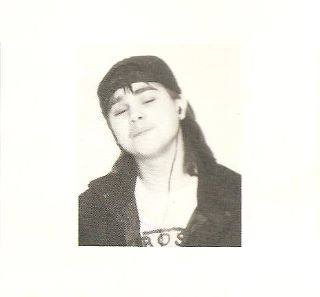 Kevin Pease. Kevin was 19, smart, an athlete, and a kid who was doing his best to transcend hardships at home. His father had been murdered just a short time before this pivotal night. One friend, asked to describe Kevin, said “Fun. Brave. But if I had one word I would say fun. It was hard not to smile when Kevin smiled.” Kevin had had a series of small run-ins with the police. He was the baby of his family.
How they spent that fateful night:
Marvin spent the bulk of the night at a wedding reception, where many tens of people saw him throughout the evening. He was the only one of the four that did not get drunk that night. Earlier in the evening he cruised around aimlessly with a few friends, looking for girls. He gave a few people rides. No less that 10 people insist that they saw him dancing and mingling between the hours of 1 am and 2am.
That night, Kevin and Eugene went to a house party in the hills above Fairbanks. Their friend had the house to himself with his parents out if town, and the predictable party and mayhem followed. A house party full of people of course saw them at the party, drinking and mingling. Both Kevin and Eugene drank heavily; Eugene drank to the point that he blacked out much of the night. A sober driver eventually drove a car packed with teenagers like sardines back toward town. He remembers looking at the clock frequently he says, because he was nervous about getting pulled over with a car full of drunk teenagers out past legal curfew. He says that the arrived in town at about 2am. This is notable because it is a full half hour after John Hartman was attacked.
Once in town, they stopped by the wedding reception, and ultimately went their separate ways, with Eugene heading to a part in a room at the Alaska Motor Inn and Kevin heading home.
George spent the first part of the night at home drinking with some friends and his girlfriend Crystal. Three sober babysitters watched George and Crystal’s daughter while they visited with their company. Another sober friend, the late Patrick Henry, older brother of Edgar Henry, said he was with George and his little brother all night. He says that they left George’s apartment as a group at about 1:30am, and walked as a group first to a friend’ s house, and then to the large wedding reception downtown. He said his brother and George were so drunk he had to “babysit” them, and consequently remembers their actions that night well. He says they arrived a the reception at 2am, and were together until after 3am.
How did they become suspects?
Eugene was arrested first, walking home from the part at Alaska Motor Inn. He ran when the police car pulled up on him, which they considered the first indication of his guilt. In reality, he ran because he was a young drunk kid, and the police were behind him. Clearly, his whole life would be different if he had run faster.
Kevin was brought in next. When he got home to is mother’s house, they had a huge fight, and he smashed up the house – punched Sheetrock, broke a few things. His mother called the police, a decision that she went to her death-bed regretting. He was a teenage troublemaker, already known to the police. When they realized he knew Eugene, a theory began to develop.
George was the third one taken. He woke up the next day still drunk and with a hurt foot. He was limping around in it complaining, and went to the E.R. to have it looked at. An ER nurse who had treated both the white boy dying upstairs and the Native boy with a hurt foot downstairs decided that the two patients were linked and alerted police. At some point the police did enough research to determine that George had played on the same high school basketball team as Eugene and Kevin. They came to the hospital for him.
Marvin was last. They showed up at his home, where he was sitting with an uncle, and took him in for questioning. During his interrogation he said he was innocent dozens of times, apologizing when an officer accused him of being disrespectful for saying it, and calling both officers “sir” through the entire interview, but never wavered for a moment in his insistence that they had the wrong person. Marvin was in that same yearbook photo, and probably the only one who had managed to get a car since graduation, and for the scenario that the police were building there had to be a driver.
A child was murdered at 1:30am, at which time four Indian boys were dancing at a wedding, walking to a friend’s house, and driving in a car packed like a sardine can. Yet, by the next morning the police are taking a victory lap for the local press, theorizing that these Indians probably killed the kid because he was white, or else that it is simply in their savage nature.
If you have read this far, you are likely left with nothing but questions, most of which boil down to why and how. If what we wrote above is true, and it is, why did they arrest these four men? Why were these alibis discounted? How were they convicted?
The answers can be long, or they can be short. The short answers are that they were arrested by chance, and guilty of being Native before the first question came. That they were drunk, terrified, with no idea what their actual legal rights were since they were not raised in the Law and Order culture, but the culture of Interior Alaska, where in the late 90’s most Native kids understood that once the cops picked you up whatever came next was up to the cops, and that resistance made things worse.
Their alibis were dismissed as not reliable, because their alibis were Indians. The D.A.’s closing argument was that, much like in the “I am Spartacus” scene, that Natives will lie for Natives, take care of their own kind, and can’t be trusted. Similar to the decrees long issued in this country that the savage is different.
 They were convicted in puppet show trials by juries not made of their peers, with no physical evidence, and plenty of corruption. And the trials didn’t matter. Despite the fact that no one here had ever seen any prisoner from Fairbanks Correctional costumed that way before, they marched them out chained together and dressed in orange for their arraignment. The public defender of course voiced his shock and called it grandstanding, but it was too late. The picture was snapped of the four chained together in orange, and it would run beside the smiling school picture of a victim that could be anyone’s child in every early article and news story run in Alaska and was the stock image for years to come. And the story, see, made sense. It didn’t have to make factual sense to make sense in the hearts of many. The official statement may as well have been, “Four Indians savagely killed a child, because he was white. No one’s children were safe, but now they are. We are protecting you from a fear you felt but could never substantiate. There will be no further questions.” They didn’t come up with any motivation beyond hoping that the public would assume these four were just senselessly violent people.
The LONG answers? Will be here, in this blog, and are partially addressed in the links below. You do not have to take our word for it, because we wouldn’t expect you to, and because we don’t need you to. All we ask is that you remain, hear this story, and take from it what you will.
If you want to do further reading, please take a moment to look at the work of journalist Brian O’Donoghue and the UAF Journalism Department Students via their website, or the “Decade of Doubt” series that ran in the local paper.
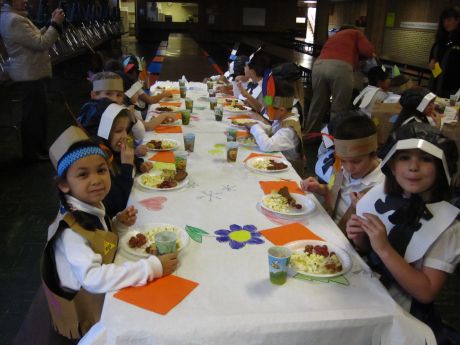
Alaska. The tourists come here in buzzing clouds, thick and as transient as mosquitos. They are very old. They are in the twilight of their lives. The women have poofs of white hair and wear elastic banded blue jeans. Their husbands carry cameras and wear khaki explorer hats.They arrive on enormous cruise ships and travel the thin highways on guided bus tours and train tracks, led by bright-eyed college students spending their summer working as tour guides. The greatest generation, spending their carefully sequestered Alaska portion of their retirement account, shuffling on the gravel at every highway overlook, scanning the horizons with their binoculars in search of a bear, a moose, their history. They all buy the same deep blue sweatshirt that says “Alaska: The Last Frontier,” in gold-embroidered letters. It is, after all, why they came – to see the Last Frontier. It calls to them because they come from places where the frontier has been conquered and settled and is gone now. Alaska is the last, the very last, American frontier.
There is a lot of magic in a name; part truth and part spell. The Last Frontier was bestowed carefully, a tribute both to the land’s untamed expanses and America’s deep rooted nostalgia for the era of cowboys sleeping under the stars and teepees peppering the wide open plains. America misses the Last Frontier. The idea that our ancestors walked bravely into the unknown, carved trails through an unforgiving wilderness, and ultimately weaved from the fabric of drastically different cultures, hard work, and luck the world’s strongest country is a great story. Our story. It is written so deeply into our collective consciousness that we walk with it, always, so intrinsic that we forget it is there. All of those old men and women were children once, together in that November classroom to learn the story. We were all there. When winter began to bite through fall we carefully stapled together the wide brown band of construction paper and pasted bright feathers to our Indian head-dress. We glued the bright yellow paper buckle to our pilgrim hats while the teacher laid out the multi-colored corn and parents arrived for the feast. And there, divided only by our different paper hats, we acted out the story: pilgrims and Indians eating together. Pilgrims and Indians celebrating abundance, welcoming the winter, waiting for the thaw, for the spring when America would begin in earnest. Thankful. So very deeply thankful for not just a meal, but for what was to come.
The story of our bright beginning, the purest freedoms, the wide open plains, that story is deep in our bones now. But we know that it wasn’t that easy. We feel the ghosts of other, less often told stories, lurking in the periphery of that happy story. We close our eyes and see teepees burning. We know that the pilgrims won, and we know how. Sand Creek. Custer’s Last Stand. Trails and trails of blood and tears carved through what was the frontier, paved and perfected so that the wild could become America. We sense it – that when those early November’s frost chased away the last of the leaves and winter was moments away, thousands of children were placed in hard-dug graves, wheels of wagons crashed over tiny bones and ground them to dust, and the division was real. Some of us walk with those stories, too, as deeply written and as impossible to shed as the first Thanksgiving. But those stories are heavier. Harder to carry.
For most of America, the stories get further away each season, until they are so far in the distance they are forgotten. The terrible ones remain untold until the words are hard to form and people are able to forget. But this is the Last Frontier, and here, the wagons must keep moving if America is to take root properly. Here it is sometimes America of golden arches and great bridges, but much of the time it is still cowboys and Indians.
In Alaska we are plagued with a terrible double vision, one we cannot make peace with. See, this is the America that learned from its past. This is the country that has progressed, where a million men marched, where a woman would not budge from her bus seat, where we can erradicate the past in order to form a more perfect union. And Alaska is part of that America. Yet, we are out of time in some ways. We are not as far along in our story, we are somehow still in the part where teepees must be burned and trails must be carved, even though we know the ending, even though McDonald’s is here before all the bison are dead. We are American enough that we believe ourselves to not be racist, to believe ourselves to be undivided. But when Martin Luther King had a dream, soldiers still came in the night to take Indian children out of their beds and send them away. Not a story from our ancestors, a story from our parents. It’s all wrong. Someone forgot to divide the Indians into reservations and erect copper likenesses of their murdered chiefs in the town squares. Someone forgot to build town squares. We are not divided enough to pretend convincingly that we are undivided. So, we have to play a kind of first Thanksgiving. America lays out the feast and shows us the colorful corn that could never grow in this soil. See here? America says. The proof that this is your story, too. Our story together. And we put on our technicolor feathers and flopping construction paper buckles and rehearse our happy meal. Pilgrims and Indians, cowboys and Indians, make believe until you believe.
Then, sometimes, something happens that breaks it all back open and the other stories come roaring alive. A boy, say, scalped on the streets, his blood staining snow, the last of his hot breath wisping into the late fall sky, life leaving him.
Men in cars with red and blue flashing lights, wearing badges and those black paper hats that were placed onto their heads so long ago that they have forgotten they are there. Still, right away they scan the horizon, begin looking for four Indian boys playing at warrior games, feathers like a shadow. The investigation is over now, before it has begun, because these men remember this story. They know how it ends already.
This story is very old. This is the story of America. This is the story of the Last Frontier, the very last. This is a story that you know already. This story was whispered to you once in the rustling of construction paper and dried corn. This is a sad story. Listen, listen.
 The Fairbanks Four