Unknown's avatar

About thefairbanksfour

A blog promoting awareness of the case of the Fairbanks Four, four young Native American men wrongfully convicted of a brutal murder and sexual assault in 1997. One post at a time, we will tell the story of a shocking murder, a hasty small-town investigation, and reveal the shocking racism and personal motives that fueled the process. You will hear directly from the accused who are writing in from prison, stories of brutality and corruption from witnesses ignored by police, testament of alibis, and much more. The innocence of The Fairbanks Four will become evident, their fight for justice with the Alaska Innocence Project will be followed, and slowly the story will lead toward the real killers.

State of Alaska Responds to Fairbanks Four Claim of Innocence

clockTick, tock. Tick, tock.

Life is about time. Time is all we have, really. And time is what the State of Alaska has stolen from so many, and what they are always wanting more of.

In the last hours of the last day remaining of the six month extension the State of Alaska was granted to review the Alaska Innocence Project’s motion for post conviction relief based on actual innocence for the Fairbanks Four, the State of Alaska has finally responded.

In September the Alaska Innocence Project and attorney Colleen Libby filed motions claiming that George Frese, Eugene Vent, Marvin Roberts, and Kevin Pease were innocent of the crime for which they were convicted. The state responded to that claim (which spanned some 131 pages) with a 23 page response which focuses largely on legal technicalities and little on the inherent accuracy of the claim that the Fairbanks Four are innocent, and that five other men are actually responsible for the violent beating death of John Hartman.

In general the response by the state reads like a typical attack by a prosecutor made on the arguments of opposing counsel. The response appears to be hastily written, with typos and a very conversational tone. It is not an thorough nor is it an independent review of the case and the claims of innocence by the Fairbanks Four, which is what the State of Alaska assured the Alaskan public is what they would receive at the end of the long extension (HERE).

In fact, the complexity of the case and the need to be thorough were cited as primary reasons for the long extension request. Senators Begich and Murkowski both wrote open letters to the governor (HERE and HERE) stating the importance of a thorough and independent review. Murkowski demanded that “no stone be left unturned.” In response, the State of Alaska overturned no stones. In fact, they only attempted to bury the stones. Begich asserted that “there can be no excuse for not having acted quickly in pursuit of justice and fairness for all involved.” In response, the State of Alaska acted slowly in pursuit of vague and poorly crafted arguments that this case should be kept out of court, with no indication that these arguments were in the interest of justice nor fairness.

We will highlight some of the most important and striking statements made by Alaska Prosecutor Adrienne Bachman on behalf of the State, and respond to them here. In this post we will focus on a few of her most important and central arguments. In the days to come we will continue to provide specific responses to the many statement made by the State. For tonight we will highlight the principle attacks on the Holmes confession. Quotes from the filing are in bold.

“As reported at the court’s last status hearing, investigation into the allegations made in the petitions is not complete.”

Let us begin by clarifying the roles of the State and Innocence Project. The Innocence Project is a legal non-profit. They function as a neutral third party who conducts independent reviews and investigations of cases that are referred to them and pass the initial screening process, during which it is determined that there exists a credible indication that the case may be one of wrongful conviction. They then complete a review and investigation and produce findings. In the case of the Fairbanks Four there has only ever been one independent investigation. That investigation was done by the Innocence Project, and the findings of that investigation were made public through the filing of a post conviction relief motion.

The State of Alaska was tasked only with reviewing and verifying the information in the PCR filing made by Alaska Innocence Project. The Innocence Project is staffed by one attorney, run by a volunteer board, and funded through donations and grants alone. They investigated a case that originated in 1997, reviewed all original materials, investigated the assault of Hartman, procured at least one direct confession, and filed their findings in less than eighteen months. By contrast, the State of Alaska has scores of attorneys at their disposal, access to the use of Alaska State Troopers, police, Alaska Bureau of Investigation, and millions of dollars in their budget for this fiscal year alone. Yet, they were unable to thoroughly review the work of one attorney in an eight month period. This is cause for concern. Furthermore, they failed to even scratch the surface of the task given them, which was to complete a review of the Alaska Innocence Project findings and investigate the evidence contained within. Instead of investigating the information to verify its accuracy they simply crafted an argument to keep the information out of court.

Let us also clarify what exactly the Fairbanks Four are asking for. They have filed a motion for post conviction relief that asks the state to vacate their convictions. It does not ask for immediate exoneration and release. It asks for convictions that were obtained with incomplete information, fictional information, fabricated testimony, coached and bribed testimony, and junk science to be vacated. The state could comply with that request and proceed into a trial. If the State of Alaska could convict them today with all available information admitted into trial, they could vacate these convictions and return to court to have an honest and fair trial, kinda like the one promised to all Americans in the constitution. It is not the release of the Fairbanks Four the State of Alaska is arguing against, it is their right to have a jury of their peers determine their guilt or innocence in a court of law. For eight months the State of Alaska has, with its virtually limitless resources, produced a document that not only fails to fulfill its expressed purpose, but is by their own admission “not complete.”


Bachman makes numerous and vigorous assertions that the testimony of William Holmes (HERE) is not in fact a confession, but hearsay.

“What the petitioners present amounts only to hearsay allegations that a third person, Jason Wallace, made incriminating statements about assaulting John Hartman…and hearsay is not admissible evidence.”

Webster Dictionary defines the two words in question here as:

Hearsay. noun. information received from other people that one cannot adequately substantiate; rumor.

Confession. noun. a written or spoken statement in which you say that you have done something wrong or committed a crime.

The confession by William Holmes is a firsthand account of his actions, motivations, intentions, movements, and observations the night John Hartman was killed. He confesses to driving into downtown Fairbanks that night with a group of friends for the express purpose of assaulting someone. He expresses that he intended to harm someone, and to drive the car necessary for all parties to flee the scene of these assaults. He further states that after learning John Hartman had died from the assault that he told his accomplices to not talk about the assault.

William Holmes confesses his crime. He confesses his sins. In fact, Holmes first attempted to provide this confession to the Fairbanks Police and through them, the District Attorney and state. They then hid the information and did nothing with it. Read about that HERE.

When the State of Alaska interviewed William Holmes about his involvement with the Hartman murder he maintained his guilt and the guilt of the other parties named. Without the ability to disprove his claim it appears that Adrienne Bachman chose the only method left to her in attempting to uphold the Fairbanks Four conviction, which was not to address whether or not the confession was true, but simply to craft an argument that it was technically not a confession.

The legal definition of hearsay is more complex, but in essence the same in spirit and application. Bachman’s assertion that the Holmes statement is purely hearsay is absurd. If her version of hearsay were to be applied that would mean that essentially a person could agree to drive their friend to go stab someone. They could wait outside until the friend came back out, bloody with a knife in hand, and said “I just finished stabbing so-and-so, let’s get out of here,” and that person’s testimony would not be allowable in court. I am not attorney, but I don’t need a legal degree to tell you, that is stupid. And if it is the best that the combined brainpower, money, resources, and attorneys at the department of law can produce in eight months, we should all be very concerned.

Bachman goes on to poke holes in the credibility of Holmes and Davison’s statements by explaining that they should not be believed because they did not come forward to get any leniency for themselves. As in, they had nothing to gain by coming forward, so we should not believe them.

Um…….okay, I officially have a headache.

In reality, the fact that neither Holmes nor Davison had anything to gain in coming forward lends credibility to their statements. If they had been offered some kind of leniency or reward or personal gain their statements would be less credible. But apparently at the department of law doing the right thing simply because it is the right thing to do is unheard of. Somehow, I am not surprised. They themselves seem much more interested in taking action for personal gain or to avoid responsibility for their actions than in doing the right thing. Which is disturbing. Because that means that the State of Alaska is apparently less ethical than a petty criminal and a triple murderer.

Perhaps the most interesting element of this filing is not what is in it, but what is NOT in it.

Bachman makes many personal attacks on Davison. Apparently when she was unable to dismantle the factual nature of his statements she opted to take a stab at intimidating and humiliating him to weaken his will. Remember, this young man had nothing to gain and everything to lose. She attacks him over and over as a person, yet does not bother to attach evidence that her claims are factual.

Bachman makes many comments about interviews and evidence that she does not introduce or include.

Bachman insinuates that she has ‘many’ witnesses, yet does not name even one.

What this filing fundamentally contains is a lot of grasping at straws, and very few facts. It is heavy on attempts to attack the truth through technicalities and light on any actual truth of its own.

Funny thing about the truth – it outlasts us all. Time reveals it. Funny thing about darkness – light banishes it.

The State of Alaska had an opportunity to seek justice instead of ego. Fundamentally, it is disappointing that they did not take that opportunity. No matter how hard they try to make this case go away, it will remain. No matter how hard they try to bury the truth, it will emerge. It is not disappointing because their approach will destroy the truth – it won’t. This battle will be long, but truth will prevail. It is disappointing because life gives human beings opportunities to choose between what is status quo and what is right. Those opportunities are gifts, and they failed to receive it. And at the end of the day, that is sad, because there is nothing so rewarding in life as to listen to your better angels and take a stand for good.

justiceAdrienne Bachman is only a person. In all reality she is just a person with a job, following rules, and taking orders from department heads and bosses. Orders from above.

We are taking orders from above, too. Perhaps it is time that she seeks a power higher than the one whose orders she followed today.


Fairbanks Police and District Attorney HID A MURDER CONFESSION in Fairbanks Four Case

truth“There may be times when we are powerless to prevent injustice, but there must never be a time when we fail to protest.” Elie Wiesel

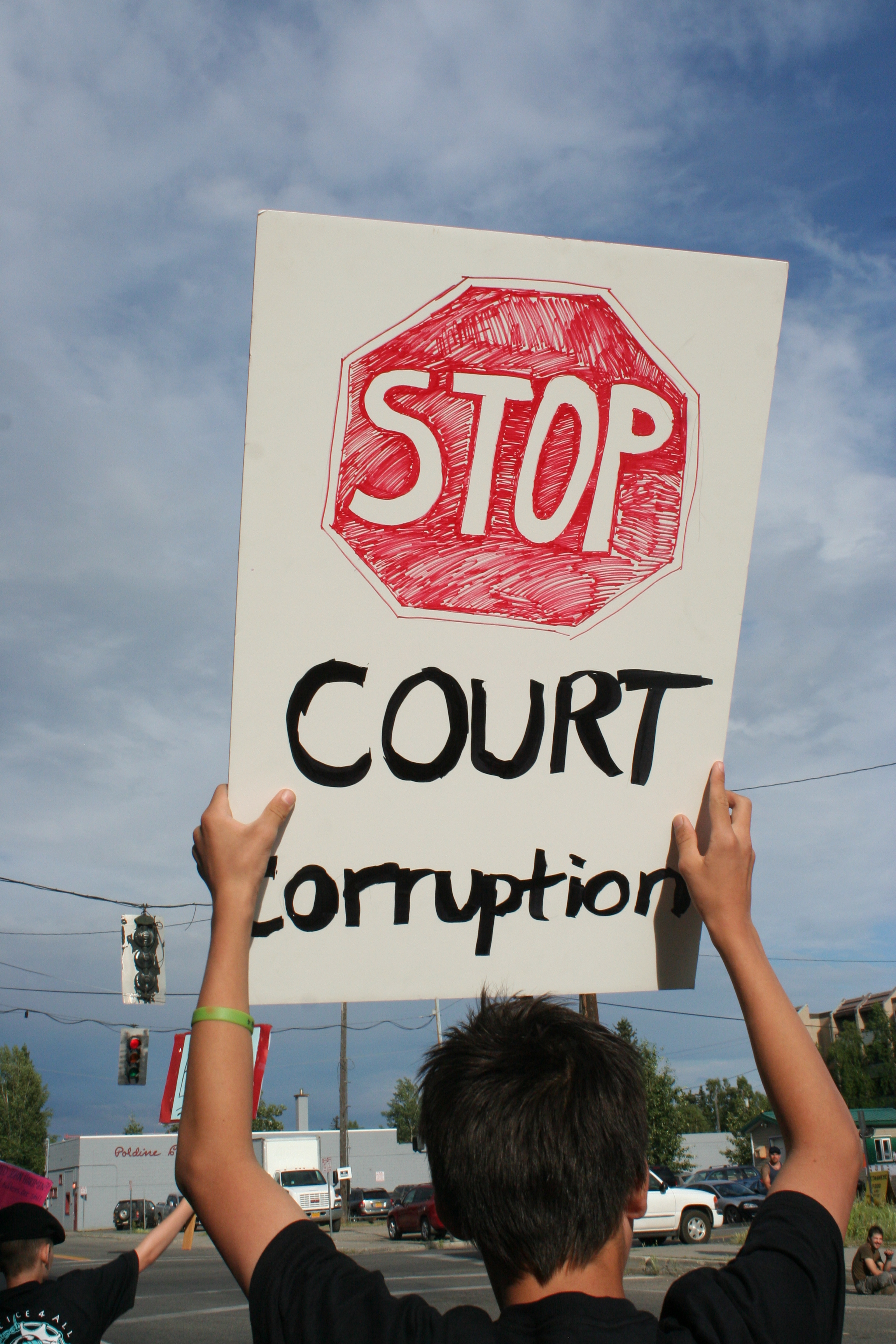
The time for protest is now.

The time for justice is now.

The time for the people to take back the justice system of Alaska is now.

The sitting Fairbanks Police Chief has called the Fairbanks Four case “model police work.”

The state of Alaska has said that they have never had any indication that justice was not served.

If we live in a state where this is model police work, and murder confessions by other parties do not constitute an “indication” that the wrong people are in prison, we are in incredible trouble as a society.

We have called it one of the most deliberate and disgusting miscarriages of injustice in the history of Alaska. Today, the debate ends. The Alaska Innocence filed a motion to supplement their motion for Post Conviction Relief that definitively proves that the Fairbanks Police Department received a confession of murder by William Holmes, given to a prison guard in the California prison where Holmes was serving a sentence for unrelated murders, and DID NOTHING WITH IT. They hid it. They swept it under the rug. They kept it in the dark, not realizing that the LIGHT IS COMING.

The State of Alaska commits a crime against George Frese, Kevin Pease, Eugene Vent, and Marvin Roberts every moment of every day. They put innocent men in prison in 1997 and have fought to keep innocent men in prison ever since.

Articles about this filing will dominate the news in the days to come. Read one HERE and below, and stay tuned. We will post in more detail. 


http://www.ktuu.com/news/news/group-claims-officials-knew-of-murder-confession-years-before-fairbanks-four-filing/25862168

State Prosecutor Bachman’s Astounding Interview With Indian Country Today

truthWe have been pleased to see the story of the Fairbanks Four debut onto various national media outlets, but have been perhaps most gratified to see the case appear on Indian Country Today. This story has universal meaning and all Native rights issues are, at their core, human rights issues. That said, history indicates that progress is rarely made on Native issues unless and until the indigenous people of America join forces. So, we have been especially pleased to know that the story of the Fairbanks Four is reaching across tribes. This story is new to most Native people only in its specifics. Mistreatment and dismissal at the hands of the American government is, of course, a very old and familiar story to people of all tribes.

Indian Country Today’s latest article on the Fairbanks Four case is an interview with state prosecutor Adrienne Bachman, who is responsible for heading the state’s review of and response to the recent Alaska Innocence Project filing. Nothing would please us more than to tell you that the window this interview provides into the state’s perspective gave us a hope that the state intends to lead a fair and balanced investigation in the interest of justice. However, in this interview Adrienne Bachman reminds us a great deal of her predecessors – the interview contains a few politically correct general statements and an awful lot of detailed statements which indicate that Adrienne Bachman stands firmly where Jeff O’Bryant stood before her – determined to uphold a prosecution through any means necessary. And the devil, as they say, is indeed in the details.

Read the interview for yourself HERE. Below, we would like to highlight some of the more fascinating lies it contains.

“All of the arguments currently made in the petition were made during the original trial, except the Holmes affidavit. Only the Holmes allegations are new.”

This particular statement is one of the most bold, baffling, and patently false of them all. The Alaska Innocence Project filing contained over 130 pages. Less than ten were dedicated to the Holmes confession. Some other highlights? The eyewitness expert who determined that the testimony of Arlo Olson was scientifically impossible. The causative instrument forensic specialist who debunked the state claim that George Frese’s footwear matched the victim’s injuries. The affidavits by half a dozen others, including one that outlines a detailed confession made by another of the five perpetrators Jason Wallace, and language which strongly infers that the contents of the sealed brief contain yet another confession. The statement that the only new allegations contained in the filing are contained in less than 10% is outrageous. We will hope for the best here and assume that perhaps the prosecutor was only able to read the first few pages on her month-long vacation. Read the entire AKIP filing for yourself HERE. Read about SOME of the additional new evidence HERE, HERE, HERE, HERE, HERE or even, HERE.

“The petition characterizes the original evidence, but a review of the actual trial testimony shows that there were many additional pieces of evidence that are never mentioned by either the petition or the newspaper articles that seem to form the basis for much of the public opinion that lingers about this case. Examples include the various admissions or confessions made by three of the four.”

Well, this is not so much a mischaracterization as it is an absolute lie. Bachman states here that an example of evidence that has never made it into the newspaper or the AKIP filing includes “various admissions or confessions made by three of the four.” The interrogations and police interviews can be read HERE, HERE, HERE, and HERE and just in case you want to be sure you can find them in the press, take a look HERE and HERE.

Eugene Vent, after 11 hours of interrogation in total, made incriminating statements. Read about his take on that HERE. The method used to obtain the statements HERE. George Frese also made incriminating statements in the case, after hours of interrogation, and sandwiched between insistence on his innocence, a request to go home, and statements that he didn’t”actually remember any of that shit.” George’s statements were not allowed into trial after the court determined they were ILLEGALLY OBTAINED.

For readers who struggle as much as the prosecutor with counting in the single digits, that makes for TWO people who made highly questionable statements but certainly statements it would be reasonable to classify as “admissions or confessions.” Her assertion that she is in possession of three admissions is patently false.

“The state is committed to conducting a prompt, thorough and thoughtful investigation of the Holmes allegations. It is a top priority.”

Sigh. Here is a statement we WISH was true. In reality, the state waited almost a month into their 45 day response time to even begin work on this case, and in an initial interview with the Daily News Miner Bachman made it clear that her first priority in regards to the Fairbanks Four case was for the state to review the original case. You know, THEIR case, which is apparently quite unfamiliar to them. In her response to the AKIP filing Bachman made it clear that her actual first priority during the beginning of her review was her “long-standing” vacation plans. Don’t take our word for it, read all about that HERE.

No one on the jury thought there was a reasonable doubt about their guilt based on all of the evidence presented at trial.

The first jury to hear a case against George Frese ended in a hung jury.One juror, convinced the accusations were the result of a conspiracy, locked themselves in the bathroom and refused to come out. It has always seemed, to us, that juror had doubts.


The interviews of both men were fair and above board. The police did not supply the details of the beating, Mr. Vent did. He named his co-defendants as involved in the beating, not the police. As a further example, Eugene Vent told the police that he’d given [John Hartman] some gum. Since the police had not mentioned chewing gum, but did find a small pack at the scene, Mr. Vent’s own words told the world that he had been there – no matter how much he now attempts to back away from those statements.

Okay, she does know we can read, right? I am going to skip quoting anything related to gum from Eugene’s interrogation, and use a quote I find more suitable from Eugene while being interrogated: “I can’t believe what you’re saying right now.”

Like, really. I can’t believe what you’re saying right now. Sadly, that is not true. In 1997 being tricked and lied to by people meant to protect you and uphold justice seemed unbelievable. Today, it seems routine. Live and learn.

We would like to encourage all of you to read the interview with Bachman for yourself, and any and all of the case materials she refers to. We would further encourage you all to let your elected leaders know whether or not you think this case was handled properly in 1997, and whether or not much has changed since then. Although it would be possible to pick this interview apart line by line, we will leave off here with a quote from us, and a quote from someone far wiser.

At the end of the day, only one of two things can be true: either Bachman lacks the ability to read and understand the material that she is responsible for reviewing, or else she has a full grasp on the information and is choosing to lie. Neither is acceptable. We have said for the last sixteen years without abating that the State of Alaska has demonstrated a lack of ability and propensity toward dishonesty in this case that indicated it should be removed from their jurisdiction, handled by a federal agency, and that each indication of corruption, perjury, bribery, racism, and civil rights violation should be investigated thoroughly by a federal body as well. We think we have done a good job laying out our extensive reasons for taking that position; we would like to thank prosecutor Bachman for taking the time to do several press interviews that demonstrate state bias more effectively than we could ever hope to do on our own. – Fairbanks Four Blog, today, right now.
Woe to those who make unjust laws, to those who issue oppressive decrees, to deprive the poor of their rights and withhold justice from the oppressed of my people, making widows their prey and robbing the fatherless. – Isaiah 10: 1-2

Rise From The Ashes – Audrey George – Albis and Witnesses XI

Audrey“Love one another and you will be happy.  It’s as simple and as difficult as that.”  ~Michael Leunig

Location became central to the investigation into the night of October 10, 1997. No location is mentioned more frequently in study of the case than the wedding reception that took place at the Eagle’s Hall that night.

A wedding is a time for celebration. The joining of hearts, of families, of paths. The beginning of children, futures, sorrows and happiness unknown – and a promise by two people to stick together through whatever may come. A wedding is a a time when people gather to witness love, to share in love, to be a part of that hopeful moment when two lives are woven into one.

We have spoken before about the pain and the shame that came with this case and how it touched so many in our community. When the Fairbanks Four were wrongfully accused, investigated, interrogated, and convicted of the murder of John Hartman, what should have been a night remembered as all brides remember their wedding was transformed into a criminal investigation. One wedding guest, while being interrogated for hours and hours, answered simply when he was being pressed about why he wanted to attend the reception, “Because Audrey is my family – because, I love her.” And it should have been love, after all, that was remembered of that night, without the shadow of pain and a complicated web of deception and hardship.

For Audrey McCotter and the late Vernon Jones, whose wedding became central to the Hartman investigation, there would always be something in the background of those happy wedding photos. No one knew, as they danced and laughed, smiled and cut cake, reunited with friends and family gathered there to celebrate – no one knew that this night would change lives. That a series of events was about to be set into motion that would change the Native community of Fairbanks and force the examination of society, of the concept of justice, and ignite a struggle to assert a place in it. That night, it was just a wedding between two people who loved each other dearly. Yet by morning, things had changed. In the police theory the Fairbanks Four were accused of having met up at the wedding reception, left briefly to commit a murder, and return to dance as if nothing had happened. On the day that her wedding announcement should have appeared in the local paper, Audrey’s wedding reception was referenced over and over in articles about a brutal killing.

Audrey speaks out below for the first time publicly about how her life intertwined with this case, about her wedding night, her personal struggle with the events that unfolded, and the heartbreaking loss of her late husband Vernon Jones.

We applaud Audrey for her courage. She is taking a brave step onto a new path. Knowing her personally I can assure all of our readers that Audrey’s hardships have made her a person of incredible strength and compassion. The gifts she has given to those around her after rising from the ashes of her own pain are incredible. We are grateful for her support, and humbled by the strength it took to share this deeply personal part of her life with the world. Here is her story, in her words:

My marriage began and ended in blood. Our wedding was in Fairbanks but we lived in Unalakleet so it was hard to plan long distance but we did it. A lot of special family members were there that are passed on now such as Teddy Luke, Morris and Thelma Thompson, and James Grant, Sr. My whole family and my husband’s whole family from the Koyukuk River area were there. We planned it during dividends so our family could afford to fly into Fairbanks to celebrate our happy day. It was precious to us, but that day has been remembered for something entirely different. It was October 10, 1997 the day John Hartman was murdered and subsequently when the Fairbanks Four were found guilty of murder.

One year and eleven months later my husband committed suicide. Life is not fair. I started a battle the day he died. I battled depression, alcoholism and thoughts of suicide. I’ve been sober eleven years now, I’m remarried, my two children are happy and healthy. I consider my life to be blessed and I’ve not only survived trauma but I’ve excelled.
I want the Fairbanks Four to rise from the ashes of loss and destruction and be blessed and excel as well, but they are still in the battle. I am no legal eagle, so my support of the Free the Fairbanks Four Movement will have to be my weapon.

Public humiliation and shame will now be turned around back on the courts. We did nothing wrong. I got married and my guests were happy young people celebrating with us. An important and less known fact is that Marvin Roberts, one of my guests at the reception, had a reputation as a responsible young man who was sober that night and he wasn’t known to get into trouble the way kids occasionally do.  We will continue to celebrate when they all walk again as free men. I’m tired of death and injustice when it’s within our power to stop it. Treat others as you wish to be treated and we have not treated these four men well.
~Audrey (McCotter/Jones) George

We know this much is true: the story of the Fairbanks Four will ultimately be remembered as a story of the power of love and truth. Someday, a story of the enormity and power of love will be the one in the background of those wedding photographs, as it should be. It is love we fight for and with. Thank you Audrey for being part of the fight.

No Excuse – A Letter from Senator Mark Begich


363Following in the footsteps of many ordinary citizens, local leaders, and more recently Alaska Senator Lisa Murkowski, Senator Mark Begich released a letter to Alaska Governor Parnell asking for swift justice in the case of the Fairbanks Four.

We applaud Senator Begich for advocating for justice. Leaders take a stand when the good of their people is at stake, regardless of the political cost or benefit. Both Begich and Murkowski have taken a risk and demonstrated that they have what it takes to lead.

We hope the Governor is getting the message from above and below: this case is a test of the transparency, ethic, functionality, and intent of the justice system under Parnell. So far, Parnell’s administration and the Attorney General are failing this test.

When state prosecutor Adrienne Bachman announced that the state had just begun its investigation 37 days into their allotted 45 days, the prosecutor’s dismissive remarks were followed in short order by this letter from Senator Murkowski.

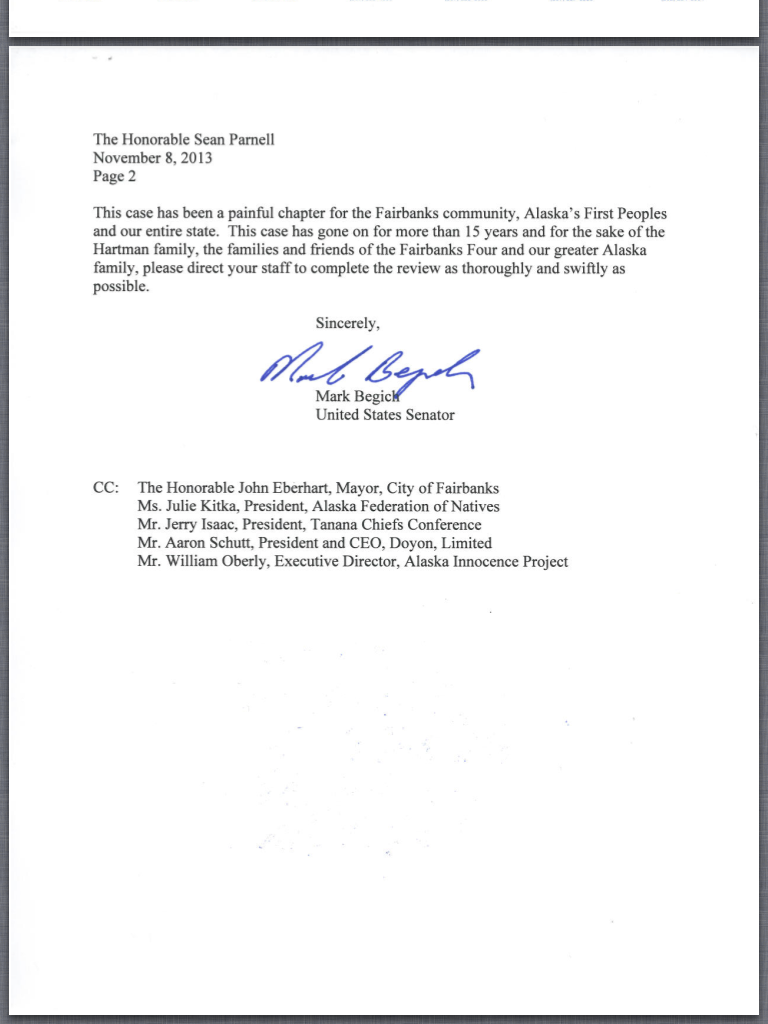
Following the state’s request for an extension until May 15, 2014, the letter below from Senator Begich was released. It speaks for itself.


BegichPage1


BegichPage2


BE encouraged by these letters. This fight has been long and in some ways has only just begun. There remain forces of darkness inside the justice system, but the truth will soon prevail and clear a path so that others will not experience the same injustice. The light is coming.

State of Alaska Seeks to Delay Response in Fairbanks Four Case Until May 2014

Image

Yesterday the State of Alaska filed their response to the post conviction relief application filed on behalf of the Fairbanks Four by the Alaska Innocence Project. In their response the State of Alaska asked for the court to extend their allotted 45 day response time to May 15, 2014 – over seven months from the date of the Alaska Innocence Project filing. 

The filling by Innocence Project contained two matching confessions, one given by Jason Wallace in 1997, the second given in 2011 by William Holmes, and alluded to the existence of a third confession filed under seal for court consideration. These confessions represent only a fraction of the evidence contained in the filing supporting the innocence of the Fairbanks Four and the guilt of the other men. William Holmes and Jason Wallace implicate themselves, Rashan Brown, Shelmar Johnson, and Marquez Pennington – all men with lengthy criminal records. Three of the five named are behind bars for unrelated multiple murders, and the remaining two reside in the greater Fairbanks area.

State Prosecutor Adrienne Bachman, who is the prosecutor assigned to the case by the state, filed to motion requesting an extension until May 2014 and made the unusual and striking choice to list one of her reasons for delay as her personal long-standing vacation plans. She also went on to explain that it would take the state time to familiarize themselves with the original case (their case) and that after the lengthy review of their original files they would look at the new information presented in the filing.

When the state of Alaska was handed information that strongly implicated their own employees in conduct that resulted in the death of at least six people, the 16-year long wrongful imprisonment of four young men, a complete breakdown in public faith in the system, they made a press release assuring the public that they were sure they were right, but would “independently’ investigate themselves. When this press release came out there was a significant response from the citizens of Alaska and their leaders, concerned that the tone of the press release was dismissive. The State was then handed resolutions from the largest tribal organizations in Alaska and a letter from the Senator Lisa Murkowski, all containing polite but direct requests for the case to be given the full attention of the State. With all of this in hand, they ASKED FOR A SEVEN MONTH EXTENSION.

For the first month following the filing by Alaska Innocence Project, the state did nothing. Literally nothing. Thirty-seven days into their allotted forty-five day response time, the State announced that they had just begun their review.

On the last day remaining in their response time, the State of Alaska asked for the lengthy extension, which contained their plans for the second month of the seven months the requested to investigate: NOTHING. Nothing, that is, pertaining to the case. The second month will be used to accomadate the long standing vacation plans of Prosecutor Adrienne Bachman.

The state of Alaska has at their disposal the investigative might of the Alaska State Troopers, Alaska Bureau of Investigation, City Police, the Attorney General’s office, hundreds of attorneys, boundless access to the prison system, and virtually unlimited spending capacity. Clearly, the State of Alaska can use the tax dollars its citizens contribute to expedite the handling of this case to a timeframe that reflects the seriousness of the charges levied in the Alaska Innocence Project Filing. 

Their response is obscene. The idea that a state paid attorney is perhaps at this moment fanning herself on a sandy beach while four innocent men sit in prison is offensive to humanity. I wonder, while she watches her own children play, if she ever considers the children of other women. I can think of a few.

John Hartman, for example, who was kicked so brutally that he was left nearly unrecognizable, thrown on the side of the road, and died a unthinkably painful death. 

Teacka Bakote, whom Jason Wallace beat to death with a hammer before he lit her on fire.

Hakeem Bryant and Christopher Martin. William Homles left them on the side of the road, dead, just five years after they left Hartman the same way.

Julie Ann Wilde. Rashan Brown shot her in cold blood. 

Victor Torres. He was only 19 years old when Rashan Brown murdered him.

All of those people were human beings, who will never take a family vacation. Their mothers will never hear their voices again. They will not be coming home for Christmas.

George Frese, who will fall asleep tonight behind the concrete walls of Alaska’s highest security prison. George’s daughter, Tiliisia, who has celebrated 16 birthdays without her father. 

Marvin Roberts, a high school valedictorian who was headed to study engineering in college on scholarship when he was sent to prison for a crime he didn’t commit.

Eugene Vent, who was only 17 years old when he last saw his family. He is in his thirties now.

Kevin Pease, whose mother Carol died in a fluke accident in 2006. Kevin was, of course, not able to take a quick vacation from prison even to bury his mother.

And the faceless. The missing. The victims not yet named. 

ImageThe State of Alaska is an institution, but it is a human institution. The Governor, The Attorney General, The Prosecutor, The Lead Investigator – these are all just titles. Surely, at home, someone calls these people Mom, Dad, Grandpa, Auntie, and the like. They are all human beings, and I wonder, does it ever cross their mind that the words and names and numbers and deadlines on their desk are just titles, and that behind them, human beings? That these are other people’s children?

Behind the cry for justice is a simple proclamation: we are human beings. Just as significant as you, our children just as precious and loved as your own.

We are all human beings. And when human beings are at stake in every possible sense, there isn’t time for vacation. It is time for as many hands a possible. This investigation should be handled with as much precision, care, accuracy, and urgency as possible, because human lives are at stake. That doesn’t mean that they investigation should be rushed or done poorly. It doesn’t mean that no one should take a vacation or get to enjoy their family. It simply means that this case should be handled in a manner which reflects the seriousness of the situation, the stakes, and the resources the state has at hand.

We wish, for these people in power, that they may come to understand the importance of the work they do, and with that understanding, proceed into their work with dignity as well as perfect memory for their own humanity and the humanity of those around them.


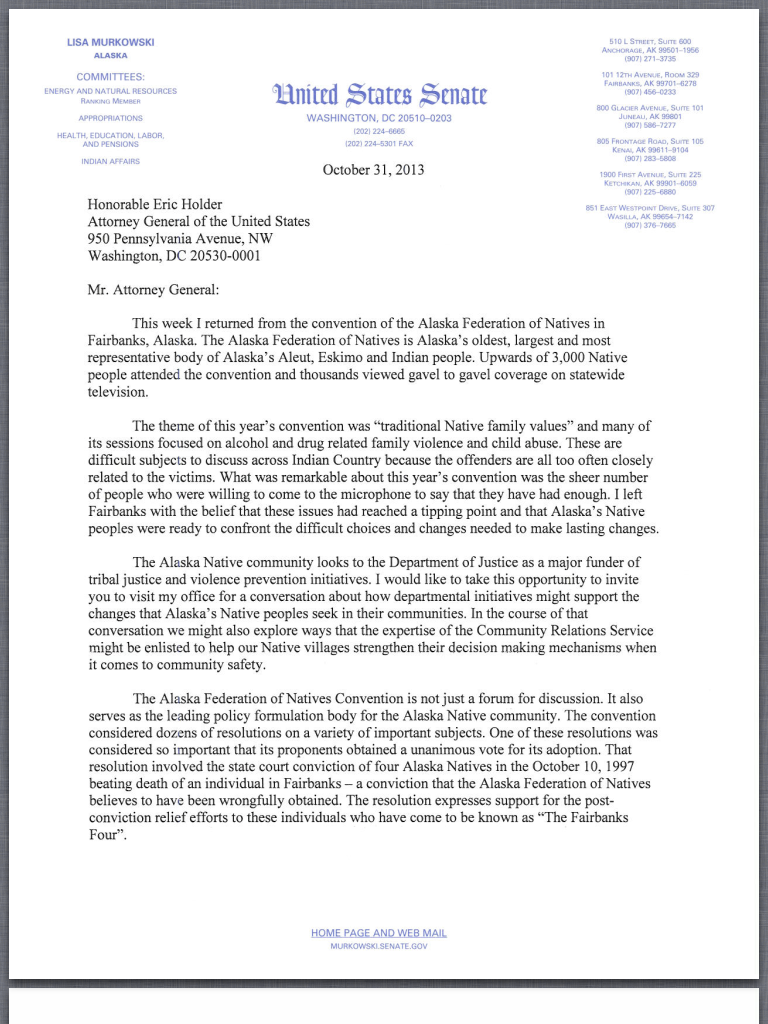
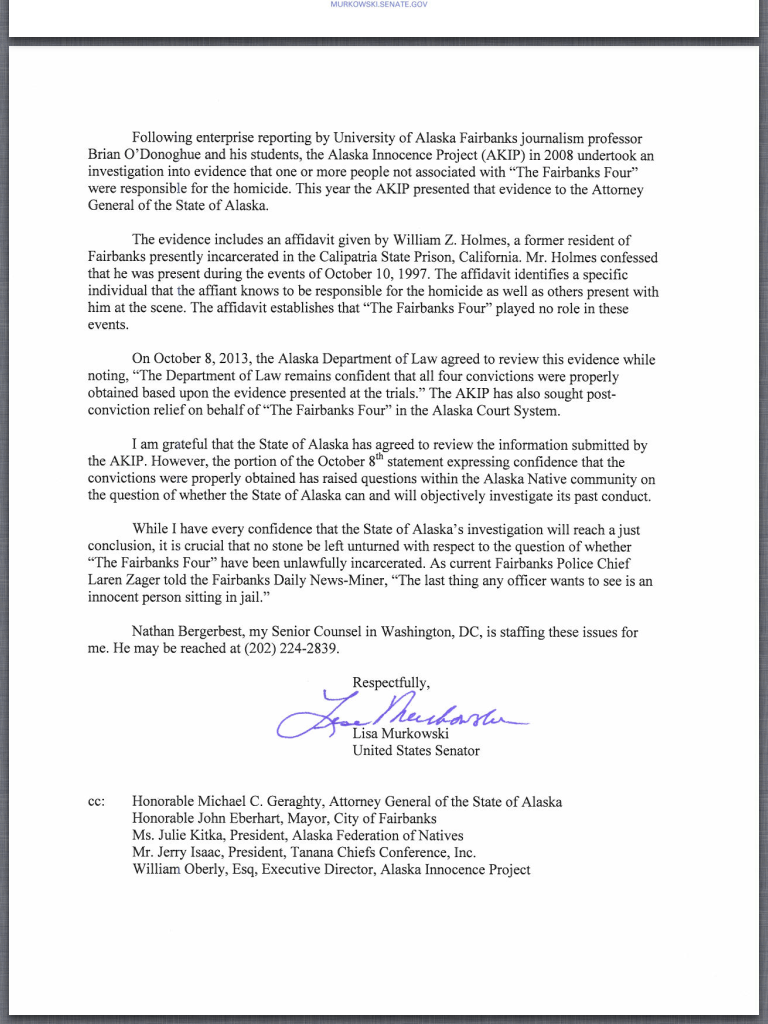
Sen. Murkowski on Fairbanks Four Case – Leave No Stone Unturned

ImageAccording to attendees of the Alaska Federation of Natives conference where a large demonstration took place in support of the Fairbanks Four, LIsa Murkowski voiced her support of the efforts to overturn the controversial convictions of Marvin Roberts, Eugene Vent, Kevin Pease, and George Frese.

In the wake of Assistant Attorney General Adrienne Bachman’s comments yesterday that she believed her review would take “many months,” and indication that the state intended to first review the original case material prior to investigating the new information in the murder of John Hartman, Murkowski’s office made a press release that included the letter below.

Image


Image

We applaud all who take a stand on this case, for justice in any circumstance, and agree wholeheartedly with Sen. Murkowski that this case must be investigated properly, swiftly, and in the interest of true justice.


“Men make history and not the other way around. In periods where there is no leadership, society stands still. Progress occurs when courageous, skillful leaders seize the opportunity to change things for the better.”  —Harry S. Truman


State of Alaska Fails to Investigate ‘Fairbanks Four’ Case In 45 Days, Says They WIll Take “Many Months”


ImageWhen the Alaska Innocence Project submitted an application for Post Conviction Relief on September 25, 2013 the clock began ticking on the State of Alaska. They were given the standard forty-five days to respond to the filing. Many residents of the interior Alaska community of Fairbanks wished that they would act more swiftly, given that the contents of the filing indicated that not only had four young men been wrongfully incarcerated for sixteen years, but three of the five men named as the true killers of John Hartman had gone on to commit brutal murders of unarmed civilians within a small handful of years following Hartman’s death. Perhaps more disturbingly, the other two alleged by the filing to have viciously beaten John Hartman to death for Saturday night amusement are free and still roaming through the streets of Fairbanks, Alaska. The gravity to the allegations – that the state had wrongfully imprisoned four innocent men for sixteen years, that in doing so had allowed killers to go free, and that a slew of brutal murders came as a result of the state’s actions – left hope among many in the community that the state would respond to the grave allegation swiftly.

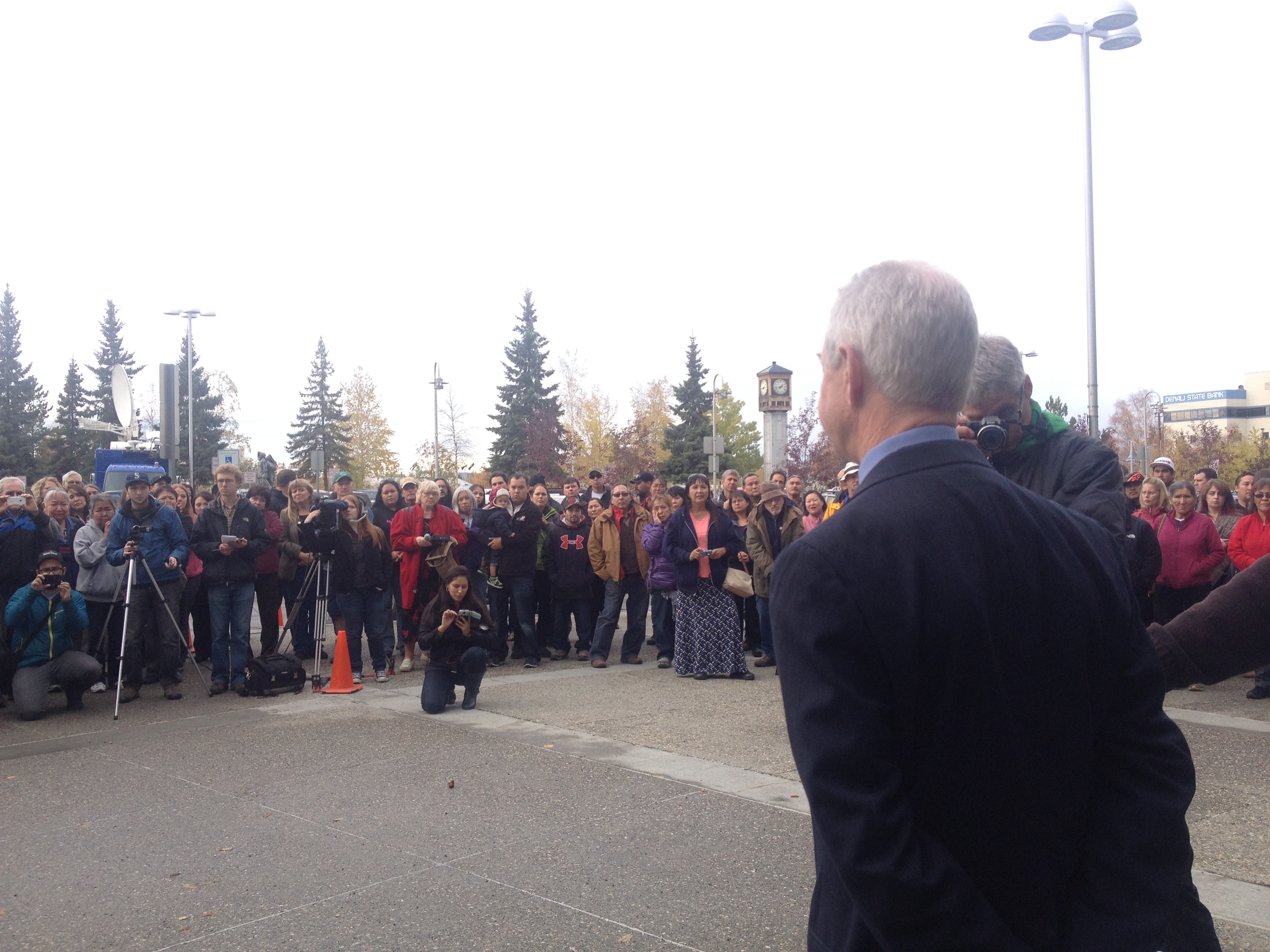
The first indication that the State of Alaska did not intend to act with a sense of urgency came a few hours BEFORE the filing, when Police Chief Laren Zager indicated to reporters for KTUU Channel 2 Anchorage that the filing was not credible and would not gain traction, BEFORE having read the filing or seeing the evidence it contained. This concerningly early statement was an early indicator of how the powers that be were likely to respond. These early remarks were uninformed and dismissive. Supporters remained hopeful that the future official response would show more awareness of the gravity of the issues at hand and take a more informed position.

Just over a week after the filing, with 37 days remaining until the state’s response to the Innocence Project would be due, the State of Alaska issued a press release  through the Department of Law regarding the post conviction relief filing.

“Although there has never been any credible or serious allegation about the integrity of the investigation, or the prosecution, which led to these convictions, the department will conduct an independent review,” the State said in its press release. They went on to reassure the public that they were confident the right people were in jail, and that they would soon begin an “independent review” of the case themselves.

The press release was met with disgust by supporters of the Fairbanks Four, who found the statements attacking the credibility of Tanana Chiefs Conference, Alaska Federation of Natives, and the Alaska Innocence Project disheartening. But the content of the release that drew the most criticism was the promise of an “independent review.” The offer for an “independent” review was misleading, since the State of Alaska investigating itself is of course not an independent investigation, but an internal investigation. The complete dismissal of the independent review that had taken place was also poorly received.

The National Innocence Project entered into the Fairbanks Four case as neutral third party tasked with completing an independent investigation of the convictions of the four men. As with any other case that the legal nonprofit decides to complete a thorough investigation and review of, the Innocence Project enters the situation as a completely neutral party well qualified to review the prosecutions in a case, the original investigative materials, evidence used to obtain convictions, and any pertinent new information. When the State issued their press release they failed to acknowledge that the one and only independent investigation ever launched in the Fairbanks Four case had already been completed, and its findings filed in the form of an application for post conviction relief claiming complete innocence, thereby verifying that the Fairbanks Four had been wrongfully convicted.

The tone of the press release was once again uninformed and dismissive. The press release further indicated that the State intended to take longer than the allotted 45 days, and restated the continued confidence the State had in its original convictions. 

In an email to Alaska Dispatch in response to the State press release, Executive Director of the Alaska Innocence Project Bill Oberly said the state’s tone was disappointing. “We hope the negative tone of their press release is not indicative of their approach to this case.”

In response to the tone and content of the State response supporters of the Fairbanks Four and concerned Alaskans flooded the Governor’s office with letters asking for Governor Parnell to expedite the review. The governor’s office was sent over 4,000 signatures on a petition asking for clemency or the timely review of the allegations of corruption and wrongful conviction in the case. The Alaska Federation of Natives, the largest organization of its type in the Alaska, unanimously passed a resolution  on October 27, 2013 asking the State to review the new evidence in the filing immediately. Crowds of hundreds of protesters gathered at at least four separate events to protest the continued wrongful imprisonment of the Fairbanks Four and urge the state to act swiftly in the case.

ImageFour days after hundreds of protesters gathered to demand an expedited response from the State that was in line with the seriousness of the situation, the state announced that with only eight days remaining in their 45 day response time, they had just begun looking at the case. They further indicated that it would take them “many months” to review the convictions, and that not until they were finished reviewing their OWN investigation and materials they have had in hand for the past sixteen years, that they would begin to look at the new information on the case. (READ ARTICLE HERE)

Supporters are calling for interference from the Federal Bureau of Investigations to investigate the original investigation, the allegations of corruption and institutionalized racism, evidence fabrication, and public corruption that have long flanked the Fairbanks Four case. They are also seeking allies from national and international justice organizations to call for an open and efficient investigation of the case, and an investigation of the state officials, police, and prosecutors involved in all stages of investigating and litigating the case, from 1997 to present.

Image

We deserve better than leaders who are uninformed.

We deserve better than a justice system that is dismissive,

We deserve to live in a community where transparency is valued.

We deserve to live in an Alaska where there truly is JUSTICE FOR ALL.

We hope that the State investigation is full of integrity, is appropriately swift, and is as independent as an internal investigation can be.

To those who seek to further justice by impartial and ethical practice, we will always support you, and fear not, the light is coming.

To those who still seek to stand in the way of justice – THE LIGHT IS COMING.


The Light Is Coming

BillFilingWhen the Reverend Scott Fisher prayed with the crowd gathered in front of the Fairbanks Courthouse on the day the Alaska Innocence Project filed their court motion claiming the innocence of the Fairbanks Four, the hundreds gathered under a cold and gray sky fell silent and listened. It was that strange kind of silence – the absence of noise where sound should be. It was as if we all just knew that this prayer should be alone in the air, its path upward completely clear, the words free to travel unaccompanied into the heavens.

Just a few hours ago, it was night. Yet, the sun rose. Morning came. The light made its way over the horizon, and now we stand in the light. For sixteen years we have waited. For sixteen long years these young men in prison have waited, in darkness, with only faith that light would come. We call upon the soul of this young man John Hartman, who was taken by darkness, and promise him, morning is on its way. We remember that with only faith in the darkness we stood, we prayed, we waited for the light.

The preacher’s voice was soft. This was a lamentation, a laying down of grief. This was the painful recollection of so many prayers said and left unanswered. Yet in the long pause that followed these heavy words, hundreds of heads remained bowed. Everyone knew this prayer was not over. When he resumed it was in a voice of power, a proclamation.

But now, there is light on the horizon. We can see it, we feel it, and we know the light is coming. To those of you who have waited, with only your faith, who have feared and gone forward, who have fought for justice in a dark, dark world, let me assure you: THE LIGHT IS COMING. To those young men in their prison cells, fear not: THE LIGHT IS COMING. To those of you who have hidden in the darkness, kept yourself and your secrets there: THE LIGHT IS COMING. And it is time. Step into the light. Seek the light. Because it is seeking you, and soon there will be no dark place left to hide. We have walked through darkness these many miles and we have many miles left to travel, but there on the horizon we can see a glimpse of morning and we know THE LIGHT IS COMING.

courthousecrowdIt is hard to say when the clouds parted and the sun shone down on those people holding hands, heads bowed. But when we looked up, it was a blue-sky day. The summer found its way into the autumn, the sun touched everything, and the looming gray marble of the courthouse faded into the background, insignificant amongst the brilliant red and gold leaves on the trees and the blinding white sun shining off of the river. The clock tower and church bells rang out at once in a strange and serendipitous orchestra, and people broke out into song.

Nuchalawoyya

Nuchalawoyya

The song was Nuchalawoyya, a song many hundreds and maybe thousands of years old, from the people and the place on the river that these wrongfully imprisoned men dream of returning to. A word that means in literal translation, where two rivers meet. But, as many words, loses meaning in a simple translation. The word is a place where rivers meet, a place where people from many places met. A place where, long ago, people discussed things like treaties and territories. A place of common ground, a destination, and now, a celebration. A song.

The song began with a small circle of four men. The men who were singing were boys once. Just kids in 1997. Theirs were the first voices to ring out that day, a powerful song from this small circle of four men. All of them were interrogated in this case. Each of these men, in their mid-thirties now, have carried with them these many years a burden we rarely discuss – the shame that came with this case. The shame of feeling and believing that if they had been stronger and louder; that if their voices had somehow been heard that their friends would not have been taken. They have walked with the guilt of survivors, never knowing why it was they were not taken. They have understood the grief of Eugene and George, who buckled under pressure and have had to live with the shame and the belief that if they had been stronger perhaps they would be free, their friends would be free, they would be there as men should be, at home to care for their families, and now, that perhaps the next victims of the men who killed Hartman would be alive and home as well. These men have carried with them a thousand shades of shame, the pain unique to those who spoke the truth and were not heard.

The list of names of the men who were given this shame as boys and who have carried the weight of it through the years grows shorter with the passage of time. Beside them in that circle was the space where others should have been. People who are gone now. Many of the young people who were interrogated, questioned, who testified in those dark years, who lived through a time when they spoke as strongly as they knew how and were not heard, have been buried. Some have died at their own hand. Yet, as these remaining men broke into song you could see some of the burden – a burden which will never leave completely – lighten.

This time they were heard, and their voices were joined by many others.

For far too long a time this case has been about darkness. This injustice has thrived in shadows and fed itself on secrets. Injustice draws strength from the evils of humanity – shame, fear, trickery, corruption, pride, denial.

That time is over.

For those of you who have information in this case, step into the light. The sun is on the horizon, morning is on its way, and if you don’t seek the light, it will find you. The light is coming.

For those who have walked with a heavy heart, who still carry the shame and grief and fear and pain, set it down. Let that darkness go. The light is coming.


*photo of Nuchalawoyya above is by “FairbanksMike” whose lovely pictures can be seen on Flickr

Forensic Expert Contends Fairbanks Four Footwear Did Not Cause Injuries of John Hartman

WARNING: THIS POST CONTAINS GRAPHIC IMAGES OF INJURIES USED AS A COURT EXHIBIT. CONTENT MAY NOT BE SUITABLE FOR ALL READERS.

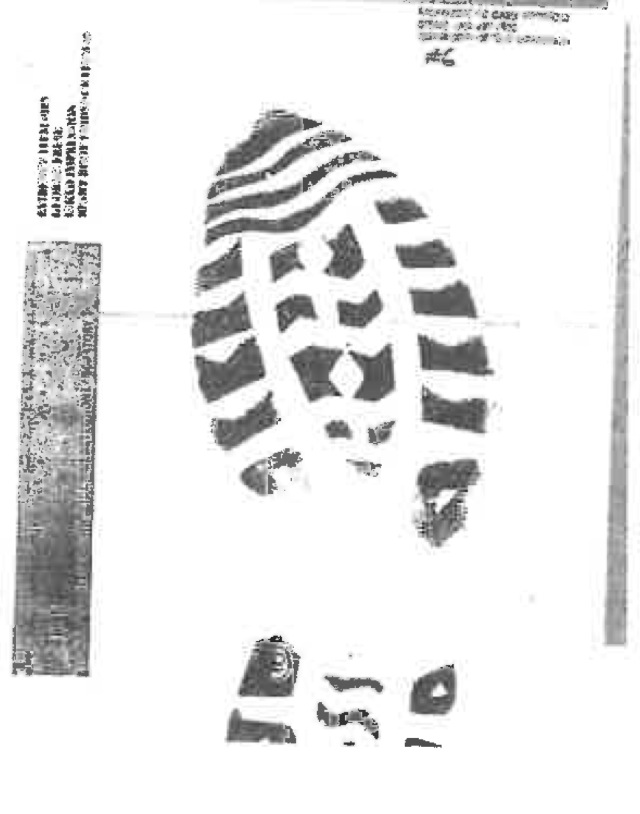
During the trials of George Frese, Eugene Vent, Kevin Pease, and Marvin Roberts, known collectively as the “Fairbanks Four,” there was only one physical exhibit. The exhibit was a transparency of George Frese’s boot print laid over a photograph of the injuries on John Hartman’s face.

When the Fairbanks Four were arrested their footwear, clothes, and an incredible array of other belongings were sent to the lab to be examined for DNA evidence and examination to determine whether or not any of the footwear could have been the causative instrument/agent in the kicking death of John Hartman. Ultimately, the state lab was not able to make any determination that the footwear caused the injuries.

Boot PrintAs part of their examination of evidence, they made prints of the shoes and boots belonging to the Fairbanks Four. These images were created by the state forensic lab, and therefore were marked with a lab logo. The lab created these prints in order to use them to compare against the injuries on the victim, They made the comparison and were not able to link the footwear of the Fairbanks Four to the injuries, and the prints were ultimately not useful to create a scientific exhibit that supported the guilt of the four accused.

The lack of corroboration by any outside source of the police theory that George Frese had injured his foot by kicking John Hartman was hugely problematic to the prosecution’s case. Without ANY physical exhibits created by a scientific source and no DNA evidence of any kind, prosecutor Jeff O’Bryant and police officer Aaron Ring made the unorthodox decision to make their own exhibit to demonstrate a correlation between the victim injuries and the boot of George Frese.

Although Frese had come to the emergency room with an injury to his left foot (read George’s timeline HERE), which the police and prosecutors contended was evidence of his guilt in the crime, they used an image of his right foot to make the exhibit. This exhibit was made overnight in a hotel room by O’Bryant and  Ring, and introduced to trial the next day. The exhibit consisted of the transparency of George’s boot taken by the state, and laid over a photograph of the victim’s face. The exhibit bore the state lab logo, creating the appearance that the exhibit had been created by a lab and was scientific in nature. In reality, the exhibit had no more scientific merit than an average craft project, And it was, essentially, no more than a craft project. Neither O’Bryant nor Ring had any training of any kind in forensics, let alone in the highly specialized field of causative instrument forensics. (Read about their exhibit-making HERE)

Court Display

Court Display

During the first trial, the trial of George Frese, the exhibit was introduced unexpectedly. Frese’s attorney, Robert Downes, made no objection to the exhibit. This is surprising, given that the exhibit was nonscientific, and even common sense would indicate that it was not a valid piece of evidence. However, Downes had more to rely on than just his own common sense and judgment in making the determination of whether or not to object to the admission of this exhibit. His own hired expert, a man named John Cayton later filed a detailed affidavit you can read HERE expressing his concerns about both the unscientific evidence allowed into court and the conduct of Frese’s attorney, told Downes as soon as the prosecutor attempted to introduce the exhibit that even without any preparation he could successfully argue against its admission because it was so grossly misleading and without scientific merit.

John Cayton was not allowed to testify, oddly blocked by the same attorney who hired him to help defend Frese. In a 2003 interview with reporter Brian O’Donoghure, Cayton said, “In 30-plus years, I can’t think of other trials where such techniques were used to convict a suspect.”

Downes declined to object or allow the testimony of his own expert against the exhibit. This choice, along with the choice to not call any witnesses on behalf of the defense, coupled with the fact that Downes worked as a prosecutor for many years prior to being assigned to represent George Frese, and the fact that he was appointed a coveted judgeship in Fairbanks following the guilty verdict in the Frese trial, has long created speculation by supporters of the Fairbanks Four that Downes did not properly defend Frese, and the more troubling speculation that he may have failed to represent his client deliberately.

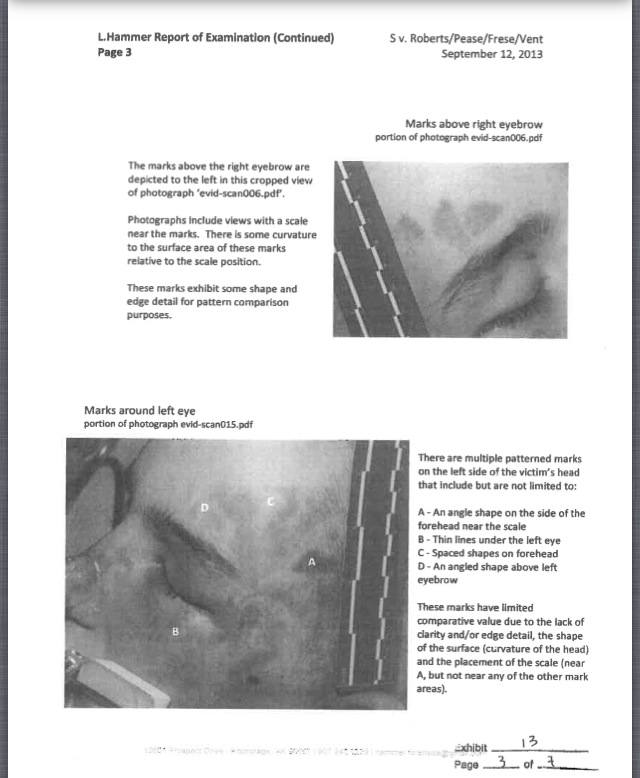
Critics of the prosecution in the Fairbanks Four case have long pointed to the exhibit made by Ring and O’Bryant as a deceptive exhibit, and argued that it may have played a significant role in the wrongful conviction of the four men. The request for post conviction relief based on a claim of innocence submitted on behalf of the Fairbanks Four by Alaska Innocence Project contains the affidavit of a renowned causative instrument forensic scientist Lesley Hammer (read her qualifications HERE) who concludes that there is no correlation between the boot of George Frese and the injuries on the victim.

Image Hammer’s report, alongside the affidavit of Bill Oberly, also unveils a disturbing series of events that took place during the investigation by Alaska Innocence Project in this case. According to the filing, Alaska Innocence Project requested access to copies of the court exhibit and victim photographs, and were denied access to them by the Fairbanks Police Department. Fairbanks Police Chief Laren Zager has been consistent in his public statements regarding this case that the police intended to behave with transparency and would cooperate with the Innocence Project. However, the filing makes it clear that the one and only request made for reasonable access to the evidence used to convict the Fairbanks Four was denied by the Fairbanks Police Department. The actions of the FPD police chief are in direct contradiction to his previous statements. Not only did he not encourage transparency and a careful look at this case, he actively prevented men whose claim of evidence is backed by representation from the Innocence Project, thousands of community members, community leaders, and social equity organizations from having access to the materials used to convict them.

Image                                                                                                            Expert Lesley Hammer goes on to draw a number of other concerning conclusions, including that the late Dr. Fallico, medical examiner for the state of Alaska during the Fairbanks Four trials, did not demonstrate even the most basic understanding of the procedures, techniques, and evaluative processes of causative instrument forensics, including the basic standards used to create footprints and make comparisons.

Causative instrument forensics is a complex and highly specialized field. Human skin is elastic, and marks made on human skin have to be very carefully evaluated in consideration of force, skin condition, temperature, and many other factors. For lack of a better example, consider the task of determining what knife caused a stab wound. It is not as simple as holding a knife up to a picture of the wound and deciding these are about the same size, so this must be the wound. There is a lot involved – serration, knowing what the scale of the photograph is so you can accurately understand size, depth of the wound, etc. Determining what object caused an injury is a complicated scientific task. There are many experts qualified to make these determinations. The expert whose findings are contained in the filing is a well known causative forensic instruments specialist. Those involved in the Fairbanks Four case were not. The only testimony given regarding the “match” of the injuries to Frese’s boot was Lt. Paul Keller, who had no forensic training of any kind.

The observations on the inadequacy of the people involved in collecting and evaluating the evidence is concerning and raises questions about the potential problems with the validity of procedure and testimony in other criminal cases as well as the Fairbanks Four case. The revelation that Police Chief Zager refused access to the materials is equally disturbing. However, those elements of the filing are incidental.

The central and most important conclusion in the filing regarding the court exhibit and footprint evidence is simple and straightforward: First, the exhibit presented at court was indeed completely unscientific. Second, even without access to the best possible materials, the causative instrument forensic specialist was unable to make any correlation between the boot of George Frese and the injuries on John Hartman. The bottom line is that for the first time a truly qualified specialist has made a comparison between the boot print and the injuries central to this case and determined that the boot of George Frese does not match the injuries on the victim. The report concludes by saying that more accurate, definitive results could be achieved and the report completed if the expert is allowed to access the actual evidence.

READ THE ENTIRE PCR FILING, INCLUDING THE FORENSIC EXPERT AFFIDAVIT HERE

*We feel it is necessary to always address an aspect of reporting on this case that remains troubling to all of us, which is the explicit discussion of the manner, cause, details, and, in this post, photographs, of the injuries to and death of John Hartman. We apologize to any who knew and loved him, as we know that the continued discussion of his death must bring you terrible pain. We want to take a moment to tell readers that one of the hardest parts of discussing this case will always be revisiting the heartbreaking suffering and death of John Hartman. We recently posted about that HERE and encourage all readers to hold this boy in respect and love, with prayers and healing thoughts for his family and all who suffered because of his death.