William Holmes Confession in Hartman Murder Supported by Others, Evidence

decadeSince the moment the Fairbanks Four were arrested for the murder of John Hartman in 1997 the case has been plagued by questions, community concern, and accusations of corruption. As the years passed the movement to exonerate the men convicted in the locally notorious beating death has not faded, but grown larger and more persistent. These efforts have raised funds for rewards, appeals, litigation costs, awareness campaigns, and to support the work of the Alaska Innocence Project. Many events, speeches, news articles, television specials, and rallies have been held over the course of the sixteen years that the Fairbanks Four have been incarcerated, and the case has long been a line dividing the residents of Alaska’s “Golden Heart City” between those who believe the four are innocent and those who do not. In all the years that the case has worked its way through the Alaska court system and the court of public opinion, there is no question that the most explosive development in the Hartman murder and plight of the Fairbanks Four has been the confession of convicted killer William Holmes, who names himself and four other men as the true perpetrators of the murder of John Hartman.

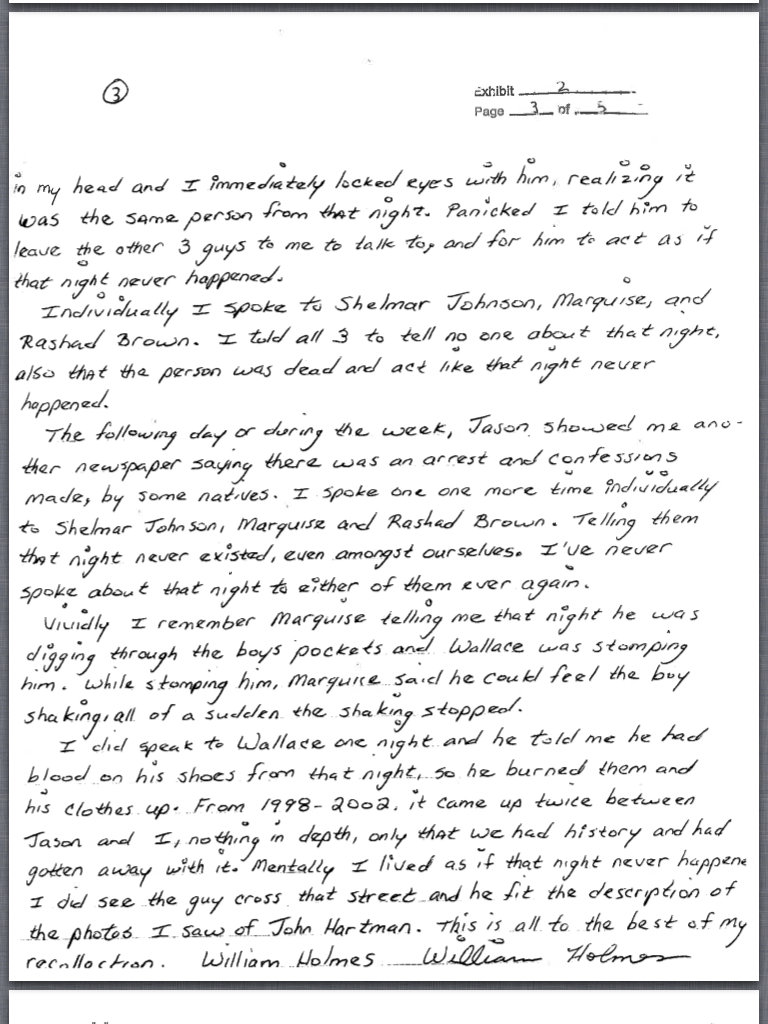
Holmes ConfessionThe handwritten confession, received by Alaska Innocence Project in late 2011, is the most shocking revelation of the application for a post conviction relief file on behalf of the “Fairbanks Four” on September 25, 2013. However, the handwritten three page confession is only a fraction of the contents of the 138-page filing. (READ CONFESSION).


Following the filing the State of Alaska’s representatives, Jason Skidmore on behalf of the Attorney General’s Office and Fairbanks Police Chief, were dismissive of the confession. Their criticism was essentially that the confession was not credible given the source – that the character of a known murderer was suspect and Holmes had nothing to lose. In this post we seek to counter that position and give a brief overview of the supporting statements of others and documentation that bolster the validity of Holmes’ confession.

In the days and weeks to come we will take a more detailed look at each of these piece of the Alaska Innocence filing. But for now, we want to outline the contents of the filing that corroborate the confession.:

1.) The affidavit of Scott Davison, who provided a statement to Alaska Innocence Project in 2008. In his sworn affidavit Davison details the confession that Jason Wallace gave to him in 1997 in the days after the murder of John Hartman. The details of the confession Davison recalls and the confession of Holmes, each given without the knowledge of the other and some 14 years apart, match closely. Scott came forward with no motivation (reward was not yet in place) beyond doing the right thing.

2.) The DMV records supporting that Holmes in fact owned and was driving the vehicle he describes in the confession. When a confession is not credible, small details are incorrect. For example, a person fabricating a confession often does something like name a car that they owned, but not at the time of the crime.

3.) Records from the FNSB School District affirming that the five accused were, as Holmes claims, classmates. They all attended Lathrop Highschool, as did EJ Stevens and Chris Stone, the last two people to see Hartman alive. Again, this is the kind of small detail that a false confession often misses.

4.) The filing also indicates that sealed statements made by Jason Wallace likely corroborate the confession of William Holmes. Reporter Brian O’Donoghue recently wrote an article that addressed this sealed statement in detail. His speculation, backed up by jailhouse interviews with Wallace and some thinly veiled comments from a few local public defender’s, is essentially that Wallace confessed to the Hartman murder sometime around 2002-2004 to his public defender, but that the attorney has kept quiet under the guise of attorney-client privilege. Unless and until a judge orders the “sealed” evidence to be opened, its contents cannot truly be know. But O’Donoghue’s work provides a strong hint to the contents of the evidence under seal. Read the article HERE.

5.) The details in the confession of William Holmes closely match what is known about the crime, victim’s injuries, and crime scene. Holmes describes spotting Hartman as he turned off of Barnette Street. He describes how Jason Wallace stomped Hartman over and over, despite the protests of the others present. He describes how, as Marquez Pennington rifled through the contents of Hartman’s pockets, the boy was shaking and then went limp. Hartman was found with the contents of his pockets scattered about, his wallet missing, laying face up with his knees on the curb, torso in the street, his baggy pants down near his knees, and other clothing in place. Hartman was displaying deceberate posturing, a body state that is indicative of severe brain injury, and often brain death. It is likely that the moment when Hartman stopped shaking was the moment of brain death. His belongings were scattered as they rifled through his pockets. His position was consistent with the assault type.

6.) Holmes does not mention a sexual assault. There was early police speculation and a “satanic panic’ style community belief that Hartman was sexually assaulted. In reality there was no determination of sexual assault by anyone besides one under-qualified nurse who likely mistook the anal dilation associated with brain trauma for a sign of sexual assault. The state medical examiner and other experts brought in to look for indications of sexual assault found none. The fact is that the physical evidence of the crime never supported a claim of sexual assault, although the press and community clung to it. Given that there is more evidence that Hartman was not sexually assaulted than that he was, there is credibility in a confession that does not contain this element.

7.)  Holmes states that Jason Wallace, the ‘ringleader’ in the account give by Holmes, had a substantial amount of blood on his clothes and shoes. Although the crime scene was described as bloodless by police, and had not been seen until the image on this blog was unearthed (HERE), the nature of Hartman’s injuries, statements by the people who found him, and recollection of responding EMTs always lead most who considered it to assume that whoever committed the crime would have had a substantial amount of DNA evidence on themselves and any getaway vehicle.

8.) The Holmes confession meets all litmus tests used to determine if a confession is legitimate. He provides details on location, the victim, the motivation, and shares the chilling details that have remained with him through the years. He does all of the talking, and is not prompted with leading questions or supplied details to repeat. No one forgets a murder. Holmes has spent the last eleven years without access to the internet, to news about this case, with no contact with the others he names, and had to draw his confession from memory alone, and memory that was a decade and a half old. That he was able to provide so much detail is indicative credibility. The experience of participating in a killing as a teenager would be traumatic. Even though he says “mentally, I lived as if that night never happened,” the details were likely so clear and accessible because they were so traumatic and remained vivid.

The filing corroborates every independent and verifiable statement made by Holmes. However, the State of Alaska has still chosen to question the credibility based on the character of William Holmes as well as the “nothing to lose” factor (Holmes is serving a double life sentence for unrelated killings). We would like to address both attacks on the credibility of the confession.

First, let us say that the ONLY credible confession of murder comes from a murderer. When a false confession of murder is elicited it is, in fact, not particularly credible (read about that HERE). It is a sad irony that the Fairbanks Chief of Police would make the statement that confessions of murder by known murderers is not the kind of confession he finds credible, in light of the fact that the FPD was quite willing to take confessions in this case from innocent men that were clearly not credible. It is impossible to receive a credible confession of murder from anyone except a killer. That three of the five men named have committed other murders does not detract from the credibility of the confession, it strengthens it. It is a tragic revelation. The moment that John Hartman stopped shaking these men became killers. Three of the five went on to become serial killers. That these men are capable of the crime is clear. We find this unimaginably sad, but also very true.

The second attack on the credibility of the confession is that Holmes has nothing to lose by confessing. He is serving a double life sentence, so it is absolutely true that the threat of additional time is probably not the kind of disincentive that it would be for a free man. That said, Holmes lives in a maximum security prison in California, which has the highest rate of murder of incarcerated men by incarcerated men in the country. It is well-known that in prison culture the most hated and attacked prisoners are snitches and child molesters (there are thousands of killings and articles and studies to underscore that, look on your own if you like, HERE is a relatively random one if you would like to read about snitching in prison).

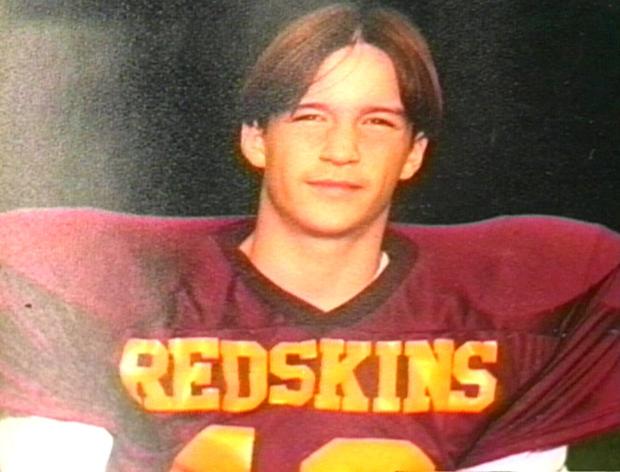
William Holmes, 1997

William Holmes, 1997

The reality is that William Holmes has nothing to gain, and everything to lose. He has put his life on the line, and although we will not defend his character, he has risked the only thing he still has – his life. Assuming he is not killed for snitching, he has certainly sentenced himself to a life of isolation, fear, and assault.  It is impossible to say what motivated Holmes, but the most likely one is perhaps the most simple – for 16 years he has lived knowing that innocent men are in prison for a crime they did not commit and he chose to right that wrong. He has committed the sin of murder, and there is nothing he can do to bring the people he killed back to their families. But he does have the ability to do what he can to end his part in the ongoing victimization of the Fairbanks Four. For all of these many years people have hoped, prayed, and dreamed that the hearts of whoever killed John Hartman would be called to come forward. We choose to believe that those prayers certainly can permeate concrete and pass through prison walls, and that they reached William Holmes and called him to do the right thing.

If Holmes came forward just to clear his conscience, he would hardly be the first. Many wrongful convictions have been resolved after the true perpetrator confesses (read those stories HERE and HERE). Sadly, initial reactions to the confessions that eventually freed the innocent in those cases were met with the same predictable response that the State of Alaska has expressed in the Fairbanks Four case.

It is extremely uncommon for a prisoner, even a lifetime prisoner, to arbitrarily confess to a crime he did not commit. Voluntary false confessions are rare as well. It is reasonably common for the wrongfully convicted to be cleared or unsolved crimes to be solved when a perpetrator voluntarily confesses years later. These confessions usually come from prison cells, because the perpetrator went on to commit similar crimes and were eventually caught.

William Holmes’s confession is credible. And, contrary to the sentiment expressed by the state of Alaska, no one has to take his word for it in isolation. The confession is backed up by hard corroboration, the matching statements of others given at other times without collaboration, and mounds of anecdotal evidence that indicates that this is what a credible confession looks like. (Read about credible confessions HERE).

Regardless of his past misdeeds, William Holmes made a decision to tell the truth. And, as we have said many times, the truth will prevail. The truth will FREE THE FAIRBANKS FOUR.


*Footnote – it remains necessary, although painful, to write about the details of the last moments of John Hartman’s life. To those who knew and loved him, we are sorry if our words bring you pain. We have posted about that HERE and encourage all of our readers to pray for John, his family, and remember to honor his memory as best you can.


Alaska Innocence Filing Exposes Flawed Eyewitness Testimony

Marvin Roberts from 300 feet away, a photograph taken 10/12/13 at McKenzie Point Correc

Marvin Roberts from 300 feet away, a photograph taken 10/12/13 at McKenzie Point Correc

The Fairbanks Four were convicted primarily on the eyewitness testimony of Arlo Olson, who testified that he was able to identify the four men, two of whom he had never seen before, from 550 feet away in the dark.

We recently posted the details of Olson’s testimony, audio recordings of his multiple recantations, discussed his motivations, inconsistencies, recantations of recantations, and his personal criminal history. (READ THAT HERE) We have also discussed how Olson’s testimony about the assault of Frank Dayton was not even consistent with Frank Dayton’s recollection. (HERE)


This is a photograph taken 16 years to the date eaglesand time of the night Frank Dayton was assaulted. Arlo testified that he identified the Fairbanks Four from this vantage point and in this lighting. According to his testimony he identified they would have been essentially next to the furthest visible building on the left, there is a parked car with headlights on at the exact location to mark the spot. We have discussed this multiple times. Those posts and conversations have their place. It is important to understand HOW and WHY a wrongful conviction occurs. But the reality is that discussions of how or why Arlo Olson lied in his testimony don’t really matter anymore. The filing by the Alaska Innocence Project filed for post conviction relief of the basis of innocence for the Fairbanks Four contains expert scientific review of the testimony that makes a very simple and indisputable claim: it is impossible for Olson, or any human being, to identify anyone from 550 feet away.

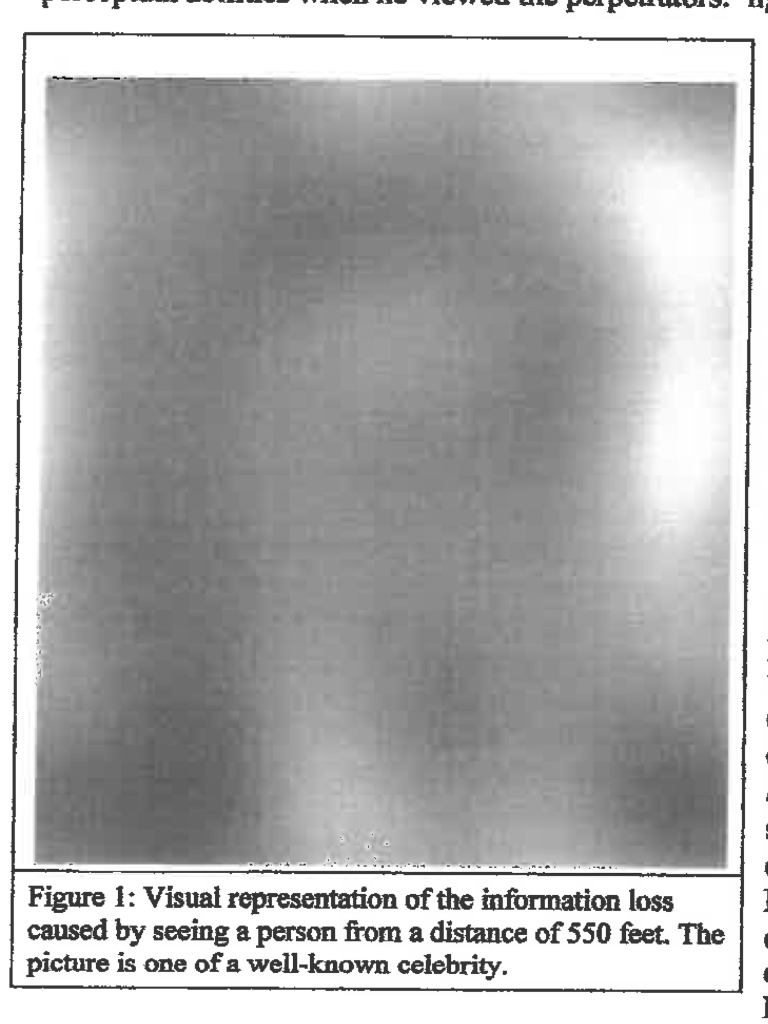
Well known celebrity as they would be seen from 550ft

Well known celebrity as they would be seen from 550ft

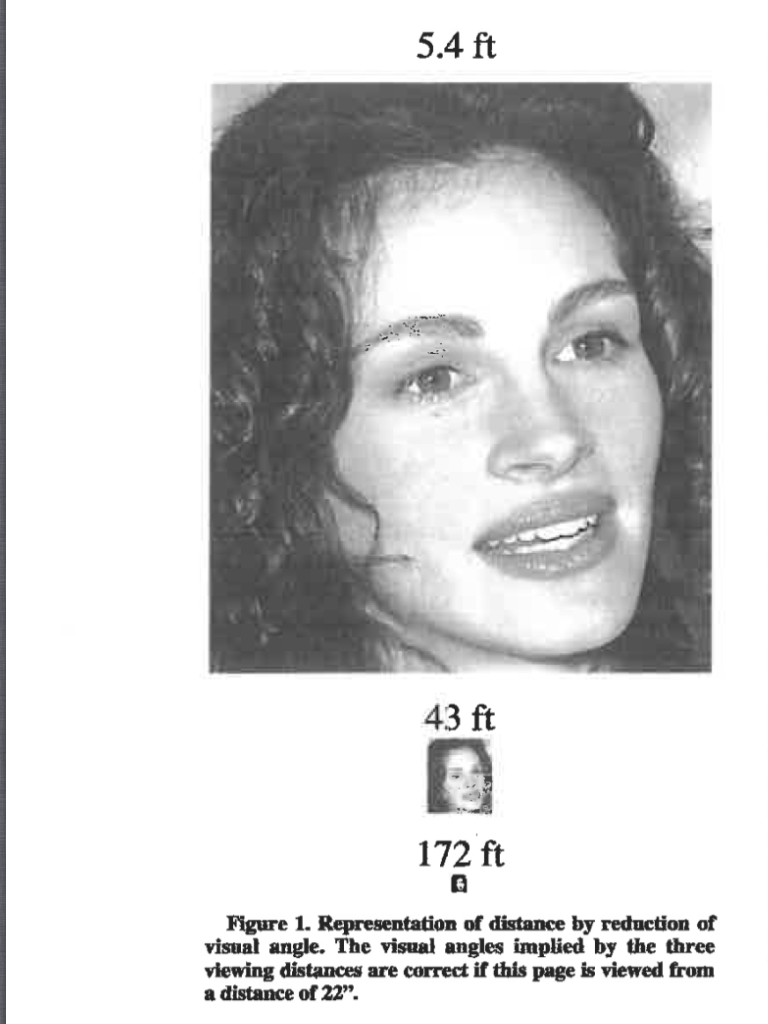
The evaluation of Olson’s testimony was completed by an extraordinarily well qualified  scientist who uses this photograph of a well-known celebrity to illustrate what the eye can see from 550 feet away in optimal conditions and daylight.  Can you recognize the face? Obviously, no, you can’t. No one can. Plainly stated, no human being can identify a face from that distance.


Julia RobertsHere is the photograph, with a representation below of the loss of perception and size at varying lengths. This issue is settled. The sky is blue, grass is green, and Arlo Olson lied in court, simple as that. There was a time when many believed to world was flat. Science sometimes answers these questions, and logic has once again prevailed.

The testimony was absurd to begin with. The idea that four men were sent to prison based on it is astounding and unforgivable. Yet, the state of Alaska considered this their most important evidence, the very prosecutor who convicted them said that without the testimony they had “no case,” and to this day imprisons the Fairbanks Four on the strength of that claim. The entire expert statement is contained in the filing we link to below for readers to review on their own.

The Fairbanks Four were not sent to jail on accident. They were not unlucky bystanders in an unfortunate misunderstanding. We believe they were the victims of irresponsible work at best, and more likely corruption. The lies of Arlo Olson were purchased by police and prosecutors with an offer of leniency in his own crimes, and if his account is to be believed, he was threatened with prosecution for perjury if he recanted. The bottom line is that there is abundant evidence that Olson’s testimony was flawed and untruthful, and now there is clear, concise, correct scientific proof.

The State of Alaska’s current response to this case is that they are sure they are right, but will now do an independent investigation of themselves, by themselves, and until that time will remain silent. We have said before, and will say again, that the enemy of the truth is not a lie, it is silence. In their silence they remain the enemy of the truth.

Application for Post Conviction Relief:

http://www.webcenter11.com/sites/default/files/application_for_postconviction_relief.pdf

Arlo Olson – “Star” in the Case Against the Fairbanks Four

ImageWe could tell you ourselves that we believe the Fairbanks Four could not have been convicted without the testimony of Arlo Olson. But that sentiment is more convincing coming straight out of the mouth of district attorney Jeff O’Bryant, who tried and convicted all four men.

“Simply put,” O’Bryant said to jurors during the last trial, “if Arlo didn’t see what he saw, and you throw out some of the state’s evidence, the state doesn’t have a case. No doubt about it.”

In this post we want to explain exactly what Arlo Olson claimed he saw, and what Arlo Olson actually saw.

On the night of October 10, 1997 Arlo Olson was an (uninvited) guest at the wedding reception at the Eagle’s Hall. That October he was also awaiting sentencing on multiple assault charges. He had severely beating his pregnant girlfriend a few months earlier, violating probation, and was looking at the possibility of a year or more of jail time.

Before arriving at the reception Arlo had spent nearly 24 hours drinking Wild Turkey and getting high. He attended the reception, commented to no one about witnessing any kind of crime, and went home without attracting any attention beyond being noted by a few other wedding attendees as extremely intoxicated. When news hit the papers that the Fairbanks Four had been arrested for the beating death of John Hartman and the assault of Frank Dayton, Arlo didn’t contact the police or comment to anyone that he knew anything about the case. Then, a few weeks later, Arlo emerged as the only witness who placed the Fairbanks Four together, and the only witness in the entire case.

Immediately following the arrest of the Fairbanks Four the police held a press conference to essentially brag about the fast and incredible speed of their investigation and arrests. The crime was solved so quickly that it was truly incredible – in the sense that it completely lacked credibility. In that moment we can only speculate that the officers involved may have actually believed that they had the right people, and that all the needed evidence would simply fall into place. Yet nearly immediately, their fragile case constructed out of speculation and the vague admissions of terrified drunk kids started to crack. First, a major alibi issue cropped up when the time of John Hartman’s assault was determined (READ ABOUT THAT HERE). Once the police knew the time that Hartman was assaulted a quick review of all of their original interrogations and interviews demonstrates that the accused, the people who were with them that night, and scores of other alibi witnesses provided ample evidence that the four were scattered across town, nowhere near the crime scene, and not together at the time of the crime.

Within a few short weeks the case the police had so boldly touted as an example of their expert investigative skills threatened to fall apart completely when the lab results came back. Despite testing hundreds of items – fingerprints from the car, DNA from the crime scene, scrapings from the victim’s fingernails, all of the clothes and footwear collected from the Fairbanks Four, fingerprints from the scene, and so on – there was absolutely NO indication in ANY of the lab results that linked the Fairbanks Four to the victim, the crime scene, the car, or to each other. The police had taken their victory lap in the press, claiming to have solved the brutal and bloody stomping death of a young boy in a matter of hours, and were now faced with a case that consisted of virtually nothing. Scores of alibis, no witnesses, and NO PHYSICAL EVIDENCE. Their only chance at convicting the Fairbanks Four was to produce an eye witness. And so, they did.

The police tracked down Arlo Olson. They brought him in for questioning, and suddenly two things happened at once: Arlo Olson claimed to have seen The Fairbanks Four assault Frank Dayton. And, just like that, the jail time he was facing for beating a pregnant woman multiple times disappeared.

Arlo claimed he saw them all together in Marvin’s car, jump out to assault Frank Dayton, and speed off. He testified in trial that he was “110% sure” that he had seen the four. This made Arlo the only witness to claim to have ever seen the four together, link them to Marvin’s car, and the only person in the world who has ever claimed he saw any of the four accused participate in a violent group assault.

Arlo Olson testified that he saw all of this while standing in a group of other people, none of whom saw or heard anything. He also claimed that he saw all of this from over 550 feet away, in the dark.

Again, we could go on and on about why we are sure that Arlo lied. BUT perhaps it is best to hear it from the horse’s mouth. Since the trials of the Fairbanks Four Arlo has recanted over and over. He says he was pressured to say what he did, that he was wasted, that he didn’t see any of them, that the “questioning’ by the police included them showing him Marvin’s car in the police garage and asking him to identify it, telling him exactly what to say, and plainly offering him a get out of jail free card if he complied. He claims that later, when he attempted to recant, Aaron Ring would visit him again and threaten him with jailtime based on perjury.

Arlo also recanted his recantations a few times. When he was convicted, over and over again, for beating women, he sometimes elected to once again ask for leniency since he had testified in the trials against the Fairbanks Four.

Listen to Arlo recant his testimony HERE.

Read about his many recantations and download transcripts HERE.

For a long time we wanted Arlo to speak for himself here, and he went back and forth. But the time has come to bring him up. Remember that in 1997 Arlo was young, deeply troubled, and probably subjected to the same pressure that so many caved under. We want to approach him with as much love and compassion as we cab. The 44-plus entries for Arlo Olson in the Alaska Court Database tell the troubling story of the life Arlo lead following 1997. He went to jail over and over, and most of his crimes involved violently victimizing women. The juries who heard Arlo’s testimony were not allowed to know about his criminal history, or have any details of the “deal” he was offered in exchange for it. Ultimately, he may have done it under pressure, but Arlo traded one year of his life for the lifetimes of four other men. And he also cost himself the opportunity for early intervention that he probably desperately needed. Who knows how many crimes of violence and addiction that Arlo has committed through the years could have been prevented if he had entered jail for his crimes and received help with his problems.

On that fateful October night in 1997, Arlo Olson saw exactly what the human eye is capable of seeing from 550 feet away in the dark – nothing. Arlo saw blackness. But a few weeks later the police reached out to Arlo in his darkness and showed him something else – an opportunity to escape accountability for his own crimes.

In our next post we will unveil the scientific study into Arlo’s eyewitness testimony and show that not only is there any indication that Arlo was telling the truth, but that it is scientifically impossible for him to have seen it.

There is no doubt that this case has brought tremendous pain to many. Arlo is just one more person who has suffered in this situation. We have forgiven him, and hope that someday he can take the weight of these lies off of his own shoulders and find peace, happiness, hope, and forgive himself.

True Murderer Comes Forward – A Letter from William Holmes

story1We have a long tradition of letting people tell their own story.

Today, the Innocence Project walked into the courthouse and filed a motion for Post Conviction Release on behalf of George Frese, Eugene Vent, Marvin Roberts, and Kevin Pease. These men have maintained their innocence for almost sixteen years, and today definitive evidence of their innocence has been made public.

This court motion contained a lot of information – testimony by experts that George’s boot did NOT match the wounds on the victim, proof that Arlo Olson lied, proof that it would be scientifically impossible for someone to have seen what he claimed. But, the most important thing it contained, in our view, is a story. A handwritten confession, by a man named William Z. Holmes who confesses in detail the murder of John Hartman.

We have said many times that we believe people can feel the truth, see it, sense it, recognize it. And that is why we believe so strongly in the power of truth told by those who hold it. We believe the best we can do to help any injustice is to make a space where people can tell their truth. There will be plenty of articles, news, updates, and headlines about this case today, we will let them fill their purpose, and fill ours.

With that in mind, below is the handwritten confession of William Z. Homes. We will let that stand alone for today. You can judge for yourselves if it is the truth. We believe it is.

We believe in redemption. That anyone can do all they are able to change themselves during their time upon this Earth and that no matter how dark or low a place life takes us to that we can still seek light. So, we publish this with a great sadness for the heartbreaking manner in which John Hartman died, but also a hope for the individuals who did kill him, and every single one of those who helped to hide the truth and further lies, that they may use this time to come forward and begin what must be a very long journey toward redemption.

This day could have never come without the faith, hope, and hard work of many, and we thank you all. Our journey to justice is far from over, but today we begin a walk down a new road.

This is a sad story. Listen, listen.

Image

photo (1)

photo (2)

Never Forget to Remember John Hartman

Aside

Image

We grieve John Hartman.

The hardest, most painful part of writing the story of the Fairbanks Four is to trespass on the memories and recall the horrific final moments of a young boy we never knew.

In the graphic court photos, the mountains of expert affidavits analyzing his cause of death, explorations of causative instruments, manners of death, autopsies, soft tissue, timelines, witnesses, pants, the photographs of him ailing in a hospital bed aired as he lay dying in an effort to identify him, the letters to the editor, the newspaper articles, the school picture, the photo of him kneeling in his football uniform run over and over in the articles not about his life, but his terrible death…..in all of these documents someone’s child became a court exhibit. But never, ever forget, those who fight for the Fairbanks Four fight for this boy as well.

ImageIn those terrible photographs, below the wounds, was the face of someone who was loved. A son, a brother, a friend, a person. He was a baby once, freshly born, and surely his mother marveled over his little wrinkled fingers as all mothers do, so impossibly small. So perfect. His birth was the most common and divine miracle that any life is. He came into being. He smiled for the first time. He laughed. He learned to walk, tumbled on unsteady feet. Someone ran their hand over his forehead to check for a fever, someone kissed him goodnight. Maybe he wrestled with his brothers, made his friends laugh. He blew out candles on birthday cakes, he woke up in delight on Christmas mornings. He smiled toothless into those early elementary school photos. John Hartman grew out of chubby cheeks and freckles sprinkled across his nose, the winds of hundreds of summer days swept over him, the sun warmed his skin. He had a first kiss, a crush, secret dreams, unique hopes. Surely, his life contained all of these typical moments, and the thousands of moments unique to him known only to those who truly knew him. He became a boy, then a young man, grew into that middle season where childhood is waning, and the future is wide open.

And then, he was so unfairly interrupted. His life came to an end. They say that all of those moments flash before the dying, that the last thing we do before we leave our bodies is remember the life we lived in them. Hopefully, that is true, and the life that flashed before him was a happy one.

I wish we could articulate how it is impossible to work to prove the innocence of the Fairbanks Four and to tell their story without grieving the child whose death they were accused of causing – how often the reality and weight of his suffering and the magnitude of his pain and the grief of his loss weighs on us.

George Frese said he thinks of him every night, that he prays to him simply, expressing sorrow that his life ended so terribly, and implores him for help from the other side. These four men all understand that their lives are inextricably connected to the life and death of a boy they never knew, and what has arisen from that is a kind of powerful and sad kinship.

To fight for justice is to fight for justice. That four young men who committed no crime are imprisoned is a terrible injustice. That whoever killed John Hartman has never been held accountable is a terrible injustice. Every time his death is examined, discussed, his name is said out loud, the fact that he was murdered is discussed without equal understanding that he also lived – all of that is an injustice. The wrongful convictions that followed the murder of an innocent child have, perhaps, prevented him from resting peacefully, which he deserves. But the greatest injustice of all is that John Hartman died while he was just a little boy, and that the endless possible futures in his path were taken from him. In his obituary his family shared that John wanted to attend college in Michigan, where he hoped to play football and become a vet. In a world with true, pure justice, this young man would be in his thirties now, perhaps with a child of his own, marveling at the miracle that life is.

To anyone who loved and knew this boy, we are so sorry. We are so deeply sorry for your loss, and so sorry if the fight to prove the innocence of the Fairbanks Four hurts you. We are sorry for the greatest injustice of all in this story; the loss of his life and the hurt it brought upon you all.

Please remember that we never forget John Hartman. We are fighting for him, too, and doing everything we can to tell this story with tenderness and respect to the truly innocent boy who died in that long ago October.


Image

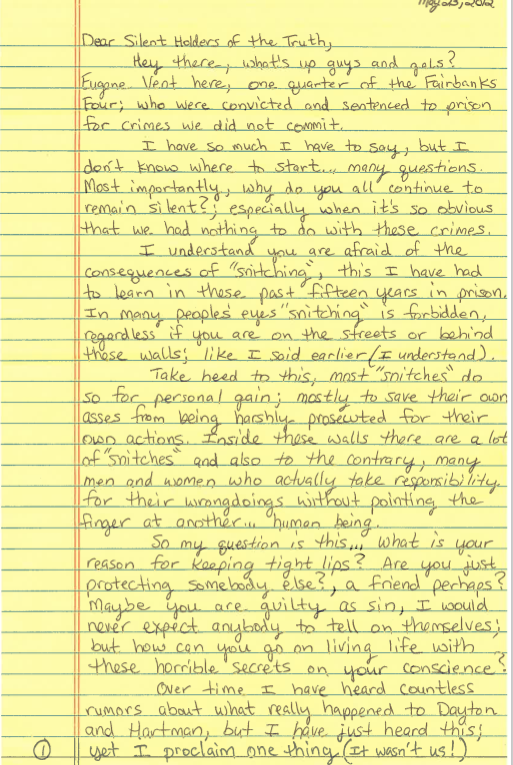
Dear Silent Holders of the Truth – A letter from Eugene

One incredibly frustrating, heartbreaking, difficult reality about the murder of 1997 is that THERE ARE PEOPLE OUT THERE WHO KNOW WHO DID IT. One investigator after another has identified a small handful of people that have information about this case, and knows that there are others. There is a $35,000 reward for information. ANYONE with information can call Bill Oberly with the Innocence Project at 907-279-0454 and come forward anonymously or on the record, and PLEASE, PLEASE, if you or someone you know has information about the killing of John Hartman, DO come forward.

What the investigators continually hear from people with information is that they are afraid of retaliation or being labeled as snitches, most especially afraid of retaliation or hardship if they themselves end up in prison. Although their choice to remain silent is their choice to make, it is heartbreaking. In order for the Fairbanks Four to get a new trial, these people would HAVE to come forward.

Below, Eugene speaks to THEM. To people that have information in this case but choose to stay silent.  Spread this letter everywhere you can, most especially to anyone you think it might apply to. Hopefully their heart is softened by Eugene’s plea and they are encouraged by his words of support.

Kevin’s Last Night – Timeline

Kevin Pease spent most of the night of October 10th and the early morning hours of October 11th with other teenagers at a house party. Much of the night is painfully ordinary – he of course could have had no idea as he went through his night that each moment would come under scrutiny. That as he climbed into a car stuffed to the brim with teenagers, laughing and enjoying the night, across town a boy had never met was being beaten to death. That he would come to be wrongfully convicted of that crime. That this night would become the one that divided his life into a before and after.

One of the kids he was with for much of the night was Eugene Vent, who of course would be accused as well. Below is a detailed timeline of his activities and movements, derived from police transcripts of interviews with others, and testimony from his trial.

10:00 pm – Kevin is with a group of kids who are all getting a ride from Christy Moses in a van who stop by Eugene’s house to pick him up. They are all headed out to a party at Kevin Bradley’s house off Chena Pump Road.

10:30 pm – The group arrives at the house party, where they play drinking games, listen to music, and hang out for the next several hours. One of the people there is Joey Shank, who doesn’t drink and is the designated driver that night.

1:30 am – A group of nine kids, including Joey Shank (sober driver), Kevin, Eugene, Shawna, Allen, Shara, Eddie, Nathan, and Dana pile into Kevin Bradley’s mother’s car and drive toward town. Kevin Bradley was ready to have the party end, and the group was hoping to meet Conan at the Eagle’s Hall. About this same time, across town, Hartman is attacked. Read his timeline HERE.

1:50 am – Joey Shank and his passengers arrive at the Eagle’s Hall. All of them, except for Shara and Nathan, get out of the car. Kevin, Eugene, and the rest stand outside on the porch talking with people who are outside. Only Dana goes inside, and looks for Conan (Everyone was! See the PAGING CONAN post). Joey estimated that they stayed for five minutes.

1:55 am – After Dana determines that Conan isn’t at the reception, the group all jumps back in the car. Eugene hopped in the front seat even though Kevin had called shotgun, so Kevin got Eugene to move and Kevin rode in the front, Eugene squeezed in with the rest in the back. They left to drive  to Conan Goebel’s house.

2:05 am – The group arrives at the Goebel Residence, but Conan isn’t home. Shawna Goebel, Kevin Pease, Eddie, and Nathan get out at the Goebel house. Joey Shank drives the rest of his passengers (Eugene Vent, Shara, and Allen) back to the Eagle’s Hall. Kevin hangs out at the Goebel residence briefly

2:15 am – Kevin walks home.

2:50 am – Kevin is at home and gets in an argument with his mother, the late Carol Pease. He woke her up when he came in, she was angry, and the two argued. Kevin overturns some potted plants  in anger. He then gets upset and leaves on a three-wheeler.

3:00 am – Carol calls the police to tell them that Kevin left on the three wheeler without permission. Of course she would have had no way to know that this call would in part cast suspicion her son’s way, and deeply regretted ever having made the call. In an interview in 2001, she sobbed while explaining to reporter Brian O’Donoghue how trivial the incident had been and how sincerely she blamed herself for her son later being framed in the Hartman case.

3:15 am – (approximately) Kevin arrives back to the Goebel residence, where settles to sleep on the floor. Conan, Shawna, Shara, and a handful of others confirm that Kevin arrived by three wheeler and spent the remainder of the night sleeping there at the house.

The testimony of a crowded house party and packed car, with the especially time-aware testimony of Joey Shank, place Kevin across town at a party and in a crowded car during the crucial times surrounding the assault of John Hartman. Like the others, Kevin is not linked to the crime by physical evidence of any kind, and has an abundance of abilis for the critical time.

In the flurry of press and speculation, the community of Fairbanks made these four young men into monsters in their minds, and were so blinded by the desire for closure that they did not consider the facts, and the gaping holes in the police theory. But dehumanizing these young men came first – perhaps if anyone had remembered that these young men were sons, brothers, friends, human beings, none of this could have ever happened. So, we will close with this picture of a young Kevin Pease as a reminder to all that these four accused were human. As a warning that this could have happened to anyone’s child, still can today. That Free the Fairbanks Four movement is a human rights movement at its core. Sign the petition to end this injustice here.

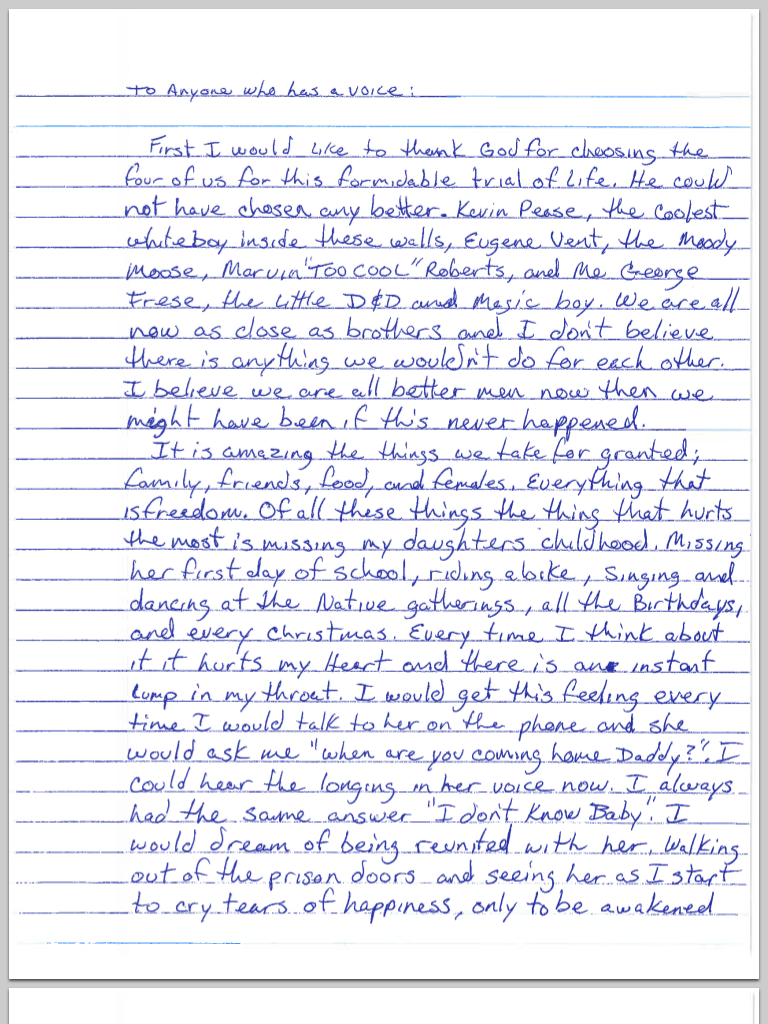
“When Are You Coming Home?” – A Letter from George

A person always tells their own story best. We could write a thousand pages without expressing the simple truth as well as one short letter.  George is not a particularly sentimental person, so I know it took a lot to write this.It never fails to humble and amaze me that all four of these men have faith that this experience was meant to be and will serve a larger purpose. I think it is hard for many of us to keep faith in a life with all our freedom and every advantage - that they have found strong faith in a relatively hopeless place is.....beautiful.

If this letter moves you, get out there, and spread the word!! There is a lot of power in the truth, it has a way of spreading far and wide when it is repeated!

Also (since George begins this letter teasing Kevin) it is probably a good time to clarify that Kevin is Outside Indian and White, not Alaska Native. We have been asked about that a few times, and although it is not terribly important, thought this would be a good time to clarify for readers that Eugene, Marvin, and George are all Alaska Native, that Kevin is Native American and white.

Want to help bring George home? Sign our petition – click HERE!

I Shall Be Released – Video Post

This short video covers the most basic information about this case. This is a great thing to pass along, link to, post on Facebook, tweet, text, and spread far and wide. Many people who do not have the time to read the case files have three minutes to watch a video.

The soundtrack is I Shall Be Released as sung by Walter Trout and the Free Radicals

They say everything can be replaced

But every distance is not near

So I remember every face

Of every man who put me here

They say ev’ry man needs protection
They say ev’ry man must fall
Yet I swear I see my reflection
Some place so high above this wall
I see my light come shining
From the west unto the east
Any day now, any day now
I shall be released

Standing next to me in this lonely crowd
Is a man who swears he’s not to blame
All day long I hear him shout so loud
Crying out that he was framed
I see my light come shining
From the west unto the east
Any day now, any day now
I shall be released


Alibis and Witnesses IV – Alibis Interrogated

If Marvin had owned a mini-van, there would probably be a “Fairbanks Eleven.” God save anyone who knew him at all if he had owned a bus, there could be an entire tribe in prison.  The next posts will feature some of the alibis and witnesses that appear to have barely escaped arrest for the crime as well. The number of people accused of involvement would have never been able to squeeze in the vehicle, and although some had their fingerprints, etc. submitted, none were arrested or prosecuted. They can be thankful for their own strength of mind and Marvin’s small car!

In all seriousness, there are several witnesses who were brought in because they were named as alibis, or who initiated contact with the police because they had been with one of the four that night. But the interviews rapidly devolved into something that reads a lot more like an interrogation. This post features one of those interviews.

These people were lied to. The police are allowed to lie. It is completely legal and standard practice. These young people were not aware of that, and were understandably baffled. These lies read a lot more like thinly veiled threats. The interrogators attempted to threaten anf bully these people into changing their stories with a common interrogation technique. The technique is, in its simplest form, just “good cop, bad cop.” We all know that term, but most of us do not appreciate how psychologically unraveling it can be. With this technique police officers offer the person being interrogated two options. Both are bad, but one is clearly better. One is a threat -“you will be accused of murder.” The other is an offer of a way out of that -” or maybe you were just a witness.”

For example, when they interrogated George they told him for hours that continuing to stick with his story (the truth) was completely unacceptable. That he had to either admit to playing a smaller role in the beating, or else keep up his story, in which case they would assume he was a ring leader of a brutal sexual assault and beating. It seems incomprehensible to most people that a normal person would pick between two lies, but the reality is that the situation is terrifying. People with a lot of power are telling you that you only have two choices. Experts say that many people give in out of terror and anxiety, and simply pick the lesser of two evils – anything to make the experience end.

Some people are very strong, very sure of themselves. These people often see right through the tactic. Others are weaker and cave immediately. Most of us are likely somewhere right in the middle, and as such are potentially vulnerable to this tactic.

In the case of these witnesses, the police attempted to give them the following choices: agree that you were present, and that you were an eye-witness to the crime (of course, they cite made-up evidence and “proof” that this is the case) or we might have to consider you a participant. Essentially, which were you? An eyewitness or a murderer?

This approach is most successful on people who have any doubt about their whereabouts or gaps in their memory as they can often be led to believe the scenario. (More on that HERE) It is actually surprising that they were not successful in creating an eye-witness with this tactic, but thankfully, they were not. Still, their treatment of these people who were simply doing their best to give their whereabouts that night is astonishing.

Race is a contentious issue in this case, but having read all of the police interviews, we can say this: there were many Native people interviewed, and there were many white people interviewed. Only Native people were subjected to this treatment. Racism is not something that can be often proven – unlike murder, it leaves no physical evidence. But there is more circumstantial evidence of these investigators being racists than there was circumstantial evidence of the Fairbanks Four being guilty of the crime.  Yet, those four sit in jail, the investigators sit behind the desks they were promoted to, and the people they bullied and berated sit with the memory of this kind of treatment. Some people recommend that we shy away from saying that, that playing the “race card” is unfair. But sometimes in life as in poker you have no choice but to play with that hand that you were dealt, and in this case the circumstantial evidence of racism is in our opinion overwhelming. Readers will have to judge for themselves.

Vernon Roberts. When Vernon Roberts was interviewed by the police he told them simply that he was drinking that night at George and Crystal’s apartment, that he did not remember the specific time that things happened, but said that the order of events was that they drank at the apartment, that they then walked from George’s apartment to downtown, that the group spent time at the reception, and that he and George parted company in front of Tommy’s Elbow Room (also known as Cabaret).

He confirms that the group of people outlined in George’s timeline. He says that his girlfriend thought George was about to get in a fight in front of Elbow Room, that he left and returned to George and Crystal’s apartment.We know the times of these events through the testimony of people who were keeping track of the time (see George’s timeline HERE). There is no question that his intoxication makes him a somewhat unreliable alibi. But there is much to be learned about the case from the way he was interrogated.

Vernon’s interview rapidly devolved into an interrogation-like situation, with officers Aaron Ring and Jim Grier tag-team questioning him for a long period of time. When he concedes that he was drunk and that it is possible that he may not remember the entire night they begin to use the same interrogation techniques on him as they had on the four. They tell him some severe lies: they say that George sent them to talk to him, that George and Eugene indicated he knew who was responsible for the sexual assault, that coming forward as an eyewitness would help George, and insinuate that he will be in trouble if he does not come forward with the story they are supplying. NONE of this is true. They accuse him of being in the car, of sitting in the middle seat, of being either a participant or a witness. So, his bad cop, good cop choices are to either admit to being an eye-witness, thereby helping his friend and keeping himself out of trouble, or to take his chances on being investigated as a participant.

Vernon made a choice after being exposed to this technique for a long time in the interview that probably kept him from being either pressured into some kind of false statement or even falsely imprisoned for murder as well – he told them that he wanted to speak to his father, and when they pressured him to stay, he insisted.

A long excerpt of his interview is below. In time we hope to find a way to post these thousands of pages of documents in their entirety to link to (so if anyone knows how to do that, volunteer). Vernon’s experience is simply best told through the police transcript, and we wanted to include it. Prior to the segment here Vernon outlines his night over and over. Shortly after the ending of this segment there is a prolonged period of time where Vernon says he wants to speak to his father, the interrogators encourage him to wait, and eventually his insists and leaves. Vernon’s experience is simply best told through the police transcript, and we wanted to include it.

Interview conducted with Vernon Roberts. Interview conducted by Detective Aaron Ring and Investigator Jim Geier. For the purposes of this transcription “R” will indicate the voice of Vernon Roberts, “G” will indicate the voice of Investigator Geier, and “X” will indicate the voice of Detective Aaron Ring.

X:  I mean I suppose it’s even possible could YOU have been in the car with these GUYS when this happened?
R:  No, I don’t think so.  I think I was downtown most of the night.  Actually all the night.
X:  I mean you…

R:  Until I came over here
X:  Because we have some information that there was maybe even another person with these four guys.
R:  Um

X:  When this happened.

R:  I don’t know
X:  And I was wondering if maybe that could’ve been you.  Maybe you stayed in the car or something when this happened.  is that a possibility?
R:  Nah, cause if this shit would a happened in front of me, man, I would’ve stopped, I’d put a stop to it
X:  Oh, unless you had too much to drink and you were just sitting there and these guys were, I mean they’re out of the car and all of a sudden it happens and it’s too late for you to do anything, ya know, this probably only took a few seconds
R:  I don’t remember, I shouldn’t, I honestly don’t know.
X:  Well, ya know, I , I don’t like keeping things from ya here. And, and I’ve talked to George and George has admitted what his involvement in this is

R:  Uh-huh (affirmative)
X:  Okay, and uh, and I asked who else I can talk to about this, and he told me you, okay you’re not under arrest here or anything, cause I, I don’t think that uh anyone’s told us that he was involved in kicking this guy or anything, but the information we have is maybe you have some information about it, or maybe YOU were even in the car, okay.  So that’s what I’m looking at.
R:  Well, like I said, I have no informatio
X:  Did you have a car that, did you have a car that night?

R:  No, I was walking.
X:  Okay, well that leads me back to the night there at the Eagles and I wanta, I wanta be serious with you here, okay.  I don’t want you to cause a problem for yourself by, by trying maybe to keep things from us.

R:  Oh I’m not, I, that, I’m being honest, honest with you guys
X:  Cause the most important, the most important thing that you can do now is be completely truthful in this thing.

R:  That’s what I’m doing
X:  And I think maybe you’re afraid that you don’t wanta get your friends in any deeper trouble, let me tell you this, George can’t be in any deeper trouble, he can’t be in any deeper trouble.  He’s told us that he did this, okay.  He’s told us that he did this, Eugene told us that he did this, okay.  I mean it goes all the way around.

R:  Uh-huh (affirmative)
X:  And they’ve already told, so any, any information that you have isn’t gonna hurt George, I mean it’s not.  We just wanta verify some things that he’s told us about his limited involvement and he said, these other guys were more involved than he was and that he just kicked this guys a couple of times, he didn’t have anything to do with sexually assaulting this guy

R:  Uh-huh (affirmative)
X:  And I asked him well how can I verify that and how can I prove what your involvement is and he tells me I should come see you, okay.  So what does that leave me to believe is that you were either there or he told you about it, and I’m, I’m kinda curious as to which it was.
R:  I don’t even know.

X:  Cause he, okay
R:  I’m telling you guys the honest truth, I mean you all just

X:  I know
R:  Act like I’m fucking lying to you all, but

X:  Well no, no

R:  Shit
X:  No, I don’t think it’s, I wouldn’t call it that

R:  Yeah, but that’s what your saying
X:  Vernon, well, well here’s the
R:  Be, be truthful, you keep saying, telling me to be truthful, and then I am…
X:  Here’s the point, Vernon

R:  And your all just, saying I’m a liar or something
X:  If we came, if we came over here and you said right away, the first, first thing we sit down with you and say, okay, I know all about this, here’s what George did, ya know, here’s, here’s the whole thing, I would think well geeze, this is kinda strange, this is George’s friend, he shouldn’t tell us this all that that quickly ya know.  So I know people cover for their friends, I, I, ya know, I don’t live in a dream world, I know people try and keep their involvement limited
R:  I ain’t covering for nobody, I’m just telling you guys what I know
X:  Well, here’s another thing that I’m concerned with Vernon, is that if you were in the car, that might be a reason you might not wanta talk about it.  Cause You would think you would be in trouble, okay.
R:  Like I say, I don’t even know if I was in the car
X:  Vernon, here’s the thing, if you didn’t kick this, this boy, if you didn’t have anything to do with that, if you didn’t hit him, then you’re not in trouble, okay

R:  Uh-huh (affirmative)
X:  But, but if you’re a witness to it, we need, we need to talk seriously about it, okay.  If you witnessed it happen, then WE need to talk about it.
R:  I don’t know if I did or not, like I told ya, I blacked out, when I drink, when I drink
X:  Do you remember driving around with the four of them?
R:  (Inaudible) No, I don’t even know if I was, I don’t think I was either
X:  Well you, what does Marvin drive, you know what Marvin drives, right?
R:  I don’t know, I just, I don’t know, didn’t even see him that night and if I did, I was blacked out cause I don’t remember seeing him, Eugene, or Kevin.
X:  People black out when they pass out and fall down on the ground.  You were functional. You were walking around, you made it back over here, you made it back over to Chrystal’s
R:  I, I do that lots, when I’m blacked out
X:  And here’s, here’s the thing, YOU left, from Chrystal’s with George, and you ended back up over at Chrystal’s.

R:  Uh-huh (affirmative)
X:  Okay, and in between there, something happens, okay.  That’s all we’re trying to get at, okay.
R:  I know, I wouldn’t mind knowing what the hell happened too.

X:  Okay
R:  But it’s like I said, I blacked out from drinking so much
X:  Okay, but these, these boys, who have told us that they done this, when we asked them about
you, they said well, he probably knows, but I, ya know, they don’t, I don’t think any of them said that Vernon kicked anybody, did they?

Geier:  No, no involvement, but he knows about it.
X:  I mean that’s so, I’m here trying to verify yourfriends story, okay.  That’s, that’s all
R:  Uh-huh (affirmative)
X:  And if you wanta listen to the tape where George says that, I’ll play it for you, okay.  Cause he showed up at the hospital, thinking he broke his foot on this guy

R:  Uh-huh (affirmative)
X:  And, and wanted some help over there, and, and he talked pretty honestly about it, okay.  He talked pretty honestly and I’m not psychic, I’m here to talk to you cause he sent me over here, okay.  And uh, I’m sorry it took me ya know, so long to get over here to see ya, but, and then I hear more and more, and your names involved a little more and then, and uh, based on what Eugene and George have had to say, we’re here trying to find out if, if you wanta help us or not, okay.  If you wanta help us.  And I suppose that people say, well he was in the car too, he’s just as guilty, but that’s not necessarily so.

R:  Uh-huh (affirmative)
X:  Okay, that’s not necessarily the truth.  The extent of your involvement is what we’re looking at and whether you actually got out and took anything from this guy, or you hit him, or kicked him or, or, or sexually assaulted him, okay.  And whoever’s responsible for sexually assaulting this kid, that’s one thing that George and Eugene really didn’t wanta talk about.

R:  Uh-huh (affirmative)
X:  Okay, I don’t know if they’re involved in that or not, whether they put something, an object up this guy or not.    I don’t know.  I don’t know if it’s Kevin, ya know, I don’t really know for sure.  I, I wouldn’t bet that it would be George.
R:  Uh-huh (affirmative)
X:  Or Eugene, I wouldn’t bet that it be either of those guys.  Uh, but they sent me over to talk to you, maybe that’s hard, them putting this off on you to be the one to tell, ya know?  But, and then maybe that’s not fair, but that’s just the way it is, okay.  So I think maybe we need to go down and, and talk about this seriously and figure it out.  And uh, like I said you’re not under arrest.  We’re, we just wanta get this story from you.

R:  Uh-huh (affirmative)
X:  And you can come back or, or whatever.

R:  I basically told you what I know
X:  Well you said you blacked out

R:  Yes
X:  You could’ve been in the car, but blacked out.

R:  I blacked out

X:  And, how, how old are you?
R:  Twenty two
X:  Okay, I’ve been drinking since I was nineteen, drinking age at nineteen

R:  Uh-huh (affirmative)
X:  Okay, I know when YOU drink a lot, sometimes things are fuzzy, ya know, your memory’s fuzzy, but you don’t forget everything

R:  I do     X:  Okay.
R:  I, that happened to me lots of times before.  I remember some of the people telling me, oh you remember doing this and that, and

X:  Well that’s
R:  Man you were so funny that night, and I’d be like no, and then they’d be all like, I was blacked out
X:  That’s, that’s little things, Vernon, that’s, that’s little funny things that you do, but having some guys hop out of a car and, and stomp a guy, and beat a guy, is probably not something that  happens a lot.  And that’s probably something that would stick out in your mind.
R:  If, if I seen that, I mean I wouldn’t lie about it.  I’d tell you, and if I seen it or not
X:  Well, except for there’s a problem where you’re afraid of maybe being in trouble, or, or George is gonna get in more trouble if he’s the guy that sexually assaulted this boy or something.  I don’t know. There’s a lot of reasons why you wouldn’t wanta tell us that right away, and I understand that.  And I don’t hold that against you.  I don’t hold that against you at all.  But George sent us here to get the story from ya, and that’s why we’re here.  It’s as simple as that, okay.  You, you’re, you’re the guy that can tell us and I know it’s hard, I know it’s a shame that he had to put the rest of that off on you, but he told us, he did it.  He told us what he did

R:  Uh-huh (affirmative)
X:  And uh, I just need to verify that with you, verify who else was involved and verify what your involvement is, they, they don’t say you kicked him, they don’t say you hit him.  If that’s true,that’s fine.     

R:  Uh-huh (affirmative)
X:  Okay, but that doesn’t excuse you from being a witness, you still have to be a witness, okay.  And that’s, that’s all there is to it, okay.  Now, let’s just please get past this a little bit, and tell us straight about it, and if you wanta go down to the police station
R:  I am talking straight about it
X:  And make a statement about it, well we can do that, okay.  But I, I wanta, I want the whole story, ya know.  I realize parts of it are gonna be fuzzy, and parts of it you aren’t gonna remember, but the whole thing is not anything that you’d forget, okay.  And if its, if there’s other people involved that we don’t know, and that you know, we need to talk about that too, okay.  Cause I wanta make sure we have all the facts, and I ya know, if they’re friends of yours that are involved, well we still need to talk about that.  Cause just the indication I get from George, I mean he says, ya know, go talk to Vernon, Vernon will be able to tell ya, Vernon will be able to tell you what happened, that leads me to believe that you were there, okay.  And there’s some talk from some other people about a fifth guy
being in the car, okay.  Well, like we say, we’re not psychic, we’re just, we’re just trying to get to the truth.  And from what I hear from these guys, it doesn’t sound like you assaulted anybody.
R:  Uh-huh (affirmative)

X:  It really doesn’t, it really doesn’t
R:  I honestly don’t know.  I mean I’m telling the truth
X:  May, maybe we, maybe we can take a quick drive up to Ninth and Barnette and maybe that will help you remember.

G:  Do you mind?

R:  I don’t mind.
X:  Sure, let’s take a quick drive up there.

R:  I don’t remember anything though, sorry.